Voice Search and SEO in 2026: How to Optimize Your Site for Voice and AI Assistants
Voice is no longer a command to a smart speaker — it is the gateway to AI assistants and AI Overviews. Here is how to make Gemini, ChatGPT, and Siri say your brand out loud.


I will look at your site and answer your questions on the topic of this article. 30 minutes, no slide decks, no pressure.
Book a consultationTo optimize your site for voice search in 2026, give each question a short, direct answer of 25–35 words in the first paragraph under a question-style heading, build content around conversational long-tail phrases ("where to buy…", "how much does… cost", "what is the best…"), capture local near-me intent through Google Business Profile and LocalBusiness markup, win the featured snippet (position 0) — which is where assistants pull up to 40% of spoken answers from — add a visible FAQ block and Schema markup, push Core Web Vitals into the green (LCP ≤ 2 seconds), and prove expertise with E-E-A-T. In 2026, voice is not a separate channel but a way to enter a query into Gemini, ChatGPT, Siri, and Google AI Mode — so optimizing for voice and for AI answers is one and the same job.
What voice search is in 2026 and why it merged with AI assistants
A few years ago "voice search" meant dictating a query into the Google bar or asking a smart speaker. In 2026 the picture is different: voice has become one of the input methods for full-fledged AI assistants that compose the answer themselves rather than just reading out the first link.
The big shift is that on Android Gemini is replacing the classic Google Assistant in 2026. This is not cosmetic: instead of reacting to short commands, the system holds a conversation, keeps context, and handles multi-step tasks. In parallel, Apple is upgrading Siri on top of Gemini, and ChatGPT's voice mode has, per OpenAI, surpassed hundreds of millions of weekly users. The takeaway is simple: when a person asks by voice, they increasingly get a single synthesized answer rather than a list of ten links.
The numbers confirm the scale. Industry analysts estimate there are around 8.4 billion active voice assistants worldwide, and voice already accounts for more than a quarter of all queries. The practical implication: while competitors fight over text results, conversational and local voice traffic stays underexploited in many niches.
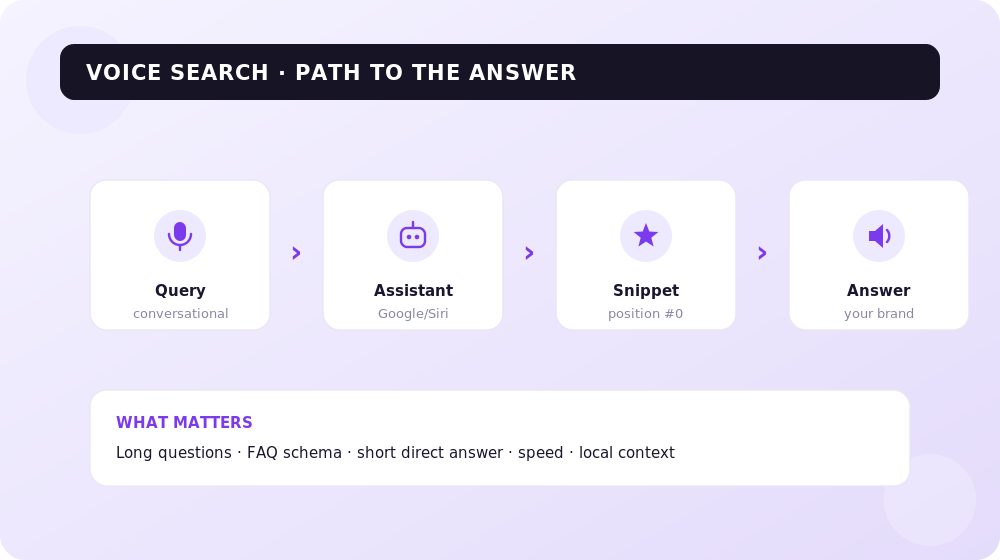
Voice → AI Overviews and AI Mode: how the results work
When you ask a question by voice, the assistant almost always taps the same engine that generates AI Overviews and AI Mode in Google. AI Mode has grown to tens of millions of daily active users in under a year, and AI Overviews appear in a large share of informational queries. For a spoken answer, the model picks the sources it trusts and paraphrases them — often naming the brand source.
Hence the key conclusion: optimizing for voice and optimizing for AI answers (AEO/GEO) is one job. If your content is structured so a short, precise answer is easy to extract, you raise your chances of landing in both the assistant's spoken answer and the text AI Overview at once. If the page is a wall of text with no clear structure, neither the voice assistant nor the AI engine can pull an answer from it.
The practical principle we use at SEOquick: write in "extractable blocks." The heading frames a question — the first paragraph below it gives a self-contained answer in 2–3 sentences — then comes a detailed explanation for those who want to go deeper.
Conversational and long-tail queries: write the way people speak
Voice queries differ radically from typed ones. A person doesn't type "buy running shoes price" — they ask "where can I buy cheap running shoes near me?". Queries get longer, more natural, and almost always contain a question word.
What to do about it in practice:
- Collect questions, not just keywords. While building your semantic core, separately write out phrasings around "how," "where," "how much," "what's better," "can I." Sources: Google autosuggest, the "People also ask" block, real support tickets, and customer comments.
- Make headings into questions. H2 and H3 in direct-question form are the hook for a voice answer and a featured snippet.
- Answer immediately. The first paragraph after the question is a short, direct answer. The ideal spoken answer runs around 25–35 words, so the first sentence should fit that range.
- The long tail wins. Low-frequency conversational phrases convert far better in voice than broad keywords — lower competition, sharper intent.
Local intent: "near me," "close by," "nearby"
Local search is the home turf of voice. According to industry data, the vast majority of voice queries carry local intent ("near me," "close by," "open now"), and the volume of "near me" queries has grown many times over in recent years. Someone driving or carrying bags doesn't type — they ask by voice and want one specific address.
To win local voice:
- Complete your Google Business Profile fully. Exact name, category, address, phone, hours (especially holidays), photos, services. The assistant pulls its spoken answer from here.
- NAP consistency. Name, address, and phone must match across your site, profile, and directories down to the comma.
- Local landing pages. A dedicated page per city/district with natural phrases about the neighborhood and city.
- Reviews and rating. Assistants like to read out places with a high rating and fresh reviews — manage reputation systematically.
Featured snippets and position 0 — the source of the spoken answer
When an assistant replies with a single fragment, it most often takes it from the answer box (featured snippet, "position 0"). Research shows a significant share of voice answers is pulled straight from the featured snippet. This is the most direct path to voice visibility.
How to capture snippets:
- "Question → short answer" structure. Right under the question heading, give a 40–60-word answer paragraph or a bulleted list of 3–6 points.
- Tables and lists for "how much" and "how." Use a numbered list for step-by-step instructions and a table for comparisons.
- Clean markup semantics. One H1, a logical H2/H3 hierarchy, and no visual "headings" in bold instead of real tags.
- Cover adjacent questions. One snippet drags a cluster of similar questions with it — answer them in the same piece.
Schema markup: FAQ, LocalBusiness, speakable
Structured data helps both the search engine and the AI engine understand what's on the page. The types that matter for voice and AEO in 2026:
- FAQ content. A visible Q&A block is a strong signal for AI answers and spoken results. FAQPage markup itself is now limited in rich results, but a visible FAQ structure on the page works for extractability regardless.
- LocalBusiness. For an offline business, the mandatory minimum: address, geo-coordinates, hours, phone, organization type.
- speakable. A Schema.org property that marks fragments suitable for reading aloud. Support is narrow (news, en-US, columns), but as a "this is a ready spoken answer" signal it is logical.
- Article, Breadcrumb, Product, Review. Baseline markup by page type reinforces trust and helps win rich results.
If you're unsure whether markup is implemented correctly, that's the first thing we check as part of a technical audit.
Speed and Core Web Vitals: voice won't wait
The voice and mobile scenario does not forgive slow pages. In March 2026 Google tightened Core Web Vitals — the "good" LCP threshold dropped from 2.5 to 2.0 seconds, and sites with LCP above 2.5s slip in rankings on competitive queries. Meanwhile the vast majority of pages in position 1 pass all three CWV metrics, yet fewer than half of mobile sites meet the bar.
The speed minimum for voice:
- LCP ≤ 2.0s, INP in the green zone, CLS close to zero;
- compressed images (WebP/AVIF), lazy loading, critical CSS;
- fast server response and caching;
- HTTPS and a stable mobile layout with no layout shifts.
Mobile and E-E-A-T: where and whom the assistant trusts
Voice is, above all, a smartphone story: more than half of voice queries come from mobile devices, and the lion's share of all traffic today is mobile. Mobile-first is no longer a recommendation but a condition of entry: if a page is awkward or sluggish on a phone, it won't make it into a spoken answer.
The second factor is trust. AI assistants don't paraphrase just any source — only the ones they "believe." The E-E-A-T principle (Experience, Expertise, Authoritativeness, Trustworthiness) is critical for voice: name your authors and their credentials, cite primary sources, keep facts fresh, and earn mentions and reviews. A brand the AI engine considers an authority in its niche is heard more often in spoken answers.
A step-by-step checklist: optimizing for voice in 2026
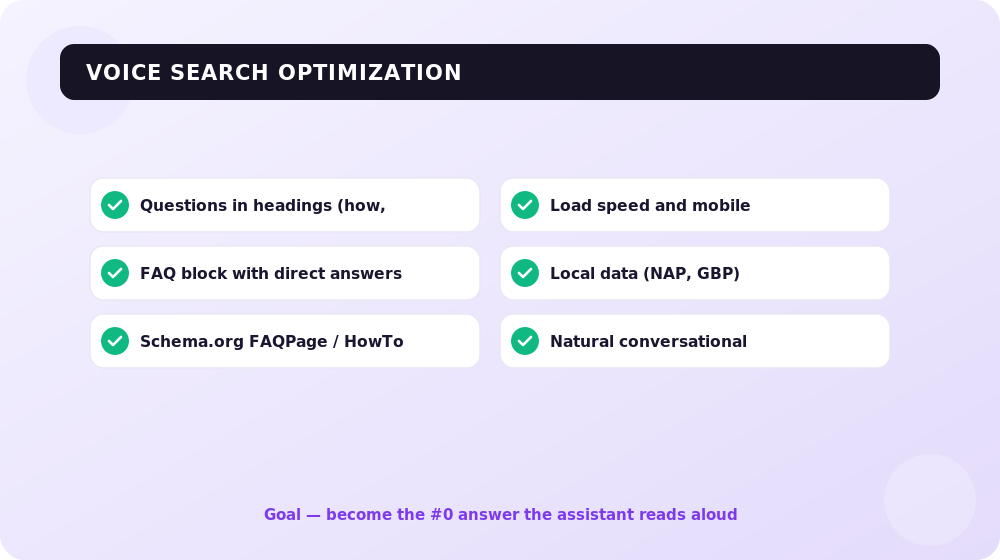
- Build a bank of conversational questions for your niche (how/where/how much/what's better) and group them by intent.
- Restructure content into "question heading → short direct answer (25–35 words) → detailed explanation."
- Add a visible FAQ block of 5–8 questions to key pages.
- Capture target featured snippets: short answer, lists, tables, clean heading hierarchy.
- Cover local intent: Google Business Profile, consistent NAP, local landing pages, review management.
- Implement Schema: LocalBusiness, Article/Breadcrumb, and speakable where appropriate; keep a visible FAQ structure.
- Push Core Web Vitals to the new thresholds (LCP ≤ 2.0s) and verify the mobile-first layout.
- Strengthen E-E-A-T: authors, sources, freshness, reputation.
- Tie it all into your overall SEO strategy — voice doesn't live apart from organic search.
FAQ about voice search and SEO in 2026
Is voice search still a separate channel or part of AI search?
It's part of AI search. In 2026, voice is a way to enter a query into Gemini, ChatGPT, Siri, and Google AI Mode, not a standalone system. So optimizing for voice and for AI answers (AEO/GEO) is one and the same work on extractability and trust.
How long should an answer be for an assistant to read it out?
Short and self-contained: aim for 25–35 words in the first answer sentence and up to 40–60 words in the paragraph under the question heading. Place the detailed explanation below — that's for humans and topical depth.
Is speakable markup mandatory?
No, it's not mandatory and has narrow support. Far more important are a visible "question → answer" structure, an FAQ block, featured snippets, and LocalBusiness markup. Add speakable as a clarifying signal, not as the basis of your strategy.
How do I optimize for local "near me" voice search?
Complete your Google Business Profile, align NAP across all platforms, build local landing pages with natural phrases about the district and city, and collect reviews systematically. Local intent is the core territory of voice.
How important is speed for voice search?
Critical. After the 2026 tightening of Core Web Vitals, the good-LCP threshold is 2.0 seconds. Slow mobile pages lose rankings and rarely make it into spoken answers, since voice is mostly a smartphone affair.
What delivers fast results when resources are tight?
Three things: rewrite your top pages into a "question → short answer" format, add FAQ blocks, and polish your Google Business Profile. These are the lowest-effort steps with the biggest payoff in voice and local results.
Hey! Yes, you. Looking for traffic for your site? SEOquick will bring you 100% organic!
SEO is your long-term and reliable source of traffic from the Google and Bing search engines
We'll do comprehensive SEO promotion: content, reputation, on-page optimization, link building
Our SEO is white-hat, our goals are your way to the TOP! We know exactly what to do and how. Isn't that just what you need?
Google AI Mode in 2026: What It Is and How to Prepare Your Site for Conversational Search
What Google AI Mode is, why CTR is falling and how to get cited in its answers. A SEOquick breakdown: 1B users, 93% zero-click queries and a working 2026 checklist.
Read →
SEO Trends 2026: 10 Changes You Need to Prepare For Right Now
The key SEO trends of 2026: AI Overviews on 48% of queries, 68% zero-click, the rise of ChatGPT and Google AI Mode. What is changing in search and how to prepare your site — a breakdown by SEOquick.
Read →
Google Search Console: The Complete Guide for 2026
The complete Google Search Console guide for 2026: adding and verifying your site, the Performance report, Page indexing, Core Web Vitals, and how to get past the 1,000-row limit.
Read →Want to apply this to your site?
We will review the current situation, find the first growth levers, and suggest a practical working format.