SEO Content Brief: How to Write One for Your Copywriter in 2026
The old-school brief — "10,000 characters, 95% uniqueness, 2% keyword density" — is dead in 2026: AI writes to that spec in minutes, and Google can tell. Here is how to brief a copywriter properly: SERP analysis instead of character counts, explicit AI rules, and E-E-A-T requirements for the author.


I will look at your site and answer your questions on the topic of this article. 30 minutes, no slide decks, no pressure.
Book a consultationYou can write content yourself — if you have the time. I do. But when you need 40 articles and 500 product descriptions, you have to delegate. And that is where things get interesting.
In 18 years of doing SEO I have seen hundreds of content briefs. Most were obsolete before they were even written: character counts, keyword “density” percentages, plagiarism-checker uniqueness scores. In 2026, briefs like that produce texts indistinguishable from raw ChatGPT output — and Google demotes them along with the site.
This article is a reworked version of our brief-writing guide. I removed everything that has died and added what you cannot brief an author without today: Google’s position on AI content, SERP analysis instead of counting characters, and E-E-A-T requirements for the writer. (A note on the URL: in Eastern Europe this document is traditionally called a “TZ” — a technical assignment for the copywriter. In international practice, it is simply a content brief.)
How do you write a content brief for a copywriter? Define the search intent and analyze Google’s top 10 results — derive the H2/H3 structure, the keyword clusters, and a word-count guideline from that. Add E-E-A-T requirements for the author, explicit AI usage rules, and acceptance criteria to the brief. Length and keyword density are a by-product of competitor analysis, not goals in themselves.
What a Content Brief Is and Why You Need One
A content brief is a document that clearly defines the task for a content writer: the type and goal of the text, the audience, the structure, the keywords, the requirements for factual substance, and the delivery format. A good brief leaves no room for interpretation — the copywriter should never have to guess what you meant.
We covered briefs as a class of documents in our article on preparing a technical assignment. Here we focus on content.
Why bother with a brief at all when you could “just order a text”:
- Formats differ: a blog article, a product page, a category page, a landing page, and a social post are all written by different rules.
- The text has to fit into the site: internal linking, structure, design blocks.
- The writer does not work at your company and does not know your product. Anything missing from the brief will be invented — and usually invented badly.
- Since 2023 there is one more reason: without explicit rules, the author will generate the text with an AI model in 10 minutes and submit it as original work.
The classic failure scenarios have not gone anywhere:
- You hand over a keyword list — you get a lifeless, keyword-stuffed skeleton.
- You hand over competitor examples — you get a rewrite that never ranks.
- You hand over a detailed brief but never check the author’s expertise — you get a text full of factual errors that is dangerous to publish.
- The new 2026 scenario: you hand over a decent brief — you get a polished AI text without a single fact your competitors do not already have.
Below, we will close each of these scenarios.
Briefs in the AI Era: What Has Changed
The biggest shift of recent years: AI models have learned to write texts that formally satisfy any old-style brief. 100% uniqueness, keywords in place, word count on target. That is exactly why the old briefs died — they described work that is now done with a single button.

Google’s Position: What Matters Is Not “Who Wrote It” but “Why, and How Useful It Is”
Google’s official Search Central documentation says it plainly: AI content is not banned. What gets evaluated is quality and usefulness, not the method of production. But there is a hard caveat — the Scaled Content Abuse spam policy (introduced with the March 2024 core update): mass-producing content to manipulate search rankings is penalized regardless of whether it was written by a human, an AI, or a combination of the two.
In practice this means:
- Generating 500 keyword-driven articles and publishing them without editing is a direct route to a penalty.
- Using AI for a draft, an outline, or a fact-checking list is fine — as long as the final text delivers real value.
- The responsibility sits with the site, not the copywriter. That is why AI usage rules are now a mandatory section of every brief.
Table: AI Usage Rules Worth Locking Into the Brief
| Work stage | AI allowed? | What to write in the brief |
|---|---|---|
| Research, source review | Yes | “AI search may be used; every fact must be verified against the primary source and linked” |
| Draft outline (H2/H3) | Yes | “The outline must be approved before writing begins” |
| Generating the full text | No (or draft only) | “Submitting raw AI text without editing = returned without payment” |
| Rephrasing, headlines, meta tags | Yes | “Title/Description — up to 3 variants; the editor picks the final one” |
| Facts, figures, expert quotes | No | “Verifiable sources only; invented references and statistics are unacceptable” |
| Personal experience, cases, examples | No | “Experience blocks are written by the author in the first person, based on real practice” |
A section like this takes half a page in the brief — and saves weeks of disputes plus risks to the entire domain.
AI Detectors: Why You Cannot Use Them to Accept or Reject Work
The temptation is real: run the submitted text through a detector and send back everything “written by AI.” Don’t.
A University of Maryland study (2025) found that popular AI detectors are only 61–69% accurate, while false-positive rates on human-written text range from 10% to 75% depending on the tool and the writing style. Dry, expert text with a clean structure — exactly what we commission for SEO — is what detectors flag as “AI” most often.
Takeaways for the brief:
- A detector is a signal for manual review, not grounds for rejecting the work.
- Accept the text based on its substance: does it contain data, examples, and conclusions that the top 10 does not? Unedited AI text never passes that test.
- If you do want to use detectors, name the specific tool and threshold in the brief up front, so there are no surprises.

Structure From SERP Analysis, Not From Character Counts
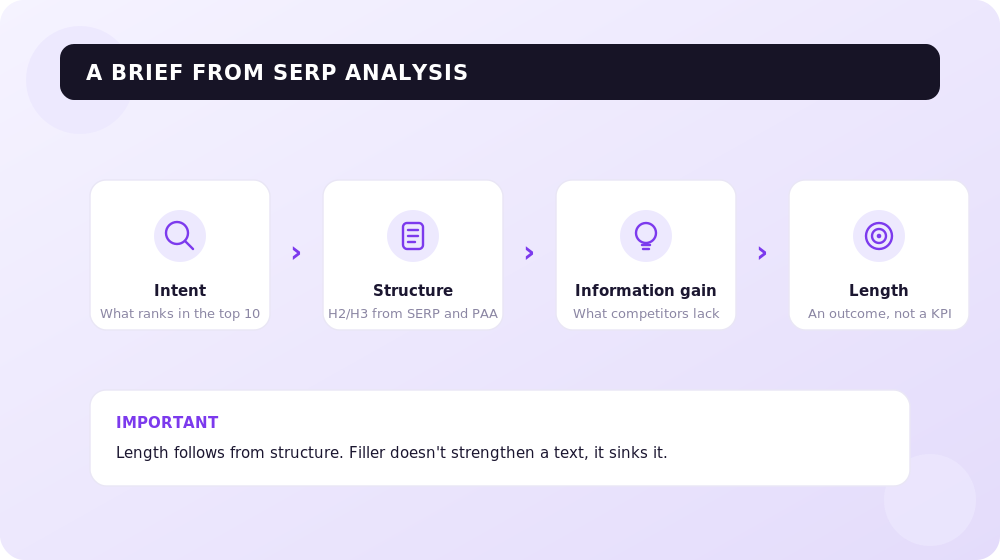
The most persistent mistake in briefs is starting with length: “write 8,000 characters.” Length is a consequence, not a starting point. The starting point is Google’s search results.
The correct sequence looks like this:
- Define the search intent. Type the main keyword into Google and look at what ranks: how-to guides, listicles, e-commerce categories, calculators? If the top results are store category pages, an article will never rank there — no matter how good it is.
- Dissect the top 10. Write out the H1–H3 structures of every article in the top ten. Mark the blocks that recur across most of them — that is the mandatory program: without those, Google will consider your piece incomplete.
- Collect questions from the SERP. The People Also Ask block is a ready-made list of subheadings and the basis of your future FAQ. Google uses these same questions in its AI answers.
- Find the information gain. This is the key step. Information gain is the new information your text adds to what already exists in the SERP: your own data, a case study, an experiment, a comparison table, an expert opinion. Google describes this principle explicitly in its patents, and in practice it is the “top 10 + something of your own” articles that displace the “retelling of the top 10” articles. In the brief, state it explicitly: “add block X, which none of the competitors have.”
- Derive the length as a consequence. If the mandatory program from the top 10 fits into 600 words, do not stretch it to 1,500. Filler does not strengthen a text — it sinks it. Set the length guideline as a range (“roughly in line with competitors, ±30%”) and mark it as a recommendation, not a KPI.
The keyword work behind the structure is easiest done with clustering: export competitor keywords from Serpstat or Ahrefs, run them through our free SEOquick keyword clustering tool — and you get ready-made semantic groups for your H2/H3 sections. The rough sorting of headings can be delegated to ChatGPT — we covered how to do it properly in our ChatGPT for SEO guide.
The core rule for the copywriter stays the same: a keyword is a question a person wants answered. The job is to answer it — not to “insert an occurrence.”
E-E-A-T Requirements for the Author in the Brief
E-E-A-T (Experience, Expertise, Authoritativeness, Trustworthiness) is the set of signals Google uses to assess the quality of content and its authors. Ever since text generation became free, the author is what separates content you can trust from content you cannot.
That is why a modern brief sets requirements not only for the text, but for the writer:
- Experience in the subject. For YMYL topics (medicine, finance, law) it is non-negotiable: the author must have relevant education or hands-on practice, and the text must be reviewed by a subject-matter expert. Spell this out as a separate line in the brief.
- Verifiable expertise. Ask the author for previous publications on the topic. State in the brief that the article will be published under the author’s byline with a bio and profile links — it keeps people honest.
- First-person experience blocks. Demand it explicitly: “add 2–3 first-person examples from real practice.” That is information gain and an Experience signal at the same time.
- Sources. Every figure must link to the primary source — not to someone’s blog that reprinted it.
SEOquick’s experience: for an English-language review site in the weight-loss niche (hard YMYL), we built the entire content operation around E-E-A-T: authors with relevant expertise, medical review, transparent sourcing. The result: growth from 100,000 to 700,000 visits per month in 6 months and a top-75 spot in the US Health/Nutrition category on SimilarWeb. Details in the case study.
It works the same way for Ukrainian projects. In our medical website SEO case study, betting on expert content written by practicing doctors took a dental clinic to Google’s top 2 for “стоматологія Київ” (“dental clinic Kyiv”) — and the site’s articles now appear in Google’s AI answers for 26,714 queries. Texts from a generalist copywriter simply do not produce results like that.
Checklist: The 12 Points of a Good Content Brief
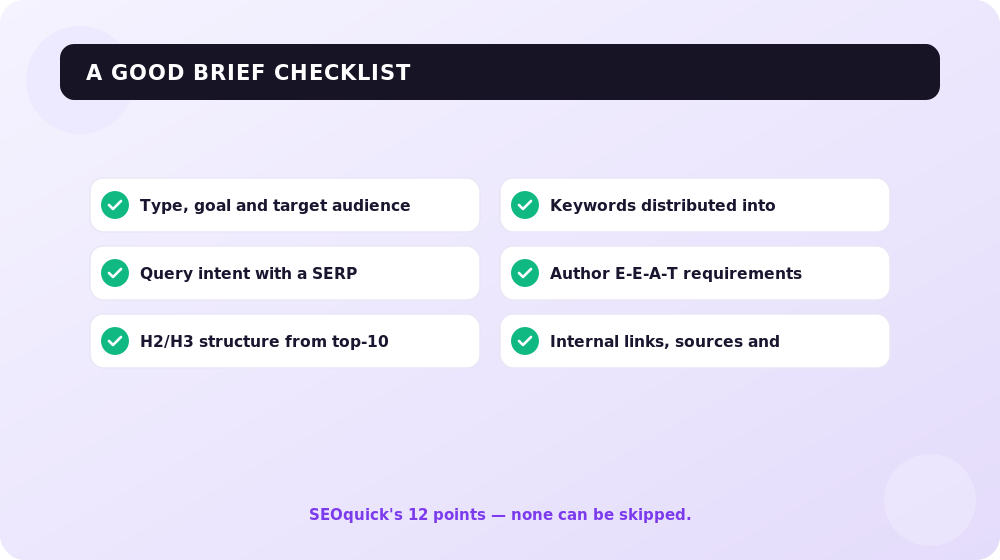
Let’s put it all together. Here is the brief skeleton we use at SEOquick — 12 points, none of which can be skipped.
| # | Brief section | What to specify |
|---|---|---|
| 1 | Type and goal of the text | Article / category / product page / landing page; inform, sell, capture leads |
| 2 | Target audience | Who reads it, their level of knowledge, the language they use to describe the problem |
| 3 | Intent of the main query | Informational / commercial / mixed — with a SERP example |
| 4 | H2/H3 structure | A ready outline based on top-10 analysis, approved before writing |
| 5 | Keywords by cluster | Keywords assigned to specific subheadings, not one flat list |
| 6 | Information gain | What the text will contain that competitors do not (case study, data, table) |
| 7 | Length guideline | A range derived from top-10 analysis, marked as a recommendation |
| 8 | Title, Description, H1 | Requirements or ready-made variants; where the keyword goes |
| 9 | E-E-A-T author requirements | Subject experience, first-person blocks, expert review for YMYL |
| 10 | AI usage rules | What is allowed, what is not, and how it is checked (see the table above) |
| 11 | Internal links and sources | An anchor list for internal links; requirements for external sources |
| 12 | Delivery format and acceptance criteria | Google Docs / Markdown, heading markup, deadlines, what counts as a reject |
The template is assembled once per project; after that only the variable blocks change — 30–60 minutes per article. Far cheaper than rewriting a finished text.
Brief-Building Tools: Overview and 2026 Pricing
Content optimization platforms automate the most labor-intensive part — analyzing the top 10 and collecting terms. Here are the four main players and their current pricing.
| Tool | 2026 price (from) | Strength | Best for |
|---|---|---|---|
| Surfer SEO | ~$99/mo | Content Editor with real-time scoring, audits of existing pages | Agencies and in-house teams with a content pipeline |
| NeuronWriter | ~$19/mo | Best price-to-features ratio, NLP terms, handles Ukrainian reasonably well | Small businesses, freelancers, small blogs |
| Frase | ~$45/mo | Fast content briefs from the SERP, People Also Ask question mining | Content marketers who need briefs rather than scoring |
| Clearscope | ~$129/mo | Premium relevance analysis, writer-friendly simplicity | Enterprise teams with budget |
The workflow is the same with any of them: enter a keyword → the tool dissects the top 10 → it returns a list of terms, questions, and a recommended structure → you turn that into a brief, and the copywriter writes in the editor while watching the score.
Three Warnings: Use Without Fanaticism
- A 100/100 score is not the goal. Chasing the maximum score leads to mechanically cramming in terms — the same over-optimization as the “3% keyword density” of 2015. Texts ranking #1 often score 60–80.
- The tools average out the top 10. They describe what competitors have already written. Follow the recommendations to the letter and you get the eleventh copy of the SERP — without the information gain the whole exercise was for. The unique blocks in the brief are added by a human.
- Terms do not replace expertise. A tool will tell you that a text about dental implants should contain the word “osseointegration.” But only an author who knows the field knows what to do with it. An NLP panel will not save a text written by an amateur.

Text Requirements That Have Not Aged
Some classic content requirements have survived every update — and still belong in every brief:
- Question-and-answer style. Every section opens with a question the audience actually asks, and answers it immediately. This keeps readers on the page and gets the text into featured snippets and Google’s AI answers.
- Short paragraphs and sentences. 2–4 sentences per paragraph, no bureaucratic prose, no convoluted constructions. Used a term? Explain it right away.
- Structure instead of a wall of text. H2/H3 subheadings, numbered steps, lists, tables for any comparison. Readers scan a text before they read it.
- The first 100 words decide everything. If the introduction does not answer “what do I get here,” the reader is gone — and your engagement signals are ruined.
- Visuals. Annotated screenshots, diagrams, and video wherever they save the reader time. In the brief, specify which blocks the author should source or describe illustrations for.
- Spelling and facts. Typos kill trust faster than bad design. And one unverified figure discredits the entire piece.
And here is what to throw out of old briefs: “nausea” and “water” percentages from text-analyzer services (metrics popular in the post-Soviet SEO market), rigid keyword density, and “95%+ uniqueness” as the main acceptance criterion. These metrics measure anything but quality — and are trivially gamed by humans and AI alike.
Briefs for Commercial Content: The Essentials
Texts for category pages, product pages, and landing pages live by different rules than articles — and their briefs are different too.
Key distinctions of commercial content:
- Only the headings and 1–2 paragraphs are tuned for SEO; everything else works for conversion.
- The text is shorter and split into design blocks: each block gets its own line in the brief with its placement, length, and job.
- The structure follows the logic of the sale (the classic is AIDA: attention → interest → desire → action), and every block leads to its own button or form.
The minimum kit for a commercial brief:
- A block table: block → placement → length → job → CTA. Or a Figma mockup with annotations.
- Copy for every interface element — including the hidden ones: tabs, FAQ accordions, hover tooltips, button labels. These get forgotten most often, then get patched in for months.
- Specifics instead of clichés. “A team of professionals” and “an individual approach” are garbage. Give the author numbers, timelines, guarantees, and case studies — let them write with facts.
- A testing plan. Commercial copy is judged by conversion, not uniqueness. Plan 2 variants of the first screen and test them on real traffic.
And the main thing: a copywriter cannot invent your advantages. If the brief contains no facts about the product, no template will save it.
Conclusions
Copy without a brief is always a gamble — garbage in, garbage out. That rule has not changed. What changed is what goes inside the brief:
- Before: character counts, uniqueness scores, keyword density, “water” percentages from analyzer services.
- Now: intent and top-10 analysis, information gain, E-E-A-T author requirements, AI usage rules, and substance-based acceptance criteria.
A text that merely retells the SERP is now generated for free — and is therefore worth nothing. What is worth paying for is what AI cannot do: real experience, verified facts, and answers that are not in the top 10 yet. That is exactly what your brief should commission.
After 18 years in this business, we at SEOquick are certain: an hour invested in the brief saves days of revisions — and sometimes the entire budget for content you would otherwise have to throw away.
FAQ
What is a content brief for a copywriter?
A content brief is a document that defines the task for a content writer: the type and goal of the text, the audience, the search intent, the H2/H3 structure, the keywords, the requirements for expertise and sources, the AI usage rules, and the acceptance criteria. A good brief removes ambiguity: the author knows what to write, and the client knows what they are paying for.
What length should the brief specify?
Length is a consequence of top-10 analysis, not a standalone requirement. Look at how much the top-ranking competitors write and set a ±30% range as a recommendation. A rigid character quota invites filler: the author pads the text to hit the number, and the piece loses to denser competitors.
Can I let my copywriter use ChatGPT?
Yes — with rules fixed in the brief. AI is acceptable for research, a draft outline, and headline variants. Forbid submitting raw generated text, invented facts, and “personal experience” written by an AI. Google does not penalize AI content as such, but the Scaled Content Abuse policy punishes mass-produced useless content.
Should I check texts with AI detectors?
Only as a supporting signal. According to a University of Maryland study (2025), detector accuracy is 61–69%, and false positives on human-written text reach 10–75%. Accept work based on substance and information gain: does the text contain data and examples competitors lack? Raw AI text never passes that test.
Which tools help build a content brief?
Surfer SEO (from ~$99/mo) and NeuronWriter (from ~$19/mo) for top-10 analysis and content scoring; Frase (from ~$45/mo) for fast SERP-based briefs; Clearscope (from ~$129/mo) for the premium segment. Free options: mining People Also Ask manually and the SEOquick keyword clustering tool for grouping keywords by subheading.
How does a brief for commercial copy differ from an article brief?
An article is an exhaustive answer to a search intent, structured from top-10 analysis. Commercial copy is shorter, split into design blocks, and driven by sales logic: each block in the brief gets a placement, length, job, and CTA. Hidden elements — tabs, accordions, tooltips — must be specified too. Such copy is judged by conversion, not rankings.
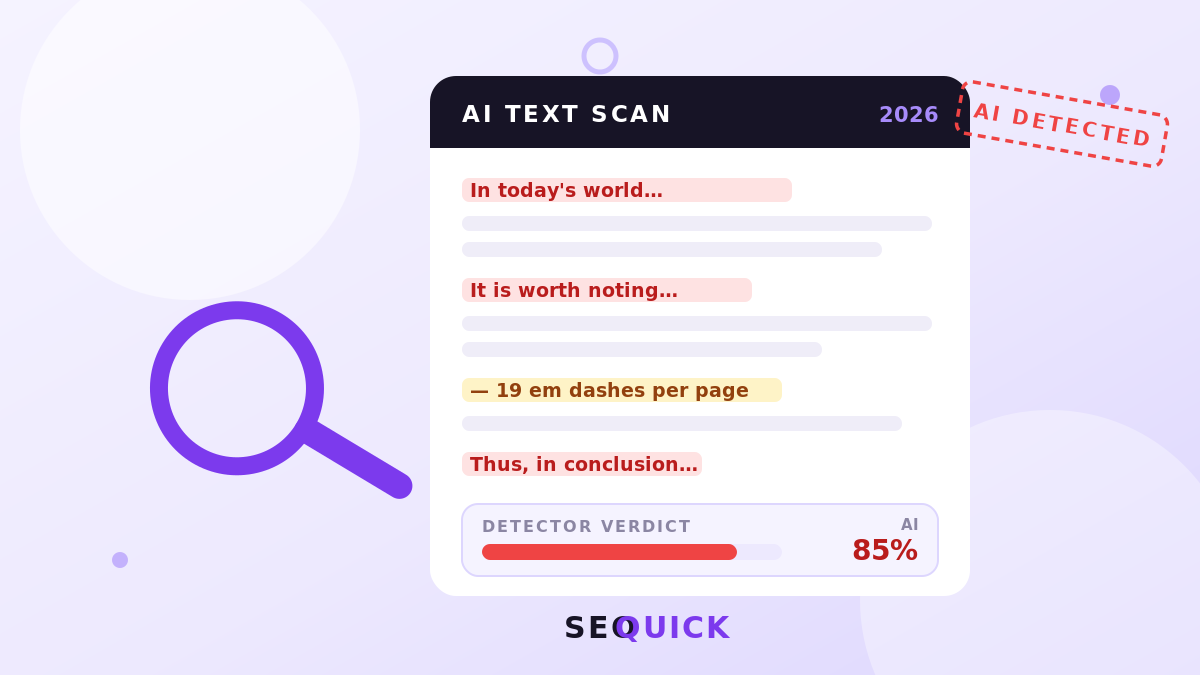
How to Detect AI-Written Text: Language Markers, Code-Level Evidence, and Detection Tools
An AI-text detection system from the creators of the Unmiss AI detector: GPT phrase markers, machine logic, special-character evidence in code, tools, and a 7-step checklist. Plus what Google thinks about it.
Read →
How to Run a YouTube Channel (Checklist)
How to upload videos, which settings you need to know, what to enable and what can bury your channel. A detailed checklist for the content manager.
Read →
How to Write a Technical Brief in 2026: A Spec for Copywriters and Developers (With an AI Draft): SEOquick
How to correctly write a technical brief in 2026: brief structure, goals and metrics, a checklist, templates for copywriters and website developers, using AI/GPT, and common mistakes.
Read →Want to apply this to your site?
We will review the current situation, find the first growth levers, and suggest a practical working format.