Traffic or Conversion: Which Matters More for Business in 2026
Conversion matters, but in 2026 traffic does more: it feeds the brand signals AI search needs to cite you, powers retargeting, A/B tests and GA4 attribution. With real numbers, here is why growing traffic earns more than fighting for an extra point of conversion.


I will look at your site and answer your questions on the topic of this article. 30 minutes, no slide decks, no pressure.
Book a consultationIn short: in most cases, investing in traffic growth earns more money than trying to squeeze out an extra point of conversion. Traffic increases sales even at a low conversion rate, feeds the brand signals AI search needs to cite you, powers retargeting, and supplies the data volume for honest A/B tests and data-driven attribution in GA4. You can't abandon conversion — but on a limited budget, traffic almost always wins.
Let me be clear up front: conversion matters, and I'm not suggesting you ignore it. If your site converts no visitors into customers at all, fix the funnel first instead of pouring traffic into a leaky bucket.
But if you already convert traffic somehow and simply want more money, you're probably spending effort in the wrong place. Businesses invest in conversion out of habit: according to Baymard Institute, the average cart abandonment rate in 2025 is around 70%, and teams fight over those percentage points for years. The bigger win usually comes from something else — growing the number of people who reach the site at all.
Below are four reasons why, in 2026, you should treat traffic as a more important metric than conversion. With numbers, and adjusted for the new reality: AI search, GA4, and brand signals.
What, again? Traffic dropped and no sales? Then SEOquick will help you bring it all back
We'll attract organic SEO traffic to your site from the Google and Bing search engines.
We'll carry out internal optimization and SEO promotion work. We'll improve reputation, content. We'll do an audit and build up the link mass.
No black magic – only white-hat SEO methods!
Traffic increases the number of sales
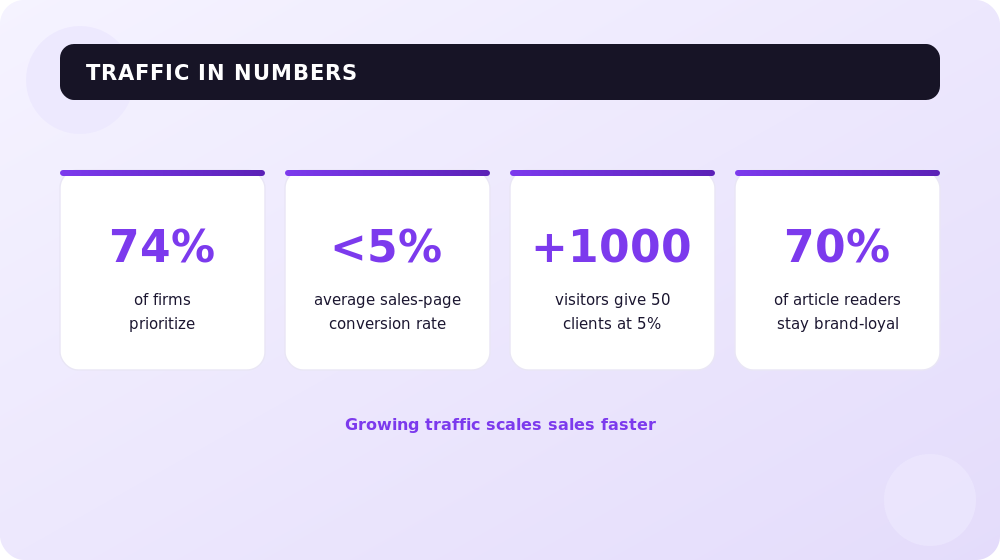
Let's start with the math — it's ruthless here. Look at the average conversion rates in your niche. What you see will probably disappoint you.
In 2025, the average ecommerce conversion rate worldwide sits around 2.5-3%, and in many categories it's even lower. That means out of 100 visitors, only 2-3 become buyers. The spread across niches is wide:
- Food & beverage — one of the highest-converting categories, around 4.9%.
- Health & beauty — about 2.5%, with strong DTC brands at 3-4%.
- Home & garden — around 1.4%: higher ticket, longer decision cycle.
- Luxury & jewelry — often below 1%.
That's the conversion rate of specially polished sales pages and landing pages, where every element — video, reviews, buttons — is built around a single sale. Your blog article won't sell like that: the visitor came for information, not to buy, and will close the page if they see an aggressive landing.
Now imagine your conversion rate is 2.5%. You can spend three months and a serious budget to raise it to 3% — a gain of 0.5 percentage points. Or, in the same time, you can bring in an extra 1,000 visitors a month through SEO promotion and paid search advertising. At the same 2.5% conversion rate, that's +25 customers every month — with no site rebuild.
Let's count it in hryvnias. Say your average order value on a Rozetka-style marketplace is UAH 1,500. 25 new customers a month means +UAH 37,500 in revenue every month, and the sum grows along with traffic. Half a percentage point of conversion at the same traffic would deliver incomparably less.
Investing in conversion pays off when you already have a lot of traffic: then each percentage point is worth a lot in absolute terms. But while traffic is scarce, it's more profitable to grow it.
Traffic feeds brand signals and AI visibility
Here's a reason that didn't exist in 2018, yet today it's arguably the main one. Brand awareness used to sound like an abstraction for marketers. In 2026 it's a concrete ranking signal — for classic search and for AI alike.
Google AI Overviews, ChatGPT Search, Perplexity, and Gemini no longer just show ten blue links — they generate an answer and cite sources. And they decide whom to cite not only by backlinks.
2025 research shows that branded search volume correlates with LLM citations more strongly than link mass does (a correlation of about 0.33 versus a weak one for backlinks). Put simply: the more people search for your brand by name, the higher the chance AI mentions you. And branded demand is born exactly where there's a lot of traffic — from content, ads, reviews, and mentions.
There's a second link too. Up to 75% of links in AI Overviews come from the top 12 organic results, and the overlap between pages cited by ChatGPT/Perplexity and pages ranking in Google's top reaches 77%. So organic traffic and AI visibility aren't two separate worlds, but one ecosystem: the quality content that collects traffic is the same content that lands in AI answers.
What this means in practice:
- Every article that collects traffic raises the chance AI cites you — a new channel of free touchpoints.
- The more people see your content, the more branded searches, reviews, and mentions you get — and the stronger the signals for the algorithms.
- Great content doesn't just bring a visitor — it builds trust. And trust is hard for a competitor to override: people don't like changing decisions they've already made.
If you want to manage this deliberately, start by understanding how AI search works today — we have dedicated AI tools and development for that. But the basic principle is simple: no traffic — no brand signals — no place in AI answers.
Recommended reading:
I also recommend watching this video on working with search traffic:
Traffic works for the long game: retargeting and the long path to purchase
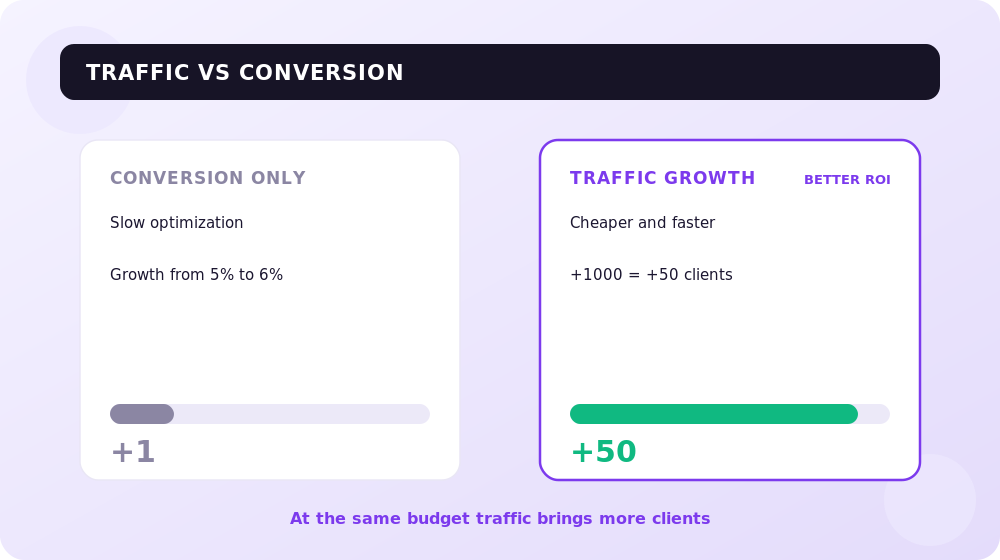
$100,000 today or $1 million in a year — which would you choose? Most people grab the bird in the hand. Traffic versus conversion is the same story: conversion gives you money now, traffic gives you many times more later.
Why don't people buy on the first touch? According to Baymard's 2025 data, the top cause of cart abandonment for six years running is unexpected extra costs at checkout (shipping, taxes): 48% of shoppers. 25% don't want to create an account. But the most important figure: 43% were "just browsing" and not ready to buy right now.
That 43% segment is gold. These people aren't lost — they're at the start of the journey. And it's traffic that lets you catch up with them later.
The path to purchase has gotten longer. In 2025, a buyer needs around 6 brand touchpoints on average before buying, and 73% of people switch between several channels before deciding. The old "rule of seven touches" hasn't died — it's just gotten more complex.
This is where traffic turns into an asset through retargeting. Every visitor who left without buying is an audience you can win back with ads. The numbers are striking:
- 76% of consumers are more likely to buy after a repeated retargeting touch.
- Retargeting adds an average of 3.4 extra site visits before the final purchase.
- Well-built cart-recovery flows (first touch within 15 minutes, second after 6 hours) recover up to 41% of lost sales.
But retargeting is impossible without traffic: the more people visit the site today, the wider the audience to win back tomorrow. Every 1,000 visitors isn't just today's 25 sales at a 2.5% conversion rate — it's also a pool of 975 people you can chase for months.
In the long run you get a self-replenishing traffic source: people recognize the brand, tell their friends, return on their own. According to the U.S. Bureau of Labor Statistics, about half of companies close within their first years — often because they bet on quickly squeezing conversion instead of building an audience. In Ukraine, where competition on OLX, Prom, and Rozetka is fierce, it's accumulated traffic and recognition that provide a margin of safety.
Traffic powers A/B tests and GA4 attribution
Here's a paradox: even conversion optimization itself is impossible without traffic. To test a hypothesis honestly, you need a volume of data. No traffic — no tests.
The numbers are hard. For a reliable A/B test, a page converting at 2-5% needs roughly 1,000-2,000 conversions per variant to detect a 10-20% lift at 95% confidence. And for traffic, the benchmark looks like this:
- Under 10,000 visits a month — tests are nearly useless: only a variant with a conversion lift above 30% will "win," and such miracles are rare.
- 10,000-100,000 visits — you can already catch improvements from 9%.
- The more traffic, the subtler the changes you can measure and the faster you get an answer.
So without enough traffic, you'll be changing buttons and headlines at random, wasting money and time, and making decisions based on noise rather than data. If you want to work on conversion systematically, start with a usability audit, and grow traffic in parallel to a volume where tests actually mean something.
The second reason is attribution. In 2026, the default model in Google Analytics 4 is data-driven attribution (DDA): machine learning distributes conversion credit across all touchpoints instead of giving it all to the last click. This changes how you see traffic: a blog that "doesn't sell directly" turns out, in the assisted-conversions report, to be that very first touch without which the sale wouldn't have happened.
But DDA has a threshold: the model needs at least 400 conversions per event and 20,000 conversions total within the lookback window. Don't hit it, and GA4 silently falls back to last-click, and all the value of the upper funnel vanishes from your reports. Again we hit the same wall: too little traffic — no proper attribution, and no understanding of what actually works.
Frequently asked questions
Which matters more — traffic or conversion?
Both matter, but on a limited budget traffic usually earns more money. Conversion grows slowly and hits the niche ceiling (often 2-3%), while traffic scales. The exception is when the site doesn't convert at all: then fix the funnel first.
Should you work on conversion at all if traffic matters more?
Yes. You can't abandon conversion — but optimizing it on low traffic is pointless, because A/B tests won't be reliable. First build up your visitor volume, then test and improve.
How is traffic connected to showing up in AI search?
Directly. Branded demand (searches for the company name) correlates with AI citations more strongly than links do. And branded demand is born from traffic: content, ads, mentions. Up to 75% of links in AI Overviews come from the top 12 organic results — so the same content that collects traffic also lands in AI.
How much traffic do you need for A/B tests?
At least around 10,000 visits a month for tests to be even somewhat reliable. A page converting at 2-5% needs 1,000-2,000 conversions per variant for a confident conclusion. On low traffic, use sequential or Bayesian testing.
Why don't people buy on their first visit?
In 2025, a buyer needs about 6 brand touchpoints on average. The top causes of cart abandonment are unexpected extra costs at checkout (48%) and reluctance to register (25%), but 43% are simply not ready to buy right now. Retargeting wins these people back — and it only works when you have traffic.
What pays off more in hryvnias: +1,000 visitors or +0.5% conversion?
At a 2.5% conversion rate, an extra 1,000 visitors a month gives +25 customers monthly. Half a percentage point of conversion at the same traffic delivers incomparably less and requires expensive site rebuilds. Early on, traffic almost always wins.
Conclusion
So, conversion does matter — and that's exactly why, in most cases, your effort should go toward traffic rather than conversion. A paradox, but true.
Traffic increases sales even at a low conversion rate, feeds the brand signals AI search needs to cite you, powers retargeting and the long path to purchase, and supplies the data volume for honest A/B tests and data-driven attribution in GA4.
Many people focus too hard on conversion and too little on attracting traffic. Remember: people won't buy anything from you if they don't know you're selling something. And they can only find out if you bring them to your site. So what are you waiting for? Go and bring them.
Content Refresh in 2026: How to Revive Old Posts and Win Traffic Back
Updating old articles is more profitable than writing new ones. How to pick pages in Search Console, rewrite the content and win traffic back — the SEOquick method with data and quotes.
Read →
Smart lead generation: grow conversion by 30% and more!
What is lead generation and why are sales not growing? What types of leads exist and why does a business need them? How a lead manager works.
Read →
Website chatbots in 2026: what you are actually buying and how to vet the vendor
Three different products are sold under the word chatbot at roughly the same price. What separates a callback service from an AI widget from a system, a nine-point checklist with live demo tests, seven questions for the vendor, total cost of ownership and rollout times.
Read →Want to apply this to your site?
We will review the current situation, find the first growth levers, and suggest a practical working format.