Stop Words in SEO Texts in 2026: Myths, Reality, and How to Write Naturally
Stop words are no longer the enemy of your text. In 2026, search engines and language models read meaning, not count conjunctions. Let's figure out where noise words really get in the way and where they help.


I will look at your site and answer your questions on the topic of this article. 30 minutes, no slide decks, no pressure.
Book a consultationStop words (or "noise words") are prepositions, conjunctions, particles, pronouns, and introductory phrases that carry almost no meaning on their own but tie a sentence together. In 2026 they do NOT hurt SEO directly: modern Google and language models read the text as a whole, understanding context and user intent. Stripping them out "for the metric" is no longer necessary — writing naturally and clearly for a human matters far more.
When we read any text content on the Internet — whether it's company blogs or posts on Facebook and Instagram — we involuntarily judge its quality by various criteria.
Some people notice spelling mistakes, others immediately spot factual inconsistencies. But what irritates readers most isn't a single word — it's "fluff": text with a lot of letters and very little meaning.
Copywriters used to be scared with rigid rules: "remove stop words," "lower text density below X percent." Today those rules are largely outdated. Let's figure out what actually works in 2026 and what's left over as a myth from the era when search engines couldn't yet understand meaning.
And if you don't know what text density is and how to lower it, this article is specially for you: "5 Ways to Lower Text Density + Free Analysis Services"
What, again? Traffic dropped and no sales? Then SEOquick will help you get it all back
We will attract organic SEO traffic to your site from Google and Bing.
We will carry out internal SEO optimization and promotion. We will improve reputation and content. We will run an audit and build up your link mass.
No black magic – only white-hat SEO methods!
What Stop Words Are and Whether They Hurt SEO in 2026
Historically, search engines really did ignore stop words: that way they saved computing resources and index space while processing billions of queries. That's where the advice "remove conjunctions and prepositions for SEO" came from.
But that rule has long been outdated. Modern Google uses advanced natural language processing (NLP) algorithms that analyze not individual words but context, user intent, and the relationships between concepts. Today the search engine understands meaning, not just words.
What's more, in many queries stop words are critical for interpretation. Compare "ticket Kyiv Lviv" and "ticket from Kyiv to Lviv" — the prepositions change the direction of travel. Remove them, and the search engine may misread the intent.
So the key takeaway for 2026 is this: stop words by themselves do not lower rankings. Positions are affected far more by low content quality and keyword over-optimization, which directly violates Google's spam policy.
However, there's a flip side: without stop words a text loses its logic. Take the sentence: "Without any doubt, Olia studies quite well, moreover she takes part in olympiads, but her grade-point average probably won't be enough for a gold medal." Strip out the noise words and the link between the parts of the phrase falls apart. Here you can't do without the conjunction "but."
The Groups of Stop Words
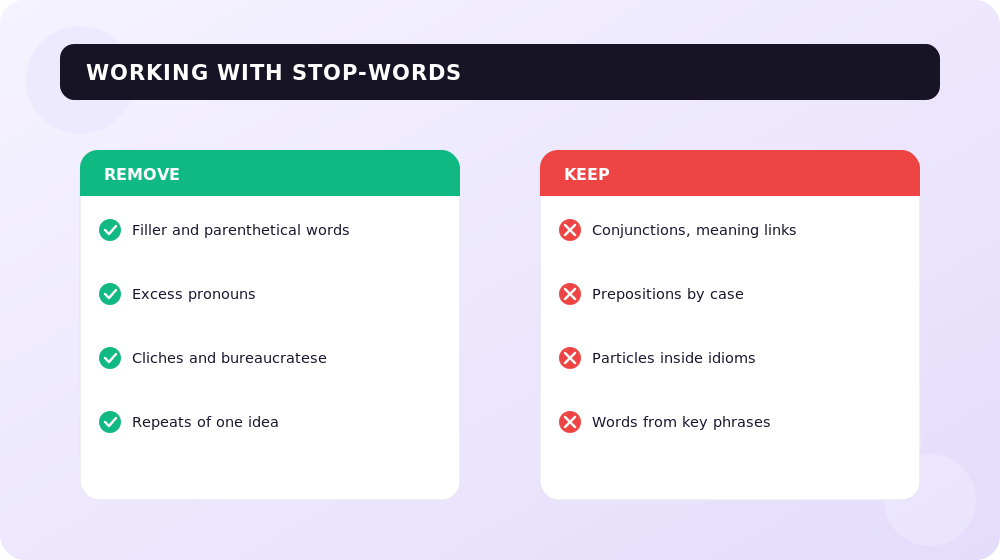
- prepositions and conjunctions (in, on, and, but, to, for);
- particles (not, no, would, just, only);
- pronouns (this, which, such, that);
- introductory words (of course, probably, certainly, by the way);
- intensifiers and evaluative adverbs (very, extremely, absolutely, incredibly);
- numerals and function adverbs (total, all, first).
Notice that some of them are the "useful glue" of language, while others turn into fluff. The job of a 2026 author is not to scrub them out completely, but to tell one from the other.
Myths About "Density" and Over-Optimization: What's Outdated
A lot of myths from the 2010s have piled up around stop words. Let's tackle the main ones.
Myth 1. "The fewer stop words, the higher the rankings"
Not true. Search engines in 2026 don't penalize function words. On the contrary, an unnatural, "chopped-up" text is harder for the reader to follow and lowers behavioral signals. The advice to remove stop words from headings and subheadings directly harms user experience — it should be ignored.
Myth 2. "You must keep density strictly below a fixed threshold"
There are no hard "density" thresholds in Google's real algorithms. That's a metric from old checker tools, not a ranking factor. According to 2026 research, keyword density by itself is not a direct factor, and the optimal natural density is around 1–2%. Chasing a specific number is pointless.
Myth 3. "More keywords = more traffic"
Today it's the opposite. Keyword over-optimization at best makes a page low quality, and at worst leads to an algorithmic filter or manual penalties — even removal from the index. Google's John Mueller has repeatedly stressed: focus on natural writing. Both people and algorithms easily recognize "forced" keywords.
If you're building a semantic core, remember: it exists to cover topics and user intents, not to cram keywords into every paragraph.
Stop Words in Titles, Descriptions, URLs, and Anchors
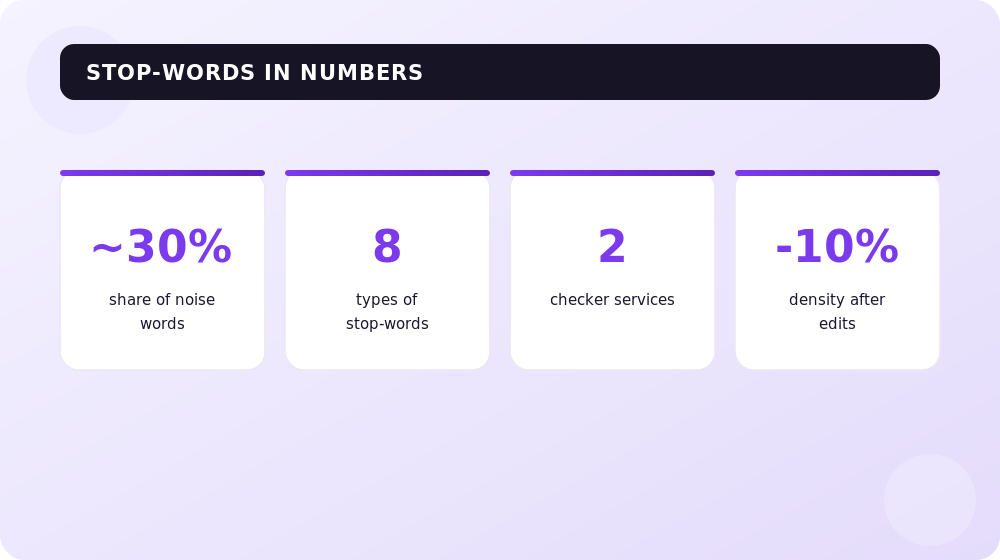
The approach to stop words depends on exactly where they appear. Here are the current benchmarks for 2026.
Title (the page heading)
The title is one of the most important signals and the first thing a user sees in the results. It's best to place the main keyword closer to the start — Google gives more weight to the first words. But that doesn't mean throwing out prepositions and conjunctions: the title should sound natural and clickable. "Flower delivery Kyiv" vs "Flower delivery across Kyiv" — choose the one that reads like a living phrase.
Description (meta description)
The meta description isn't a direct ranking factor, but it affects click-through rate (CTR). Write it as a normal sentence, stop words included. A natural description gets more clicks than a keyword-stuffed one. A safe length is roughly 120–160 characters, and mobile truncates earlier.
URL (the page address)
This is where stop words are most often unnecessary. A short, clean URL is easier to read: /flower-delivery/ is clearer than /how-to-place-an-order-for-flower-delivery-in-our-store/. Most SEO specialists agree: function words in a URL are worth removing — but only if it doesn't change the meaning.
Anchors (link text)
In anchors, stop words often aren't needed, but if the phrase sounds awkward without them — keep them. A healthy internal-link profile is built on natural, descriptive anchors, while exact-match keyword anchors should be used sparingly (5–10% of all internal links).
How AI and Language Models Handle Stop Words
The most important shift of recent years is search moving toward semantics and AI Overviews. This completely changes how we treat stop words.
The classic NLP pipeline used to remove stop words at the preprocessing stage, reduce words to their base form, and build a "bag of words." That's fast, but it ignores sentence structure and the relationships between words.
Modern transformers — BERT, GPT, LLaMA — work differently. They don't remove stop words; they split text into subwords (WordPiece, SentencePiece) and account for every word in context. Research in 2026 shows that removing function words degrades comprehension quality in modern models. In other words, stop words are not noise for an LLM — they are part of the meaning.
And AI Overviews and Google's AI Mode first detect the semantic intent of a query, and only then pull the pages that best answer it. Google thinks not in words but in entities — people, tools, organizations, concepts, and the relationships between them. According to 2026 data, 15+ connected entities per 1,000 words noticeably increase the chance of being cited in an AI Overview.
The conclusion is simple: to get into AI answers, don't strip your text to the bone — cover the topic deeply and coherently. By the way, AI tools for content can speed up that work.
How to Write Naturally in 2026: Practical Recommendations
If stop words are no longer the enemy, what should you focus on? On readability and usefulness for the human — that's the main quality signal.
- Write for people. Google explicitly recommends natural writing and "people-first" content. Algorithms evaluate how genuinely useful a text is.
- Keep a simple reading level. For snippets and voice search Google prefers a grade 6–9 level. Avoid bureaucratic jargon and convoluted participial constructions.
- Break up long sentences. Compare: "An unexpected overnight snowfall complicated the movement of transport due to the poor work of utility services" and "A lot of snow fell overnight. Utility services didn't manage to clear the roads — traffic is restricted." The second version reads more easily.
- Use the active voice and verbs. It's verbs that create dynamics. Don't write 10 words where one action will do.
- Structure your content. Subheadings, lists, examples, and visuals improve scannability. This reduces cognitive load and matches how AI systems measure usefulness.
- Cut the "fluff," not the function words. The real enemy is clichés like "a wide range of services," "a team of professionals," "an individual approach," and vague phrasing like "sort of," "kind of." Those are what you should trim.
Want to work on your site's visibility systematically? Start with search engine promotion and quality semantics — that will deliver far more than manually scrubbing prepositions.
And if you want to match your site's semantics with future ad texts in order to reduce the number of stop words to a minimum, use our free utility Google Adwords Ad Generator.
Frequently Asked Questions About Stop Words
Do stop words hurt SEO in 2026?
No. Stop words by themselves don't lower rankings. Modern Google understands meaning and context rather than counting conjunctions. What hurts is low content quality and keyword over-optimization, not the presence of prepositions.
Do I need to remove stop words from text for SEO?
You don't need to scrub them out deliberately — that makes the text unnatural. Remove only the real "fluff": clichés, tautology, vague phrasing. Keep the function words that hold the meaning.
What is "text density" and does it matter today?
"Density" is a word-repetition metric from old checker tools. It is not a direct ranking factor in Google. A natural keyword density of around 1–2% is a sensible guideline, but chasing a specific number isn't worth it.
Should I use stop words in URLs?
In URLs function words are more often unnecessary: a short, clean address reads more easily. But remove them only if it doesn't distort the meaning. In titles and descriptions, on the contrary, keep stop words — that way the phrases sound natural.
How do language models and AI handle stop words?
Modern transformers (BERT, GPT) don't remove stop words; they account for them in context. Research shows that removing function words degrades comprehension. For AI Overviews, depth of topic coverage and connected entities matter more than a "trimmed" text.
Do stop words affect link anchors?
In anchors, stop words often aren't needed, but if the phrase sounds awkward without them — keep them. Natural, descriptive anchors are better than mechanical exact-match keywords.
Conclusions
In 2026, stop words are not a threat but a natural part of living language. Search engines and language models have long read meaning, context, and entities rather than counting prepositions.
So forget about mechanically scrubbing your text to hit a mythical "density percentage." Instead, write for people: clearly, with structure, with examples, and without fluff. It's natural, useful content that wins both in classic search results and in AI answers.
Text Spam Level in 2026: Over-Optimization, Keyword Density and Google Penalties
What text spamminess and keyword density mean, whether chasing a perfect percentage risks Google penalties in 2026, how to check over-optimization and write natural, relevant content for people and AI.
Read →
Image SEO Optimization: alt, Dimensions and Weight for Core Web Vitals
How to optimize images for SEO in 2026: why alt text matters, how width and height stop layout shifts (CLS), which formats (WebP, AVIF) to use, and how not to break LCP with lazy loading. A guide from SEOquick.
Read →
Keyword Cannibalization: How to Find and Fix It in 2026
Keyword cannibalization dilutes relevance and drains traffic. We break down, with real examples, how to find cannibal pages and consolidate them with a 301 redirect — by SEOquick.
Read →Want to apply this to your site?
We will review the current situation, find the first growth levers, and suggest a practical working format.