Serpstat Review 2026: A Close Look at the Ukrainian-Built SEO Platform
Serpstat is a Ukrainian-built SEO platform that has grown from an 'affordable Ahrefs alternative' into a full-blown AI-powered suite over the past two years. I break down the pricing, the five core modules, AI Overviews tracking, and the API — with real examples from SEOquick's day-to-day work.


I will look at your site and answer your questions on the topic of this article. 30 minutes, no slide decks, no pressure.
Book a consultationSerpstat is a tool that has been in SEOquick’s arsenal longer than most of our employees have been with the company.
We use it daily: for keyword research, competitor analysis, rank tracking, and — more recently — for monitoring how visible our clients are in Google’s AI answers.
In this review, I’ll cover what Serpstat can do in 2026, what it costs, where it’s objectively strong, and where it honestly loses to Ahrefs and Semrush. No promotional gushing — only what we’ve verified hands-on across our own projects.
What is Serpstat? Serpstat is a Ukrainian-built all-in-one SEO platform: keyword research, competitor analysis, rank tracking, technical site audit, and backlink analysis, plus AI tools for tracking your brand across ChatGPT, Gemini, and AI Overviews. Plans start at $50/month — two to three times cheaper than Ahrefs or Semrush, with a comparable feature set for the Ukrainian, European, and US markets.
A World-Class Product Built in Ukraine
Let me start with something nobody bothered writing about in 2018 — but that matters in 2026.
Serpstat was born in Odesa, Ukraine, inside the Netpeak digital agency, and has been developing as a standalone product within Netpeak Group since 2015. Today, more than 400,000 specialists worldwide use the platform — its client list includes teams from Uber, Shopify, Samsung, and Deloitte.
And here’s the remarkable part: the company never halted development, even during Russia’s full-scale invasion of Ukraine. The team kept shipping releases from inside the country — and it was precisely in 2022–2025 that Serpstat rolled out its strongest updates: a reworked site audit, batch domain analysis, and the entire AI stack covered below.
For us, this isn’t a “patriotic discount on quality” — quite the opposite, it’s an argument in Serpstat’s favor. You’re paying for a tool built by a Ukrainian team that understands its home market better than any Western competitor: Serpstat’s Google Ukraine databases are among the most complete in the industry.
Serpstat Pricing in 2026
Prices are current as of June 2026, per the official page at serpstat.com/page/pricing-plans. Annual billing saves up to 27%.
| Plan | Price (annual billing) | Best for | Key limits |
|---|---|---|---|
| Individual | $50/mo | Freelancers, owners of 1-5 sites | 5 projects, 100 queries/day, 10,000 rank checks, 30,000-page audit |
| Team | $100/mo | Small agencies and teams | Unlimited projects, 500 queries/day, ~100,000 rank checks, API, AI tools, MCP |
| Team x2 | $169/mo | High-volume agencies | 1,000 queries/day, 100,000 rank checks, 300,000-page audit |
| Agency | $410/mo | Large agencies and businesses | 5,000 queries/day, 500,000 rank checks, White Label reports, phone support |
A few important nuances the table doesn’t show:
- The credit model. Almost every action in Serpstat consumes credits: a domain query, a report export, a rank check, an audited page. It’s flexible — light months barely touch the limit — but it demands discipline: one careless batch analysis of 500 domains can drain your entire monthly allowance.
- API and AI features start with Team. The Individual plan has no API, no batch analysis, no AI tools, no MCP integration. If you’re reading this review for the AI features, consider the real entry price to be $100/month.
- JS rendering in the audit is also available from the Team plan up — on Individual, the crawler doesn’t execute JavaScript.
- There’s a free 7-day trial with access to Individual or Team features — enough to run your own site and a couple of competitors through it.
The Five Core Modules: What’s Inside
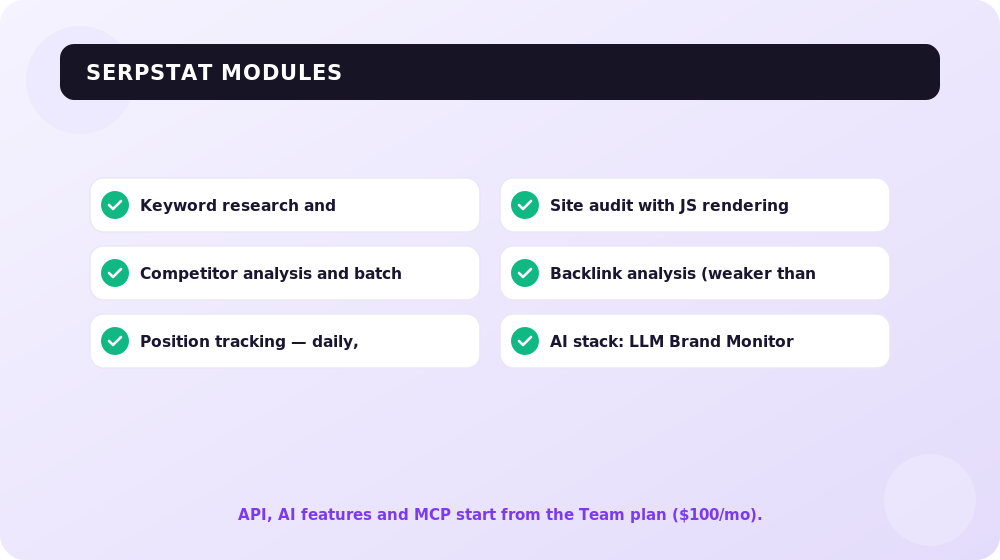
Serpstat is a classic all-in-one suite, and it’s easiest to break down by its five modules. For each one, I’ll be honest about where it matches the market leaders and where it falls short.
1. Keyword Research and Clustering
This is historically Serpstat’s strongest module and the main reason it lives in our stack.
What it does:
- keyword suggestions with search volume, Keyword Difficulty, and cost per click;
- similar and related phrases — expanding your keyword list through SERP analysis;
- search suggestions and questions — a goldmine for informational articles and FAQs;
- SERP analysis for any phrase: who ranks, with which pages and snippets;
- keyword clustering based on actual SERPs — grouping keywords by page without manual sorting in Excel.
For the Ukrainian market, Serpstat’s keyword database has traditionally been deeper than its Western competitors’: for long-tail queries in Ukrainian, it surfaces phrases that neither Ahrefs nor Semrush has. The US and European databases are solid working tools too, although Semrush is still ahead in sheer volume of American keyword data.
Clustering is a separate credit-based paid tool, but it saves hours: on a project with 3,000-5,000 phrases, manual grouping takes a full day, while Serpstat handles it in 15-20 minutes with accuracy that only needs light cleanup.

2. Competitor Analysis and Batch Analysis
The second module agencies buy Serpstat for.
Enter a competitor’s domain and you get their visibility score, every keyword they rank for, their top traffic-driving pages, and a history of changes. The Domain Comparison tool overlays the keyword sets of up to three sites and shows their shared phrases, each site’s unique phrases, and — most valuable of all — the missing keywords your competitors rank for while you don’t.
From the Team plan up, you get batch domain analysis: up to 500 domains processed in a single project — search volume, visibility, traffic, keywords. We use it whenever we need a quick read on a niche: export the niche’s top 50 sites, run them through a batch, and within half an hour you understand the competitive landscape that used to take a full day to map.
3. Rank Tracking
Serpstat’s Rank Tracker is solid and free of surprises:
- daily rank checks in Google for any region and language;
- separate tracking of desktop and mobile SERPs;
- monitoring competitors’ rankings against your own keyword set;
- tracking both organic and paid results;
- project migration from other services — moving over from Semrush takes minutes.
The limits are generous: even Individual gives you 10,000 checks per month — enough for a 300+ phrase keyword set with daily tracking. For comparison, Ahrefs’ base plan has noticeably tighter rank-tracking limits and less frequent updates.
4. Site Audit with JS Rendering
The technical audit has matured into a serious tool over the past few years. The crawler checks for 60+ error types — metadata, response codes, speed, duplicates, hreflang, structured data — and rolls everything into a report with priorities and crawl-over-crawl trends.
The key update is JavaScript rendering (from the Team plan): the crawler executes JS and sees the content of React/Vue single-page applications exactly as Googlebot does. For e-commerce sites built on JS frameworks this is critical — without rendering, half the problems are simply invisible.
I’ll be honest: for deep technical audits we still use Screaming Frog — it’s more flexible to configure. But for routine health monitoring of client projects, Serpstat’s audit covers 90% of the work, and its reports can go straight to the client without translation from tech-speak.
5. Backlink Analysis — the Weak Spot, and That’s Fine
I’ll be blunt here: the backlink index is Serpstat’s weakest module.
The service’s database holds roughly 1.1 trillion links. That sounds impressive, but Ahrefs indexes an order of magnitude more and refreshes its index faster. In practice, this means that for mid-sized and large sites, Serpstat finds 60-80% of the backlink profile that Ahrefs sees, and fresh links show up in reports with a delay.
What the module is good enough for:
- a general assessment of your own and competitors’ backlink profiles;
- tracking link gains and losses over time;
- anchor-list analysis and basic toxic-donor screening.
What it’s not enough for: serious link-building audits, prospecting competitors’ link sources, disavow work. If links are your main battlefield, you’ll have to buy Ahrefs on top. That’s exactly what we do at SEOquick: keywords and rankings — Serpstat; backlinks — Ahrefs.
Serpstat’s AI Stack: the Big 2025–2026 Update
If I were rewriting this review for one reason alone, this would be it. Over 2025–2026, Serpstat assembled an AI stack that even its pricier competitors don’t have in this form.
AI Content Tools
A set of content tools: text generation and checking, rephrasing, meta tag generation, search intent detection, transcription. They run on credits and are available from the Team plan.
My advice from practice: use them as a routine accelerator (meta tags for hundreds of product pages, Title variations), not as a replacement for a copywriter. Out-of-the-box texts still need expert editing — as with any AI generator.
AI Overviews Monitoring and Brand Opportunities
Ever since Google rolled out AI Overviews to most countries, the classic question “what position are we in?” lost half its meaning: even a top-3 site gets zero clicks when an AI answer sits above the results without mentioning its brand.
Serpstat was among the first to build AI Overviews monitoring right into its rank tracker: you can see which queries from your keyword set trigger an AI answer and whether your site is cited in it. And the AI Overview Brand Opportunities report shows the queries where an AI answer exists but your brand isn’t in it — a ready-made target list for citation optimization.

LLM Brand Monitor: 140+ Models
A separate product in the ecosystem is LLM Brand Monitor. It tracks how ChatGPT, Claude, Gemini, and over 140 other AI models answer questions related to your brand and niche: whether they mention you, in what context, which competitors get named more often, and how the picture shifts over time.
This is no longer SEO in the classic sense — it’s GEO (Generative Engine Optimization) — and Serpstat got there ahead of many: Ahrefs and Semrush shipped similar modules later, at higher prices.
SEOquick’s experience. Visibility in AI answers isn’t theory — it’s a measurable channel. After we reworked the content and structure of the website of Dobro Lyudyam (“Good to People”), a Ukrainian charity foundation, it earned impressions for 1,478 queries in Google’s AI answers — plus 50% organic traffic growth in 8 months (case study). And nadomu.kiev.ua, a Kyiv-based home-services website, consistently gets conversions straight from ChatGPT — clients come because the model recommends the company in its answers (case study). These are exactly the queries that AI visibility monitoring uncovers.
MCP Integration: Serpstat Inside ChatGPT and Claude
The most practical addition for anyone already working with AI assistants: Serpstat supports MCP (Model Context Protocol) and connects directly to ChatGPT and Claude (available from the Team plan).
This means analytics becomes a conversation: “take my domain’s keywords, compare them against three competitors, and list the topics where I have a gap” — and the assistant pulls the Serpstat data, runs the numbers, and hands you a finished table. Routine work that used to eat half a day of exports and pivot tables shrinks to minutes.

API: How We Use Serpstat at SEOquick
The API is Serpstat’s most underrated side. It unlocks with the Team plan (200,000–400,000 credits per month) and covers every module: keywords, backlinks, rankings, audit.
A live example — our internal workflows:
- Blog topic research. A script pulls competitors’ keywords via the Search Analytics API, subtracts our existing articles, and returns a topic list with search volume and difficulty. The article you’re reading right now landed in our content plan exactly this way.
- Batch keyword exports. For new clients, we automatically export the keyword sets of 10-20 competitors with a single script — instead of manually clicking through each domain in the interface.
- Recurring competitor audits. Once a month, a script captures competitors’ visibility and key metrics across all client projects and drops them into a dashboard — we spot shifts in a niche before industry channels even write about them.
And the API cost is already baked into the plan — Semrush, by comparison, sells its full API as a separate line item at a noticeably higher price.
SEOquick’s experience. Serpstat data is a working tool on our commercial projects. For an online store selling autoclaves, we built and clustered the entire keyword set in Serpstat: over the course of the project, traffic grew from 5,000 to 20,000 visits per month, the site took the #1 spot for “buy autoclave” queries — outranking the marketplaces — and earned placement in Google’s AI answers (case study).
Serpstat vs Ahrefs and Semrush: an Honest Comparison
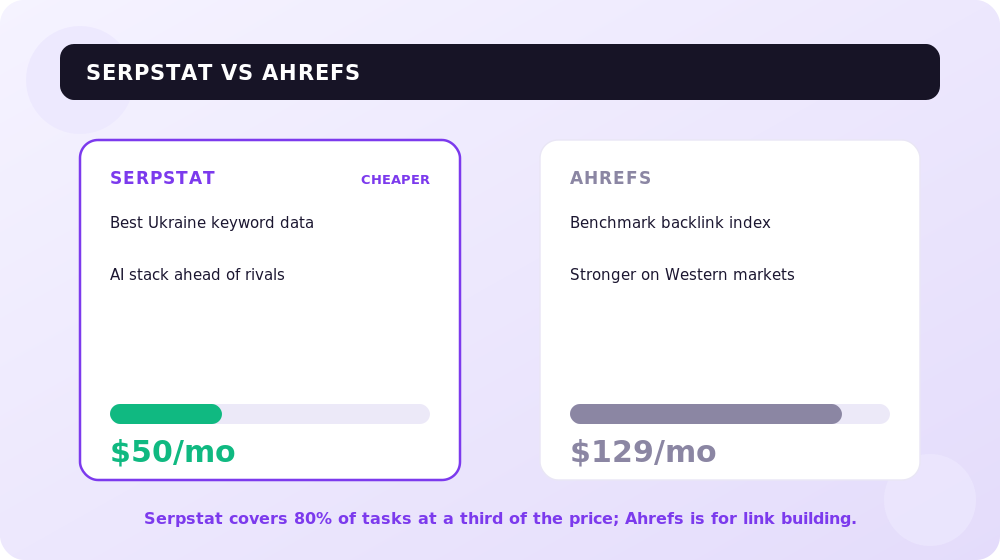
Comparing these three services head-on isn’t quite fair — they sit in different weight and price classes. But everyone faces this choice, so here’s an honest table as of 2026.
| Criterion | Serpstat | Ahrefs | Semrush |
|---|---|---|---|
| Entry price | $50/mo (API and AI from $100) | from ~$129/mo | from ~$140/mo |
| Keywords: Ukraine | Excellent — deepest of all | Average | Average |
| Keywords: US/Europe | Good | Excellent | Excellent |
| Backlink index | Weaker (~1.1 trillion) | Best in the industry | Strong |
| Rank tracking | Generous limits, daily | Tight limits on base plan | Good, but pricey |
| Technical audit | Good, JS rendering from Team | Good | Excellent |
| AI Overviews / LLM monitoring | Strong stack, 140+ models | Available, later and pricier | Available, on expensive plans |
| MCP (ChatGPT/Claude) | From Team | Available | Limited |
| API | Included from Team | Expensive, higher plans only | Separate paid subscription |
| Best for | Ukraine/EU, budget-conscious agencies | Link building, Western markets | Enterprise marketing suite |
Who Serpstat Is Enough For
Let me sum up with the formula I use in consultations:
- More than enough: freelancers and in-house specialists with projects in Ukraine and Europe; small agencies whose core work is keywords, rankings, audits, and competitor analysis; anyone who wants to track their brand’s AI visibility without an enterprise-level budget.
- Enough, with caveats: agencies focused on Western markets — the US databases are workable, but keyword data is worth double-checking; high-volume content projects — keep an eye on credits.
- Not enough: teams whose core business is link building and backlink audits. There’s no way around Ahrefs here, and the sensible setup is a combo: Serpstat as the daily workhorse plus Ahrefs for links.
In 18 years in SEO, I’ve seen dozens of services that promised to “replace everything.” Serpstat doesn’t promise that — it simply covers 80% of an SEO specialist’s daily tasks at a third of the competitors’ price, and in the AI visibility niche it’s currently running ahead of the pack. For the Ukrainian market it’s the default choice; for everyone else, it’s at the very least a mandatory candidate for the 7-day trial.
FAQ
What is Serpstat and what is it for?
Serpstat is a Ukrainian-built all-in-one SEO platform: keyword research and clustering, competitor analysis, rank tracking, technical site audit, and backlink analysis. Since 2025, it has added an AI stack: AI Overviews monitoring, LLM Brand Monitor, and ChatGPT/Claude integration via MCP. It’s used by more than 400,000 specialists.
How much does Serpstat cost in 2026?
With annual billing: Individual — $50/mo, Team — $100/mo, Team x2 — $169/mo, Agency — $410/mo. An annual subscription saves up to 27%. The API, AI tools, batch analysis, and MCP integration are available from the Team plan. There’s a free 7-day trial.
How is Serpstat better than Ahrefs and Semrush?
Entry price (2-3 times lower), the depth of its Google Ukraine databases, generous rank-tracking limits, an API included in the plan, and a mature AI stack — Serpstat shipped AI Overviews monitoring and the 140+ model LLM Brand Monitor earlier than many competitors.
Where does Serpstat fall short of its competitors?
Its main weakness is the backlink index: roughly 1.1 trillion links versus Ahrefs’ noticeably larger and fresher index. For serious link building and backlink audits, Serpstat isn’t enough. Its US keyword databases also trail Semrush in volume.
Is Serpstat suitable for tracking a brand in ChatGPT and Google’s AI answers?
Yes — it’s currently one of its strongest sides. The rank tracker shows queries with AI Overviews and whether your site is cited in them, the Brand Opportunities report finds the AI answers you’re missing from, and LLM Brand Monitor tracks brand mentions across ChatGPT, Claude, Gemini, and 140+ other models.
Can you use Serpstat for free?
There’s no full free plan, but there is a 7-day trial with access to Individual or Team features — enough to run your own site through it, build a test keyword set, and compare a couple of competitors before buying.
Ahrefs Review 2026: Pricing, AI Features, and When It's Worth the Money
An honest 2026 Ahrefs review: plans from $29, the credits model and hidden costs, Brand Radar and AI features, plus a comparison with Semrush and Serpstat.
Read →
Best AI SEO Tools in 2026: A Roundup by Task and Price
A 2026 roundup of the best AI SEO tools by task and price: Ahrefs, Semrush, Surfer SEO, ChatGPT, Claude, Profound, Otterly. Which stack to assemble for your budget — a breakdown from SEOquick.
Read →
Website audit cost in 2026: what the price is built from
31 prices from 13 Ukrainian pages: $33 to $2,035 for the same word. How a report differs from an audit, which free tools still work, which are dead — and what we charge.
Read →Want to apply this to your site?
We will review the current situation, find the first growth levers, and suggest a practical working format.