Meta description in SEO: does description still matter and how to write snippets in 2026
A meta description does not control ranking directly, but it decides whether people click your snippet or a competitor's. Here is how to write descriptions in 2026, why Google rewrites around 70% of them, and how to win the click anyway.


I will look at your site and answer your questions on the topic of this article. 30 minutes, no slide decks, no pressure.
Book a consultationJudging by the title, today we are talking about whether meta descriptions still matter in 2026.
In short: a meta description is not a direct ranking factor, but it is your free ad in the search results. Google rewrites roughly 60-70% of meta descriptions to match the specific query, yet in about a third of cases it shows exactly your text, and that text drives CTR. So descriptions still need to be written by hand, precisely for intent, with a clear reason to click.
Once again the web marketing and SEO promotion industry is full of expert opinions claiming these tags have had their day and should be dropped from the list of important ranking factors.
Other specialists keep insisting that descriptions are still needed, and that promotion success is impossible without them.
Let us figure out who is right and clear up the doubts, relying on current data and Google's official position.
Hey! Yes, you. Looking for traffic to your website? SEOquick will bring you 100% organic!
SEO is your long-term and reliable source of traffic from Google and Bing
We deliver full-cycle SEO: content, reputation, on-page optimization, link building
Our SEO is white-hat, our goal is your spot in the TOP! We know exactly what to do and how. Isn't that what you need?
What a meta description is and what Google thinks about it in 2026
In this section you will learn how Google treats meta descriptions today and what requirements it has for them.
The description meta tag is an HTML attribute meant to briefly announce a page's content. Essentially, it is a summary for the search engine and the user that can appear in the snippet of organic results below the title.
The key idea to grasp right away: a description does not force Google to show your exact text. The search engine decides which fragment best matches the query and often builds the snippet from the page content. According to studies by Ahrefs and Portent, Google rewrites around 60-70% of meta descriptions, and on mobile results that share reaches 71%.
It sounds as if writing a description is pointless. But it is not: in roughly a third of cases on the first page Google shows exactly the text you wrote. And in those 30% of cases your description is what drives the click-through rate.
Why does Google step in at all? The search engine's algorithms stop situations where the description does not match the page content or answers the specific query poorly. The engine wants to show the user the most relevant fragment, so it substitutes its own text wherever yours looks weak, generic, or irrelevant.
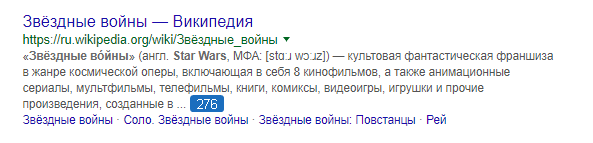
Which leads to a conclusion…
If Google pays this much attention to the modest description meta tag, it is too early to write it off. And the very fact that the system reshapes descriptions on its own speaks to the element's importance, not its uselessness.
At the same time, do not treat the description as a ranking factor. Google officially confirms in its documentation that it does not use meta tags for keyword ranking. The description's influence is purely indirect, through user behavior and click-through rate.
The purpose of a meta description is to improve a page's performance in the results. Google's official Search Central documentation states it directly: a good meta description is a short, accurate fragment that convinces the user the page is exactly what they are looking for.
A well-crafted description can improve a page's click-through rate, motivate the user, increase organic traffic, and, as a result, indirectly influence growth in search. Naturally, this requires optimizing the whole page, not just the description.
Do you want to get free traffic and promote your site? You can handle it yourself as part of SEO promotion or turn to a specialist. Fill in the form above and we will discuss a plan to grow your business.
Why some experts think differently
Want to know why some specialists are convinced meta descriptions are useless, and on what basis they reached that conclusion? Let us examine their arguments.
The main argument of the "description is dead" camp is the large room for manipulation that search engines want to stop. That is exactly why Google so often replaces author descriptions with its own.
The second argument is that this tag does not directly form a page's ranking. The influence is purely indirect, through user behavior. Only some optimizers still try to cram more keywords into the description, mistakenly believing it will boost positions.

The fact that the world's leading search engine does not treat descriptions as a ranking factor makes some people think meta descriptions are not needed at all.
But that is not the case
Google genuinely wants to keep meta descriptions relevant. But there are a few conditions for site owners:
- the description must truly match the page content;
- the content of your site's pages must be unique;
- the description must precisely match the query intent, not just contain keywords.
Google needs every description for one key goal: to give the user information for a more convenient and faster choice. It is naive to think the engine will abandon descriptions and make it harder to find the right pages.
And yes, this is nearly the only snippet element fully controlled by the site owner (or their optimizer). In terms of impact on the click it stands right after the title.
Imagine for a second that the description directly influenced ranking. That would be a generous gift to black-hat optimizers, who would push manipulation to insanity: keyword stuffing, outright deception of the user.
Now imagine the engine decided to drop descriptions from the results entirely. How would the user decide whether to click through? Search would turn from deliberate into guesswork, because the title alone clearly is not enough information.
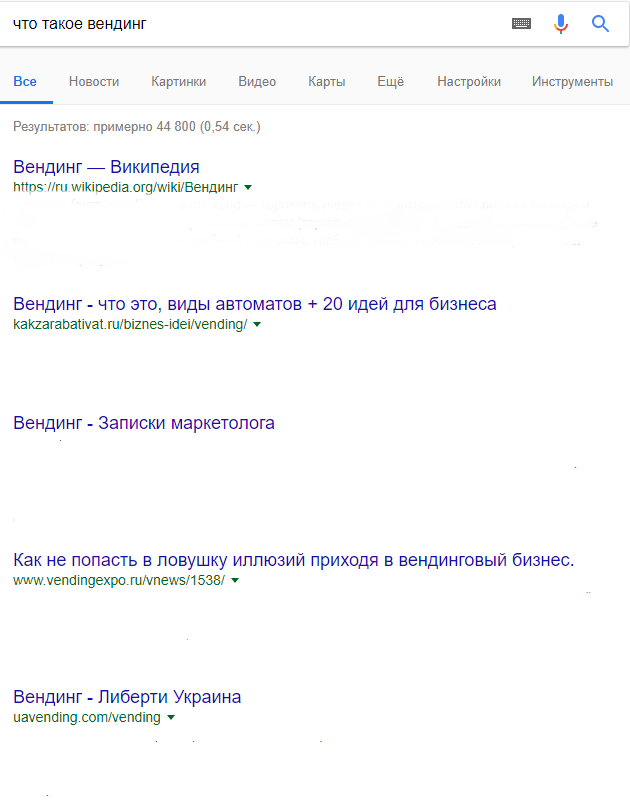
Here is an example of results where descriptions are effectively assembled by the system automatically:
Is there a future for meta descriptions in the AI Overviews era
2026 added new context. AI Overviews (Google's generative answers) now appear for a significant share of queries and change how the results look. It is important to understand the difference: an AI Overview generates its own text and cites sources, whereas a regular snippet with your description appears under the classic blue link.
What does this mean for the description? Less than the alarmists claim. Even with an AI block present, classic organic results with snippets are not going anywhere, and people still click them. The description, together with the title, remains what makes a user choose you among a dozen similar links.
It is worth noting separately that meta description and og:description are different tags for different jobs. The description works for search results, while og:description controls how the link looks when shared on social networks and messengers. They should not be confused or blindly duplicated: they have different audiences and different rules.
It is unlikely the purpose of the description meta tag will change soon. Despite constantly evolving algorithms and the rise of AI search, the snippet remains a fixed element of the results. If you create a unique, useful description, you literally "steal clicks" from competitors.
Learn more current information about meta tags in our video.
Recommended reading:
How professionals write meta descriptions in 2026
This is the most interesting part: detailed instructions for using meta descriptions. You will learn the rules that help your description actually appear in Google's results, and the secrets of effective, clickable descriptions.
Web marketers and SEO specialists need to work with descriptions and the rest of the metadata consistently and thoughtfully. Metadata is the foundation of a site's appearance in organic search, and it is one of the few elements you fully control.
Treat every description as free micro-advertising for your page in the results. It is foolish to ignore that opportunity or to fill the description in carelessly.
Use the description as a tool for communicating with the user: tell them the page has the answer to their question. And make sure it is true, by backing the promise with relevant content on the page itself.
The engine prefers a descriptive style, but that does not stop you from adding hooks: calls and arguments that motivate a click. A well-crafted description helps your site stand out and gather more quality clicks.
Speaking of the description, you cannot skip the title. Although they go in one bundle, their influence differs: it is the title by which the search engine understands what is on the page. An empty or generic description usually hurts behavioral factors, while a wrong title can bury your promotion. Our separate article will help you sort out title requirements.
How to get your description shown in Google's results
The rule is simple: if you create a description that precisely matches the query and the page, Google has far fewer reasons to rewrite it. Here are the main rules for 2026:
- Optimal length is around 150-160 characters on desktop and 110-120 on mobile. Google truncates the snippet at roughly 920 pixels on desktop and 680 on mobile, so aim for readability rather than an abstract character count. The main thing is to finish the thought.
- Front-load: put the most important parts (the key query, the value, the call to action) in the first 120 characters. They are the ones guaranteed to make the snippet even when truncated on mobile.
- Use the search query once and naturally. No keyword spam or repetition: it makes the engine suspicious and triggers a rewrite.
- Calls to action are allowed and useful. "Learn", "Order", "Get", "Compare" — a clear prompt raises motivation and directly affects CTR.
- Numbers and facts work. "18 years on the market", "free delivery", "results guaranteed" — specifics motivate a click better than vague words.
- Uniqueness — 100%. Duplicate descriptions across pages confuse both users and the engine, provoke keyword cannibalization, and signal low site quality. Every important page gets its own description.
- Write for a human, not a robot. Put yourself in the audience's shoes: which argument matters to them, which answer they seek, which call works.
Naturally, conversion growth depends not only on description quality but also on how relevant the page content is. To keep descriptions displaying reliably, it is important to keep the whole technical base of the site in order — a regular technical site audit helps with that.
Writing meta descriptions for commercial pages: a step-by-step guide
These recommendations help you create descriptions that appear in the results and increase click-through rate for commercial pages. Let us begin:
- Put the key query at the start. It is the main "anchor" for the user, showing the page has what they want.
- Add a commercial prefix. For naturalness, words like "buy" and "order" can sit next to the key query.
- More specifics — models, specs, delivery region.
- Add benefit information. You cannot mention everything, so pick the main points: discounts, an official warranty, free delivery.
- Add a hook — a call to action tied to specific information.
- If needed, include contact details or working hours.
- Emojis are allowed and help you stand out, but only when on-topic and never as a substitute for keywords.
Writing commercial meta descriptions is good, but not enough to promote a storefront.







For commercial pages to truly convert clicks into leads, descriptions must rest on a well-built semantic core: only then will you hit the user's real intent.
How to test meta descriptions: a working cycle
A description is not something you write once and forget. The best teams treat it like an ad that can and should be improved with data.
- In Google Search Console, find pages with many impressions but a low CTR relative to their position peers. These are the first candidates for a rewrite.
- Rewrite the title and description together — they work as a pair.
- Add a visible block on the page that backs the promise from the snippet.
- After 2-4 weeks, compare CTR and the number of leads before and after.
- Record the wordings that worked and scale them to similar pages.
Frequently asked questions
Does a meta description affect ranking in Google?
No, not directly. Google officially does not use the description as a keyword ranking factor. The influence is indirect: a good description raises CTR, and behavioral signals can then show up in positions.
Why does Google rewrite my description?
Most often because your text answers the specific query worse than a fragment from the page, or looks generic, spammy, or irrelevant. Studies show Google rewrites 60-70% of descriptions. To reduce the chance of a rewrite, make the description precise, unique, and relevant to intent.
How long should a meta description be in 2026?
Aim for 150-160 characters on desktop and 110-120 on mobile. Technically Google truncates the snippet by width (about 920 pixels on desktop), so it matters more to finish the thought and front-load the key parts in the first 120 characters than to chase an exact character count.
Should you put keywords in the description?
Yes, but once and naturally. A keyword at the start helps the user and is bolded in the snippet. Keyword spam, on the other hand, hurts: it prompts Google to rewrite your text and reduces readability.
What should you do about duplicate meta descriptions?
They need to be eliminated. Identical descriptions across pages confuse the engine, provoke keyword cannibalization, and signal low site quality. A technical audit helps find duplicates, after which each important page gets a unique description.
Is this the same as og:description for social media?
No. A meta description works in search results, while og:description controls the preview when a link is shared on social networks and messengers. These are different tags with different audiences, and they should be written differently.
Conclusions
Invest time in creating quality meta descriptions, titles, headings, subheadings, and image alt attributes — and you will see a positive effect on CTR.
Avoid keyword stuffing (one query is enough), prevent duplicates, write concisely, and finish the thought. Write descriptions for people, not robots: add specifics, benefits, and a call to action.
Remember the main point: in 2026 Google rewrites most descriptions, but the remaining impressions are your chance to win the click from a competitor. This is a strategic method: the relevance of meta tags does not decline, so the effort pays off continuously.
Successful promotion is the result of a whole set of correct actions. We have gathered many SEO tools that will help you improve your project, reach high positions, and boost conversion without extra costs.

Website audit cost in 2026: what the price is built from
31 prices from 13 Ukrainian pages: $33 to $2,035 for the same word. How a report differs from an audit, which free tools still work, which are dead — and what we charge.
Read →
Search Everywhere Optimization: Ranking on TikTok, YouTube, Reddit and AI Search
Your customer does not only search on Google: 49% of consumers search on TikTok, Reddit pulls 842M organic clicks a month, and YouTube is the source of roughly one in four AI Overview citations. Here is how a business owner picks 2–3 platforms without burning the budget.
Read →
AI Content and Google in 2026: What Actually Gets Penalized (Spoiler — Not AI)
Google does not penalize text for being written by AI — that is the official position. Here's what scaled content abuse really is, what changed after the 2026 updates, and how to publish AI content that still ranks.
Read →Want to apply this to your site?
We will review the current situation, find the first growth levers, and suggest a practical working format.