Facebook Contests in 2026: 10 Mechanics and 9 Rules for Effectiveness (With a Case Study)
Meta's rules were rewritten in 2026, and the old like-share-tag tricks no longer work and now cut your reach. We break down the current contest mechanics, targeting via Advantage+, and a real case where the cost per result was cut in half.


I will look at your site and answer your questions on the topic of this article. 30 minutes, no slide decks, no pressure.
Book a consultationA Facebook contest still works in 2026 — but by new rules. Meta officially bans like-share-tag mechanics and cuts reach for engagement bait, while Reels deliver 22% more organic reach, and contest targeting via Advantage+ Audiences now finds the right people more cheaply. Below are 10 working mechanics, 9 rules for effectiveness, and a real case where smart targeting cut the cost per result in half.
Facebook remains the world's largest social network: its monthly audience has long passed 3 billion active users. It has people of every age and interest — from those ordering food delivery and flower bouquets to those buying construction aggregates and changing cars often.
And they all share one thing — a readiness to communicate. That is exactly what you should leverage: run contests that engage your audience and promote your brand.
Why contests? They are still one of the most cost-effective engagement tools. According to recent data, contests and giveaways generate over 500% ROI — about $5 returned for every $1 spent — and accounts that run giveaways regularly grow roughly 70% faster than the rest. A contest can simultaneously grow your audience, draw attention, and lift sales for a company that has its own Facebook group.
There is no reason to neglect such a tool. But in 2026 it is crucial to play by Meta's updated rules — otherwise, instead of growth, you may get your reach throttled.
Looking for traffic to your website? SEOquick will bring you 100% organic!
SEO is your long-term, reliable source of traffic from Google and Bing.
We deliver comprehensive SEO promotion: content, reputation, on-page optimization, link building.
Our SEO is white-hat, and our goal is to get you to the TOP! We know exactly what to do and how. Isn't that exactly what you need?
What a Facebook contest is and Meta's 2026 rules
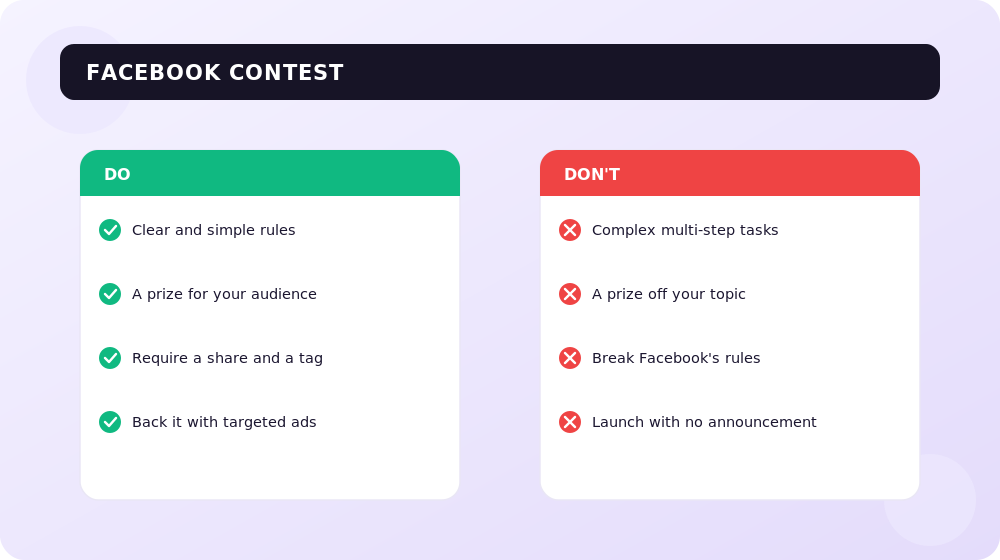
In Meta's terminology, a "contest" and a "promotion" are the same thing. A promotion is defined as an event with an element of chance and a prize, in which registered users participate.
The main thing to grasp before launching in 2026: the Pages, Groups and Events Policies have become noticeably stricter. Here is what matters.
- The venue. A promotion can only be run on a Page, in a Group, or in an Event — not from a personal profile.
- A disclaimer is mandatory. The contest rules must explicitly state that the promotion is not sponsored or administered by Meta, and that participants provide their data to your business, not to the platform.
- You can't force sharing. Meta no longer allows requiring a share to a personal timeline or a mandatory friend tag as a condition of entry. That is a direct policy violation.
- What is allowed. A comment under a post, a Page like, tagging a friend in comments (optional, not as a condition), and registering on a landing page or a tabbed app are all legitimate entry mechanics.
The problem of engagement bait stands apart. Calls like "like to win," "share to participate," or "tag 3 friends" are recognized by Facebook's algorithm and pushed down in the feed. Pages that do this regularly lose reach on a permanent basis. So in 2026, a contest must be built not on manipulating the mechanics, but on genuinely interesting content and a valuable prize.
5 questions before launching a contest
Before launching, you should answer five questions — they define your goals, budget, audience, and legality.
What is the goal of the contest?
- Growing your follower count?
- Increasing brand awareness?
- Building an email list?
- Collecting user-generated content (UGC)?
- Boosting audience activity?
- Drawing attention to a new product?
- Increasing sales?
The answer sets adequate KPIs against which you can later honestly assess effectiveness.
Is the contest's legality covered?
Prepare and publish — on the page or on an external resource linked from Facebook — the contest rules, entry rules, dates, the winner-selection mechanism, the organizing company, and the mandatory disclaimer about Meta's non-involvement.
Who is your target audience?
Knowing your audience solves two tasks. First, hitting their interests — not offering young mothers a "guess the motorcycle brand" contest. Second, it is the foundation for promotion via targeted advertising.
What budget are you aiming for?
You can put the entire budget into prizes and promote the contest for free — or set aside part of it for paid promotion and gather many times more participants.
How will you choose the winner?
The simplest way is a random pick via a random-number generator; it suits cases where the prize is awarded for the mere fact of entry. For the best photo or story, a committee of 2-3 company representatives can choose the winner. You can also pick by number of likes.
Recommended reading:
10 contest mechanics for Facebook
From a prize for a comment to slogan and Reels-video contests. Let's go through the main formats and their specifics in 2026.
1. Photo or video (Reels) contest
Participants post their own photos or videos. Cats, kids, families, travel, and photos with brand products perform well. In 2026 the Reels format is especially strong: short vertical video gets 22% more organic reach and 67% higher engagement than regular posts, and the algorithm shows it to a new audience first.
2. Idea contest
How do you sell candy in an unexpected way? Bicycles? Mattresses? Participants generate dozens of ideas, and some of them will genuinely help your business.
3. Best comment contest
Participants comment on the starter post; the best one is determined by likes. A simple mechanic, fully compatible with Meta's rules.
4. Most creative photo caption contest
You can come up with an unexpected caption for any image — see for yourself.
5. Best slogan contest
Developing a slogan is no easy task. A themed contest hands it over to the "power of the internet," and participants will happily promote the campaign themselves.
6. "Solve the riddle / puzzle" contest
Both kids and adults love solving riddles — such contests can attract many participants.
7. Most creative review contest
It is important to state in the rules that only real customers may participate — otherwise Facebook may deem the reviews fake and ban the page.
8. Prize drawing among followers
This helps quickly build an audience for a young page: simply follow it, with no forced reposts (which also aligns with Meta's new rules).
9. Best continuation of a proverb or song line contest
It activates the creative part of your audience. It makes sense once you already have a core of loyal followers — otherwise no one will notice the activity.
10. Best user-generated content (UGC) contest
Ideal for product makers: run a contest for the best recipe using your products. UGC today is one of a brand's most powerful assets: user content increases conversion by 29%, and 92% of people trust recommendations from ordinary people more than brand advertising. The content you collect can be used on your site and blog, crediting the authors.
Hack: you can spy on ideas from competitors using Serpstat — see what activities they have run.
How to make a Facebook contest successful: 9 rules
Some contests go unnoticed, collecting just 2-5-7 likes. If you are investing effort and budget, that is definitely not your scenario. Here are nine rules for effectiveness.
Rule 1. Choose a relevant, appealing prize
For purebred-dog lovers — a show leash; for moms — educational games. The prize must carry value and promote the brand, so it is best to give away something from your own product range, not no-name souvenirs. And certainly not competitors' products.
A good example from practice: a red-fish supplier, "Svoya Rybka," ran a New Year's eve drawing for a basket of red fish and got 1,100 comments — a prize pool from its own range worked perfectly.
Rule 2. Work on the copy of the contest post
Be sure to specify:
- when the drawing will take place;
- what the prize is (with an appealing description);
- what to do to participate;
- how many winners there will be;
- how and when you will contact the winner;
- entry restrictions.
Restrictions are most often needed to filter out professional "prize hunters" — for example, excluding profiles without a real name and photo, or those clogged with promotional reposts.
Rule 3. Use a bright image or video
The image should stand out in the feed, but without text overload. In 2026 it is better to bet on original content you shot yourself: Facebook now prioritizes material created by the author/page itself rather than reposts, and especially values vertical 9:16 Reels of 3-90 seconds.
Rule 4. Don't drag it out
A month-long contest will either get lost in the feed or "wear out its welcome." The optimal duration is 7-14 days: enough to gather participants but not to tire your audience.
Rule 5. Use hashtags
A standard #contest_name or relevant hashtags will help interested people find information about the contest.
Rule 6. Account for the platform's 2026 logic
The main ranking signal today is saves and DM shares — they are valued above reactions and comments. Make content people want to save or send to a friend. Cross-promotion in Facebook-friendly Instagram still works great.
Rule 7. Use free promotion
Announce the contest on your website (with a link to the group), on Instagram, in themed Facebook groups (pet lovers, veterinarians — for a pet-photo contest), and in your city's groups for a local campaign. Post reminders: how many are already participating, how many days are left. And generously hand out discounts to participants — it stimulates sales.
Rule 8. Add paid promotion and contest targeting
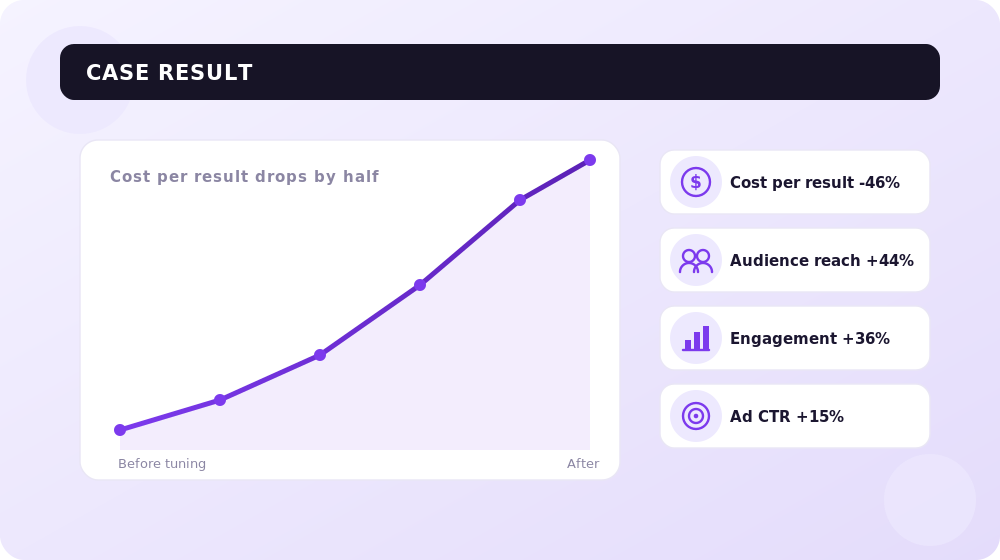
Here it is critically important to know your audience. Let's show this with a real case. An SMM team launched a contest for a food producer and segmented the audience very narrowly to understand who to target the post at. They created separate test ads for each segment.
It turned out that the best responders were active women aged 20-35 interested in shopping and fashion. At an average cost per target action (like, comment) of about 12 units, in this group the cost turned out to be half as much — around 6.5. The same contest, but precise targeting cut the cost per result in half.
In 2026, Advantage+ Audiences makes this work noticeably easier. You provide hints by age, geo, and interests, and Meta's AI uses them as a starting point and finds similar users who convert more cheaply on its own. According to Meta, Advantage+ campaigns deliver an average +22% to ROAS, and Advantage+ Creative saves about 14% on cost per result. Track effectiveness in Ads Manager.
An important note on the rules: the "tag a friend to share the prize" hack used to double reach beautifully, but a mandatory tag is now banned. In 2026, phrase it gently — invite people to tag a friend optionally, with no tie to entry, so you don't fall under engagement bait.
For those combining targeting with other channels, it is useful to read about PPC advertising, video marketing, and search engine optimization.
Rule 9. Include a "Permission to use participant content" clause
State that texts, photos, and videos entered in the contest may be used on company resources and in advertising. This protects you from claims by the authors.
Frequently asked questions
In 2026, can I require a share and friend tags to enter?
No. Meta prohibits making a mandatory share to a personal timeline or a forced friend tag a condition of entry. An "optional" tag is allowed, but not as a requirement. For like-share-tag mechanics, the algorithm cuts your reach as engagement bait.
What is engagement bait and why does it reduce reach?
These are "engagement lures" — calls to react, comment with a specific word, share, or vote for an artificial boost. Facebook recognizes such posts and pushes them down in the feed, and repeat-offender pages see their reach drop permanently.
Do I need a Meta disclaimer in the contest rules?
Yes, it is a mandatory requirement. The rules must explicitly state that the promotion is not sponsored or administered by Meta, and that participants provide their data to your business, not to the platform.
Which content format works best for a contest in 2026?
Reels. Short vertical video gets 22% more organic reach and 67% higher engagement than static posts, and the algorithm shows it to a new audience on its own. Bet on original content you shot yourself.
Should I use Advantage+ to promote a contest?
Yes, if there is a sufficient flow of target actions and several creatives. Advantage+ Audiences takes your audience hints as a reference and finds cheaper conversions on its own; on average this delivers +22% to ROAS.
What is the optimal contest duration?
7-14 days. That is enough to gather participants with a correctly set theme, goal, and audience, but not enough to tire your followers' feed.
Conclusions
A contest is a working marketing tool that in 2026 still solves several tasks at once: from gathering followers to growing sales through participant discounts. But you have to play by the new rules.
For a contest to get noticed and appreciated, three conditions are needed:
- Hitting your audience's interests.
- Virality and content value. It must not be boring or made without soul — especially when the feed is filling with AI content, authenticity is valued above all.
- Smart promotion — free plus precise targeting, which, as the case showed, can cut the cost per result in half.
Follow Meta's rules, bet on Reels and original content, use Advantage+ — and the effect of your Facebook contest will be positive.
Types of Promotions on Facebook and Instagram in 2026: 10 Tips to Grow Reach and Brand Awareness
Why run promotions on Facebook and Instagram in 2026. 7 promotion types, the Awareness objective in ODAX, Reels and Advantage+, Brand Lift measurement, and real campaign examples.
Read →
How to Write Sales Copy: Structure, 8 Formulas, Ready-Made Templates and Examples
Sales copy without fluff: the structure of a page that sells, 8 formulas (AIDA, ODC, PMHS…), a real first-screen breakdown, ready-made templates and prompts, SEO logic and metrics. SEOquick’s experience: a ×7 traffic case built on commercial pages.
Read →
SEO Case Study for Binary Options Affiliate Sites
A practical guide to promoting sites that earn from binary options broker affiliate programs (Quotex, Pocket Option and others). Up-to-date strategies, geo-targeting nuances and link cloaking for maximum revenue in 2026.
Read →Want to apply this to your site?
We will review the current situation, find the first growth levers, and suggest a practical working format.