Instagram Ad Formats in 2026: Which to Choose So You Don't Waste Your Budget
Reels, Stories, feed, carousel and Shop: we break down every Instagram ad format for 2026 — with up-to-date sizes, durations and a clear answer on what converts best.


I will look at your site and answer your questions on the topic of this article. 30 minutes, no slide decks, no pressure.
Book a consultationIn short: in 2026 the main Instagram ad format is vertical 9:16 video in Reels and Stories. Reels already account for roughly a third of all Instagram ad impressions, with the lowest CPM and the highest click-through to the website. For sales, you add carousel, collection and Shop ads with a catalog on top of video, and you hand placement distribution to Advantage+.
Marketers, business owners and bloggers run Instagram ads all the time — yet more and more of them complain about wasted budget and a trickle of clients.
And it's not the fault of "bad Instagram algorithms" or "complicated setup." Most often the problem is the wrong choice of ad format and creative built for the wrong placement.
In 2026, Instagram is first and foremost a video platform: Reels account for about half of all the time people spend in the app, and the network itself has over 2 billion monthly active users. The most effective way to turn that audience into clients is official paid advertising — and the cost per lead now depends on your skill and your format.
For how to set up targeting, read "Catching clients with great photos: Instagram targeting setup (guide)." And below is a breakdown of every current format for 2026.
You can't see it yet, but it's there! Find out how SEOquick will give you traffic
We'll smartly set up context on Google Ads with fat traffic and a high return on investment.
We'll precisely select the type of advertising that is relevant to your business and brings profit.
Our targeting always hits the mark!
Instagram advertising stopped being "one picture in the feed" long ago. Today you have at least seven working formats, and each one solves its own task: from reach and awareness to direct sales from a catalog. Let's go through them in order, with up-to-date 2026 specs.
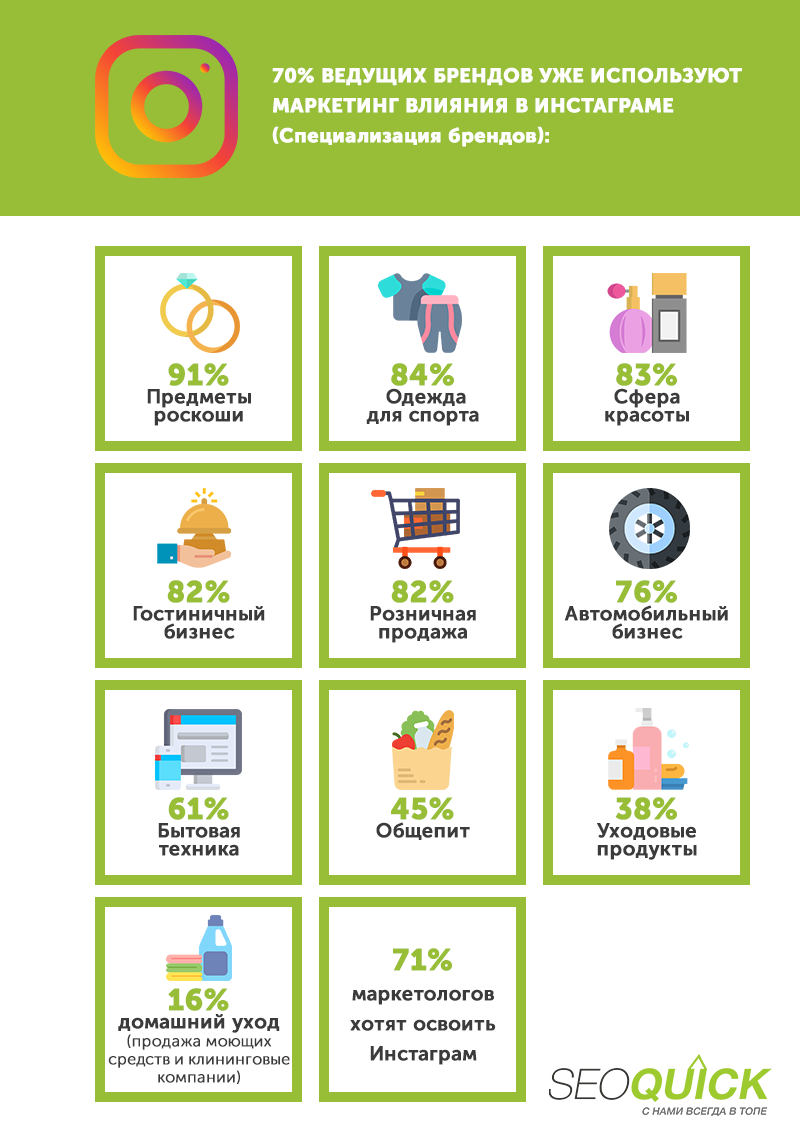
Which Instagram ad formats exist in 2026
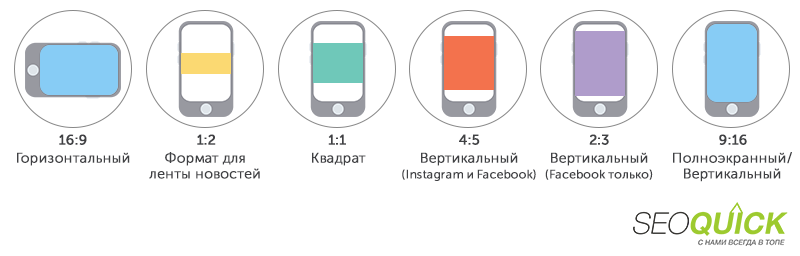
If you don't yet understand how 9:16 differs from 1:1 and 4:5 and why aspect ratios matter at all — this section is for you. Format is the first thing your audience sees. If the creative is in the wrong ratio, Instagram crops the edges to fit its requirements, and important accents, text or the CTA simply disappear.
1. Reels ads — the No. 1 format in 2026
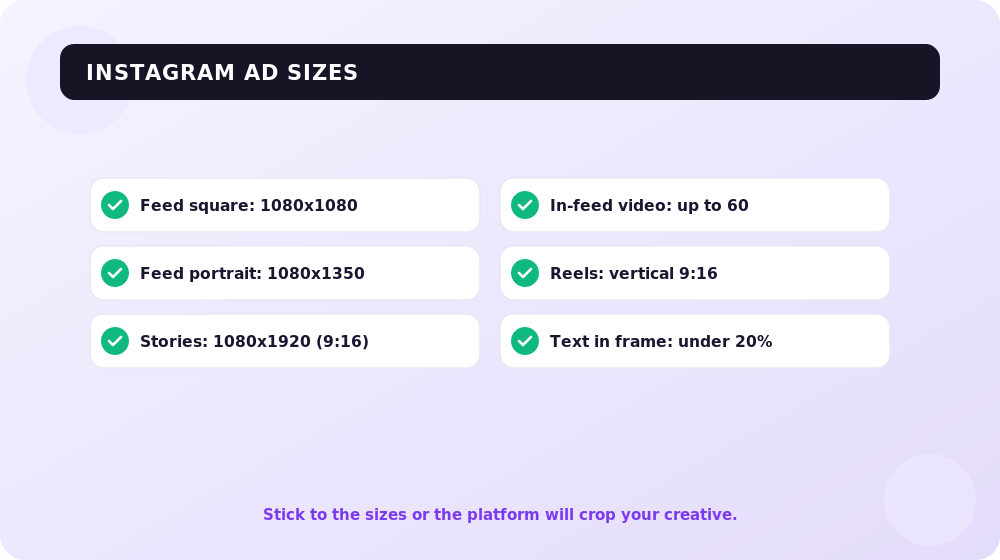
Reels are the strongest Instagram ad format in 2026. This is full-screen vertical video 9:16 (1080×1920 px). According to the platform, Reels account for roughly a third (≈33%) of all Instagram ad impressions — a year ago it was around 19%. The format has the lowest CPM (about $4–7 vs. $10–15 in the feed) and a markedly higher click-through to the website: a static image loses to short video on CTR by tens of percent.
Technically a clip can run up to 3 minutes, but the recommended "working" range is up to 90 seconds, and 15–30 seconds converts best. Keep what matters in the central safe zone: leave about 250 px clear at the top and 340 px at the bottom so the profile name and CTA button don't cover the message. Sound is a must: ads with sound outperform muted ones in engagement by about a third.
2. Stories ads
Stories use the same specs — full-screen vertical 9:16 (1080×1920 px) with safe zones top and bottom. It's the ideal format for short promos, announcements and retargeting: the content is ephemeral, fills 100% of the screen and works well on a "warm" audience. Stories usually take 10–20% of efficient spend — as a complement to Reels and the feed.
3. Feed ads: photo and video
The feed supports 1:1, 4:5 and 1.91:1 ratios. In 2026 the default for the feed is the vertical 4:5 format (1080×1350 px): it occupies roughly 20% more space on a phone screen than a square and performs better on mobile. The 1:1 square (1080×1080 px) remains universal and is used in carousels. The feed delivers the largest volume of conversions thanks to broad reach and high-intent users.
4. Carousel
A carousel is 2 to 10 cards the user swipes through. Build cards in 1:1 (1080×1080 px): Instagram crops 4:5 cards to a square and cuts off the top and bottom of the creative. Video per card runs up to 60 seconds. Carousels generate roughly 20% more engagement than a single image and are perfect for showing a product from different angles, telling a step-by-step story or assembling a mini case study.
5. Collection
Collection combines the swipeability of a carousel with the power of a catalog: a hero photo or video on top, products from your product feed below. A tap opens an Instant Experience (a mini storefront inside Instagram) where the person picks a product without leaving the app. Per Meta's data, Instant Experience drives higher engagement and lower cost per conversion than regular link clicks. It's the ideal format for e-commerce and high-AOV products — especially with a strong hero video.
6. Shop ads and dynamic product ads
Shop ads pull products straight from the catalog: the person lands on an in-app product page and can buy without leaving Instagram. This also includes dynamic product ads (DPA) — they automatically show relevant products to people who already interacted with your site or app. It's one of the most effective 2026 formats for online stores: the key to results is an up-to-date catalog, correct tags and daily syncing of prices and availability.
7. Explore ads
Explore ads appear in the Explore tab, where people go specifically to discover something new. They look like regular posts with a "Sponsored" label and work well for reach and awareness: the audience here is open to new brands and products.
You can't point to one single "best" format — it all depends on the task and the audience. For a 50+ audience, a clear image and text often work better than fast effects. For 18–35 it's the opposite: the more dynamic and native the video, the higher the chance it gets shared. The main principle of 2026: start with vertical 9:16 video, and add the other formats for a specific goal. More on video as a sales channel is in our video marketing section.
Key requirements for photos and videos in Instagram ads
Not every technically perfect image or video will work well in advertising. Sometimes a quick clip with a real customer brings more clients than an expensive studio shoot. Here are the basic requirements for ad creative.
- Good quality. Poor graphic quality is subconsciously read as "cheap product." Shoot and export at maximum resolution — for video that's MP4/MOV with H.264, 30 fps, up to 4 GB (and ideally under 1 GB for reliable uploads).
- Don't try to "push" your product. The best ad is one without a direct "buy, discount, we've been on the market for 20 years." It sells itself. A good no-pressure example is the Oreo clip about cookies at a picnic.
There's no aggressive call to buy — there's a play on nostalgia and the picnic atmosphere, which gives rise to the desire to buy cookies and head outdoors.
- Pick one technique and don't mix. Either focus on the product or a complete scene. An example of product focus is the Adidas and Prada collaboration: attention is entirely on the sneakers and bag, with no distracting details.
No bright walls, people or loud music — only the products being advertised. This technique is ideal when you need to highlight details and texture.
- Remember emotions. Purchases are made on emotions — both positive and negative. For example, Audi focused not on the car but on the actress's confident gaze and smile: "Want to be as confident in the future as I am — choose Audi."
You can barely see the car, but the ad works on association and feeling. The takeaway is simple: don't turn your ad into a teleshopping channel. Show what good your product brings into life — and people will want to buy it themselves.
Recommended reading:
What converts better on Instagram — photo or video?
The short answer is video. And in 2026 the gap has become even more noticeable.
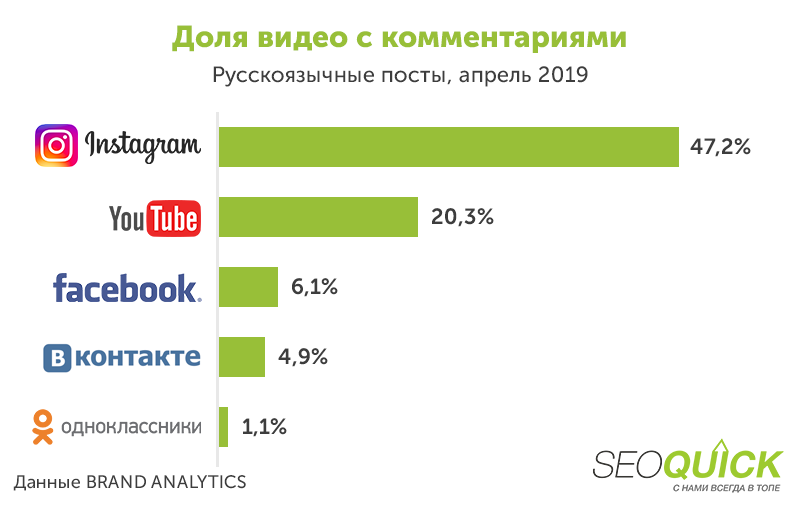
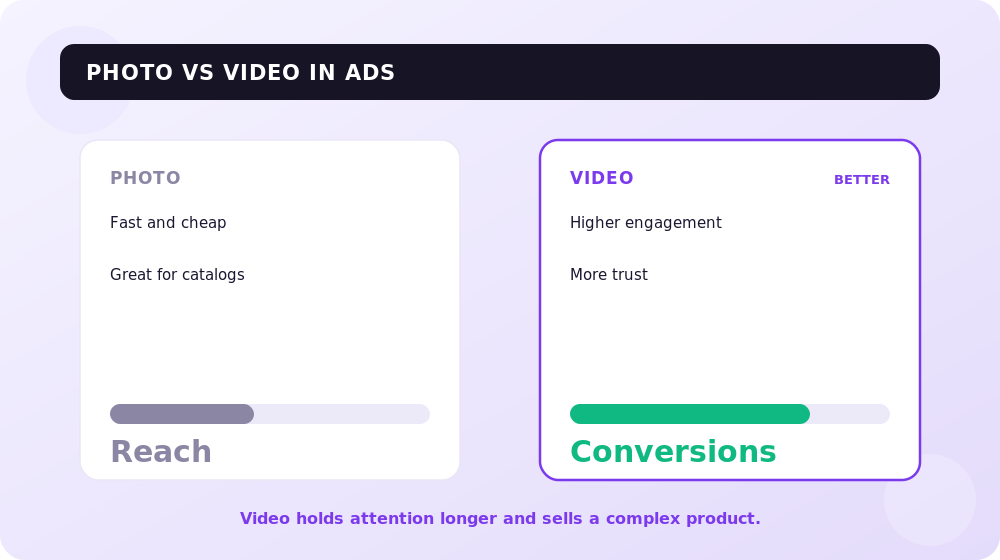
Video sparks more emotion and discussion: people don't just like, they ask about price and availability, tag friends, leave reviews — and that's extra reach. Per the platform, video delivers roughly 20% more engagement than static, and Reels bring tens of percent more clicks to the website. Short video under 15 seconds consistently shows the highest engagement.
Why people trust video more
People look for authenticity. A static photo is easy to "fix" in an editor, but a moving person turning a product in their hands and showing it from all sides is harder to fake. So video is perceived as a more honest format — as if you're dealing not with a picture but with a live seller.
A few practical tips for ad video:
- Don't be afraid to be human. Real emotions, imperfect takes and behind-the-scenes moments build trust — people understand they're buying from real people.
- Show the product as it is. Don't hide flaws: upon receiving the order the buyer will see them anyway, and trust in you will vanish.
- Make a strong hook in the first 3 seconds. The working Reels-2026 formula: a catchy hook → problem → product demo or social proof → a clear CTA at the end.
The main trend of 2026 — short vertical video and Reels
If in 2020 Stories were the trend, in 2026 the entire Instagram rests on short vertical video. Reels take up about half of all time in the app, and the algorithm actively serves them even to people who don't follow you — over half of Reels views come from non-followers. For an advertiser that means one thing: vertical video delivers the cheapest reach to a new audience.
The secret is that Reels and Stories fill 100% of the screen: even if a person isn't very interested, the first 2–5 seconds of their attention belong entirely to your clip. And there are none of the usual "distracting" feed elements here — just your creative and the profile name, which is intriguing in itself.
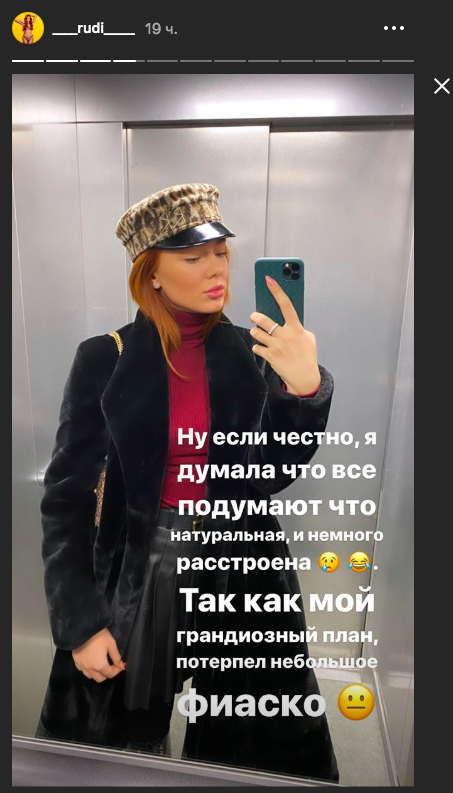
Emotions in such ads also work toward the result — both negative and positive. A blogger might post a Story about ecology and animal suffering, and the next frame is a photo in a faux-fur coat from a specific store. It hits home, motivating people to follow the link and place an order.

For Instagram ads to deliver and be backed by search traffic, it makes sense to connect them with other channels — for example, with website search promotion and PPC advertising in Google.
Instagram ad sizes cheat sheet 2026
To avoid resizing creatives by hand, keep the key parameters handy. 2026 tip: most campaigns only need two source assets — 9:16 (1080×1920) for Reels/Stories and 1:1 or 4:5 for feed and carousel. Leave placement distribution to Advantage+ — the system adapts the creative to each placement.
| Format | Ratio / size | Video duration | Best for |
|---|---|---|---|
| Reels | 9:16 — 1080×1920 px | up to 90 sec (best 15–30 sec) | Reach, sales, new audience |
| Stories | 9:16 — 1080×1920 px | up to 60 sec | Promos, announcements, retargeting |
| Feed | 4:5 — 1080×1350 px (or 1:1) | up to 60 sec | Conversions, reach |
| Carousel | 1:1 — 1080×1080 px, 2–10 cards | up to 60 sec per card | Product line, storytelling |
| Collection / Shop | Hero 1:1 or 9:16 + catalog | depends on hero | E-commerce, catalog sales |
Technical minimums: photo — JPG or PNG, video — MP4 (H.264, 30 fps), up to 4 GB.
FAQ about Instagram ad formats
Which Instagram ad format converts best in 2026?
In most niches the best start is Reels: vertical 9:16 video with the lowest CPM and the highest click-through to the website. For online stores you add collection and Shop ads with a catalog, and for a product line — carousel.
What video size do I need for Reels and Stories ads?
9:16 — 1080×1920 px. Leave about 250 px clear at the top and 340 px at the bottom for the interface. Technically a clip can run up to 3 minutes, but for sales it's better to stay within 15–30 seconds.
Which format should I choose for the feed — square or vertical?
In 2026 the default for the feed is vertical 4:5 (1080×1350 px): it takes up more screen space and works better on mobile. The 1:1 square (1080×1080 px) remains universal and is required for carousels.
How many cards can I add to a carousel?
From 2 to 10. Build cards in 1:1, otherwise Instagram crops the top and bottom of the creative. Video per card is up to 60 seconds. A carousel delivers roughly 20% more engagement than a single image.
What is Advantage+ and do I need to choose placements manually?
Advantage+ is Meta's automatic placement system: you upload several source assets (usually 9:16 and 1:1), and the algorithm distributes impressions across Reels, Stories, feed and Explore and adapts the creative to each spot. In most cases this is more effective than manual distribution.
Video or photo — what should I shoot first?
Video. It delivers roughly 20% more engagement and a markedly higher click-through to the website, and short clips under 15 seconds consistently lead on metrics. Start with vertical video and keep photos as a complement.
Conclusions
Beautifully shot, well-configured official advertising is the only truly stable way to attract clients on Instagram in 2026. The main thing is to choose the right format for the task: vertical 9:16 video in Reels as the foundation, carousel and collection for products, Shop ads for direct sales from the catalog.
Keep the current sizes in mind, make native vertical video with sound and a strong hook in the first 3 seconds — and trust placement distribution to Advantage+. Then your budget will work toward results, not toward "waste."

Best AI SEO Tools in 2026: A Roundup by Task and Price
A 2026 roundup of the best AI SEO tools by task and price: Ahrefs, Semrush, Surfer SEO, ChatGPT, Claude, Profound, Otterly. Which stack to assemble for your budget — a breakdown from SEOquick.
Read →
Agentic Commerce: How to Prepare Your Online Store for AI Agents That Shop
Agentic commerce in 2026: the ACP and UCP protocols, why in-chat checkout stalled, and what a store owner must fix in the feed, prices and stock so an AI agent picks you.
Read →
Best B2B SEO Agencies in 2026 and What They Charge
A breakdown of the US B2B SEO market: a published range of $3,000–50,000+ a month, an entry point around $5,000, and why the comparison pages that close your deal are written by your competitors. Our own prices and cases are on the same chart, honestly — including the row that fails its own test.
Read →Want to apply this to your site?
We will review the current situation, find the first growth levers, and suggest a practical working format.