SEO Guarantees: What Can Be Promised
"Guaranteed top rankings" is a phrase that falls apart after three questions: top for which queries, in which wordings and in which location. I explain what cannot be guaranteed in SEO, what can be, and what I guarantee myself.


I will look at your site and answer your questions on the topic of this article. 30 minutes, no slide decks, no pressure.
Book a consultationThe short answer: rankings cannot be guaranteed, but the work can be — and should be. Any promise of top rankings falls apart after three follow-up questions: top for which queries, in which wordings and in which location. I reviewed 22 Ukrainian agencies: 19 of them use the word "guarantee", ten of those go on to explain themselves that guarantees in SEO do not exist, and exactly one publishes the mechanics — what happens if there is no result.
This is a rewritten article. We published the first version in 2016, and over ten years almost everything in it went out of date except the question itself. The question stayed — clients still ask about guarantees before anything else. So this is not a reflection but a breakdown: what exactly the market promises, which part of it is verifiable, and what I say when I am asked for guarantees.
Three questions that put an end to "we guarantee top rankings"
When someone promises to take your site to the top, ask three questions. I have never once seen a promise survive all three.
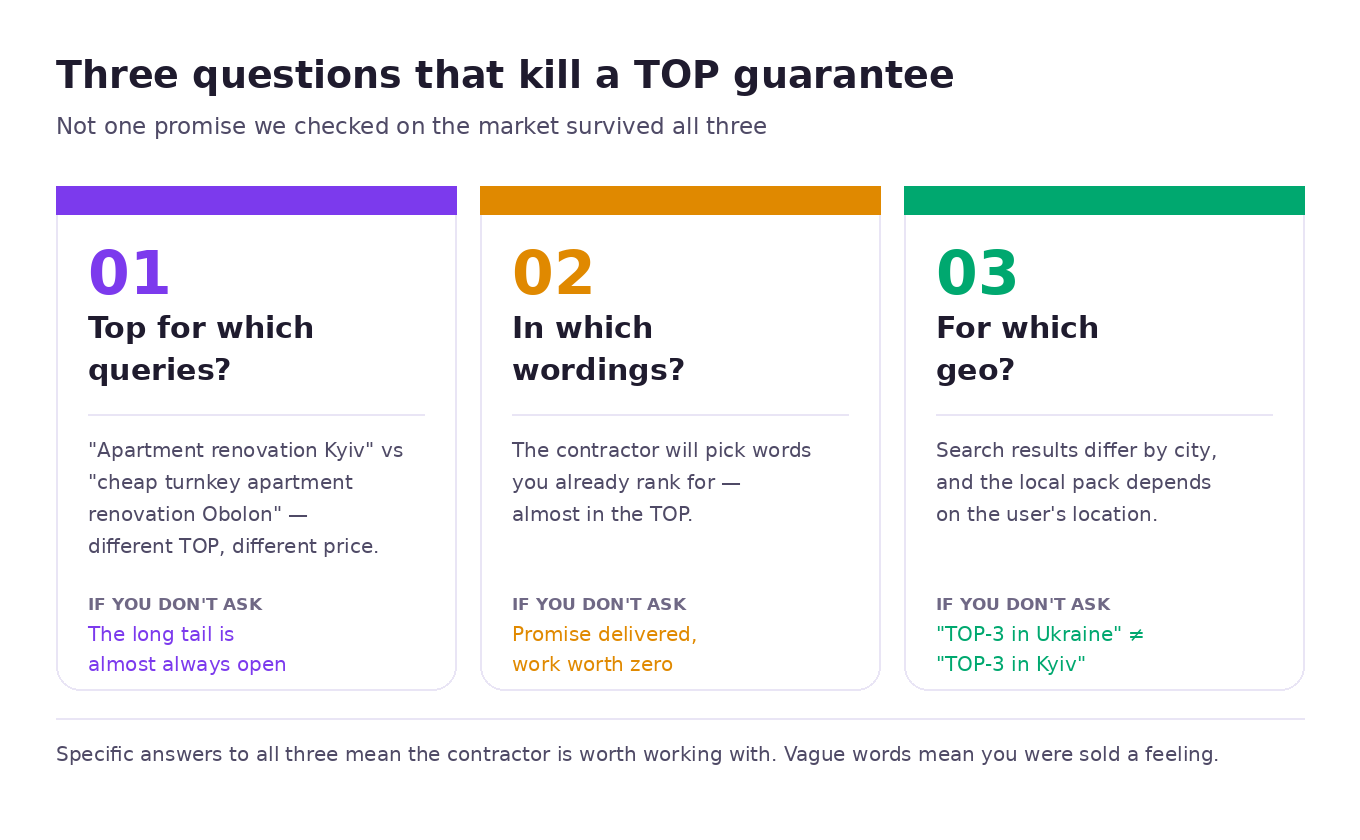
Top for which queries? "Apartment renovation Kyiv" and "affordable turnkey apartment renovation Kyiv Obolon" are two different tops, of different difficulty and different value. You can almost always break into the top for the low-volume long tail, and a vendor promising "top 10 for a hundred queries" usually means exactly that tail. The contract will be fulfilled; nothing will change at the cash register.
In which wordings? The same service is searched for in dozens of ways. A vendor will pick the wordings you already rank near the top for — and that is an honestly fulfilled promise with zero work done. That is why the query list should not be drawn up by the vendor alone, but by you together with them, and it must contain the words people actually use when they come to buy from you.
In which location? Search results differ from city to city, and some queries return a local pack where your position depends on where the user's phone happens to be. "Top 3 in Ukraine" and "Top 3 in Kyiv" are different promises, and the second can be delivered while the first stays out of reach.
This is the core point of the article. Not "guarantees are impossible" — but any guarantee without answers to these three questions means nothing. If a vendor answers all three specifically, you can start holding them to it. If they retreat into generalities, you are being sold a feeling, not an obligation.
What the market promises: numbers instead of impressions
I opened the websites of 22 Ukrainian agencies and wrote down what they say about guarantees. Captured on 3 October 2026.
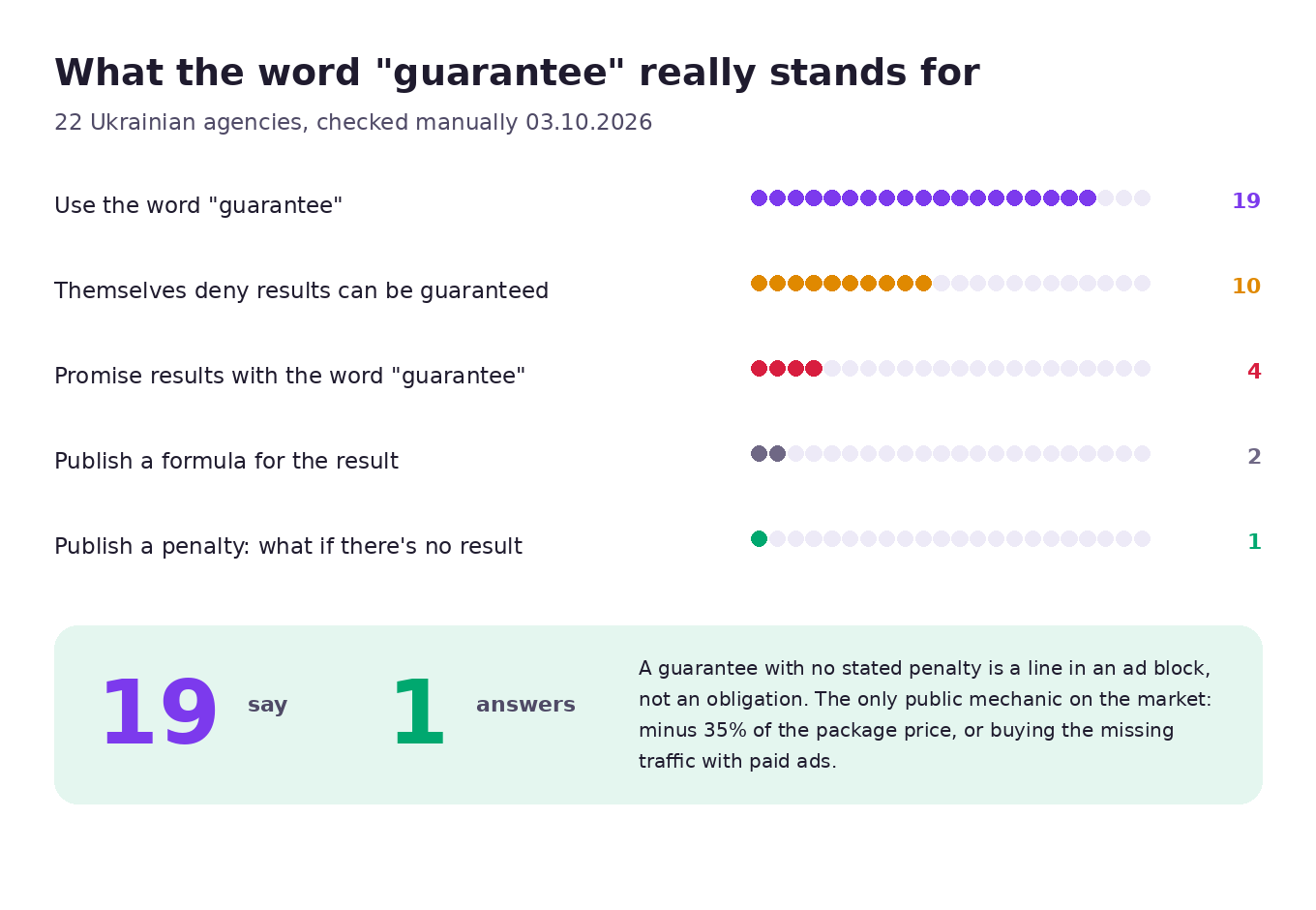
| What we found | Agencies out of 22 |
|---|---|
| Use the word "guarantee" in one form or another | 19 |
| State outright that the result cannot be guaranteed | 10 |
| Promise a result using the word "guarantee" — up to guaranteed sales | 4 |
| Publish the penalty: what happens if there is no result | 1 |
| Publish the formula for calculating the billable result | 2 |
| Offer a guarantee on the links they place | 2 |
The most telling thing is the gap between the first and the fourth row. Nineteen agencies say the word "guarantee", and only one spells out what exactly happens if the promise is not kept: the package price drops by 35%, or the missing traffic is bought in through paid ads. For the other eighteen, the guarantee carries no consequences — and a guarantee without consequences is just a word in an ad block.
I would separately note how honest some of the wordings are. Asked about guarantees, one agency answers: "we do not promise the impossible". Another writes that no agency can guarantee first-page positions. A third explains the mechanics outright: in cases like these, guarantees are usually priced into the fee. In other words, you simply pay extra for the word "guarantee", and the vendor covers the risk with your own money.
The opposite happens too. One agency's page carries the heading "Guaranteed website promotion to the top", and a paragraph below, on the same page, its own text explaining that no such thing as guarantees exists in SEO and that a conscientious specialist will not commit to a top-3 position by a specific date. Both statements on one URL.
What Google itself says about this
The shortest way to end the argument about guarantees is to open Google's documentation. It is stated there in plain words, and it has been for a long time.
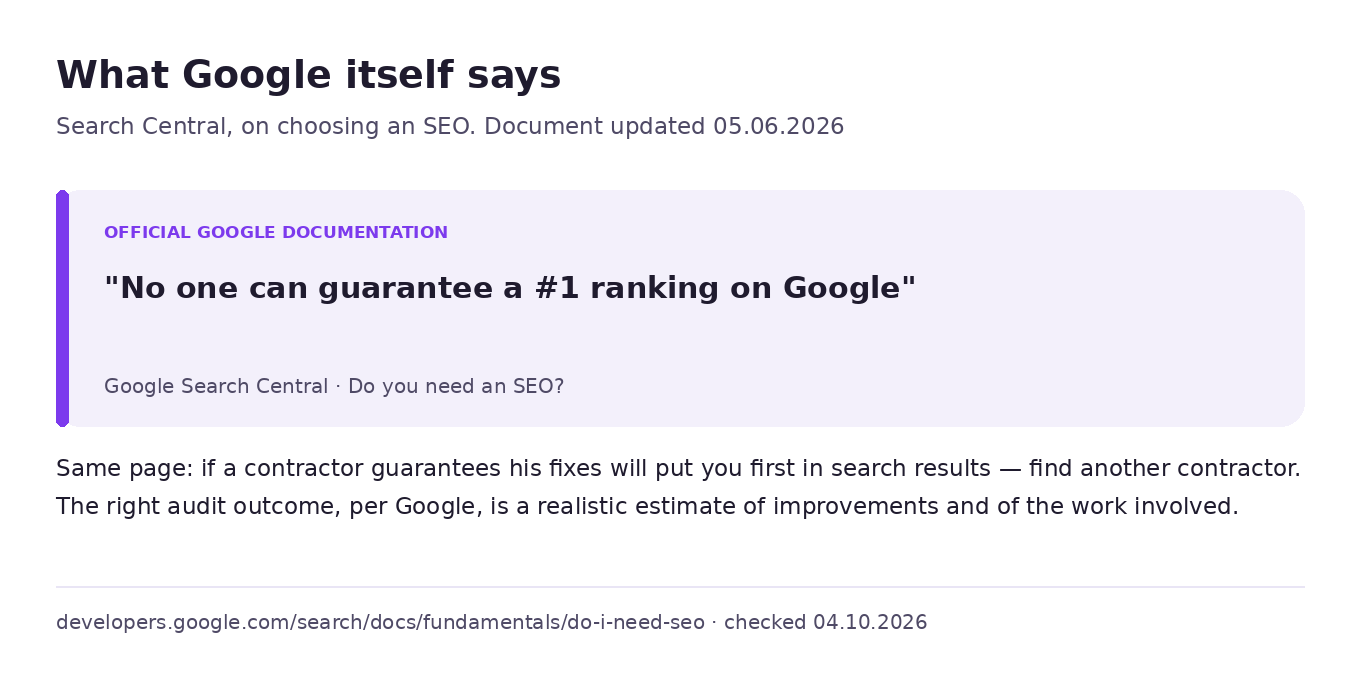
The Search Central section on whether you need an SEO states: "No one can guarantee a #1 ranking on Google". It goes on with a direct warning to beware of anyone who promises rankings, claims a "special relationship" with Google, or advertises "priority submit" of your site to the index.
The same page contains a line I would hang on the wall of any agency: if a vendor guarantees that their changes will put you first in the results, look for another vendor. And the proper outcome of an audit, Google says, is realistic estimates of the improvements possible and an estimate of the work involved. Which is exactly what this article is about.
Danny Sullivan, Public Liaison for Search at Google, put it this way on the company's official podcast in January 2026: promises are just promises, no one can guarantee anything until you have seen that it actually happened; you cannot guarantee an improvement, or appearing in the results for any particular queries, or any specific amount of traffic, or that the result will hold for any length of time.
And one more point almost nobody has noticed yet. In 2026 Google extended the same logic to tools and services around AI search. Its document on third-party SEO services states that third-party tools have no access to internal ranking data, cannot guarantee a result, and that any forecasts they make are their own forecasts which, like forecasts in general, may not come true. That applies to everyone selling guaranteed placement in AI answers today as well.
A brief note on fair citation: all quotes here are taken from Google's original English-language Search Central documentation and linked to the source, rather than from any localised edition.
What cannot be guaranteed, and why
Three things that are outside our control.
Rankings. The algorithm changes without notice, competitors are working too, and results are personalised. No vendor has access to the ranking mechanism — we observe it from the outside, like everyone else.
Traffic in absolute numbers. It can be forecast, and a forecast is a perfectly normal working tool. But a forecast and a guarantee are different things: a forecast is based on data and may not come true, while a guarantee implies liability when it does not.
Sales. The most common and the most impossible promise. SEO brings a person to the site. Whether they buy depends on price, product range, how fast your sales team replies and a dozen other things the vendor never touches.
There is a fourth one, mentioned less often: the timeline itself. The honest answer to "can you guarantee a result within 1–3 months" is no: the first month goes on on-site work, links start to have an effect later, and the compounding effect is usually visible from the third or fourth month. Anyone promising top rankings in thirty days is either taking queries you almost rank for already, or does not intend to keep the promise.
What I do guarantee
The principle is simple: I guarantee everything that is within my control, and I do not promise what is not. Looked at that way, the list turns out longer than at the places that spend their guarantees on rankings.
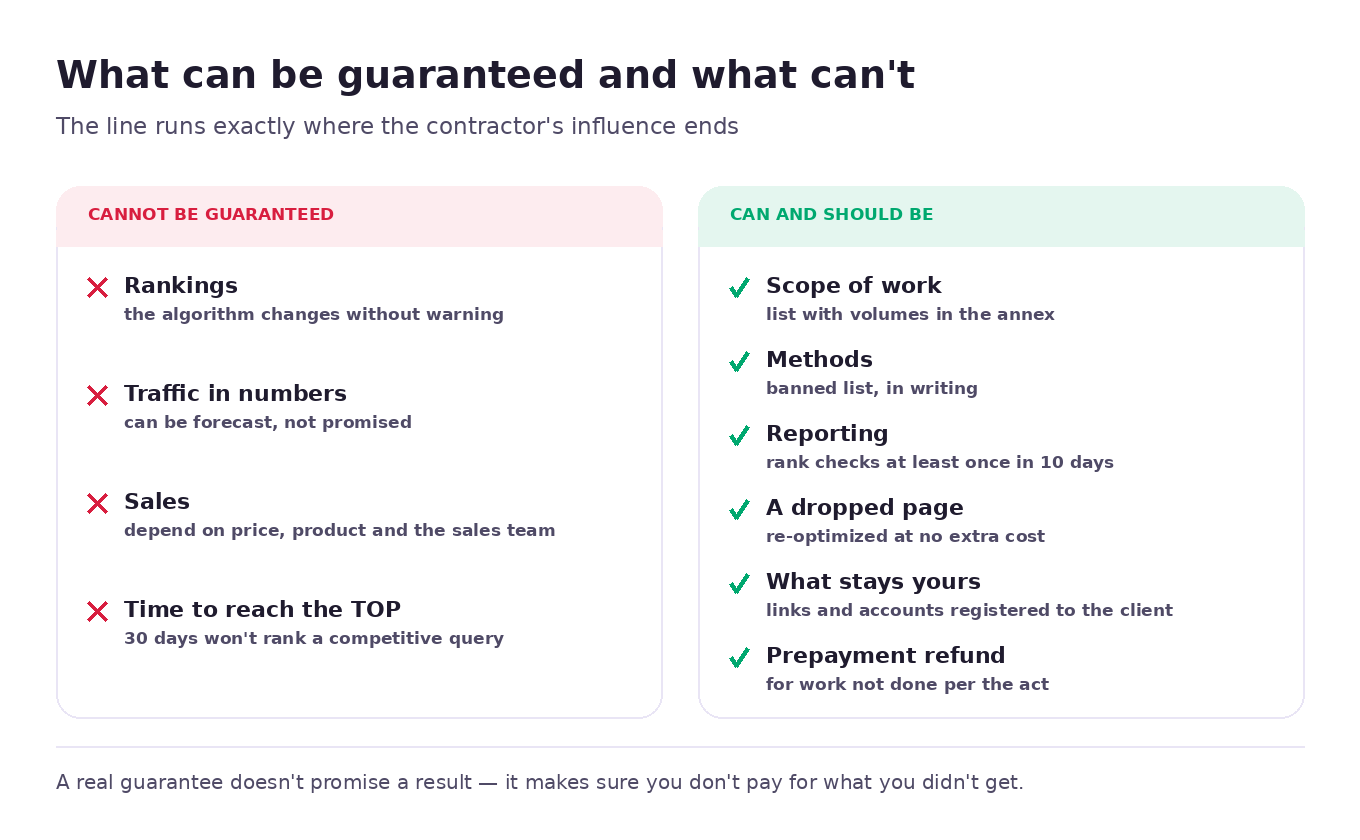
Scope of work. The monthly volume is fixed in an annex to the contract. Not "a set of promotion activities", but an itemised list with volumes that shows what was actually done.
Methods. The contract comes with a list of prohibited methods I commit not to use: auto-generated text, unaltered copy-paste, hidden text, cloaking, doorways, link farms. That is a written obligation, not the phrase "we only use white-hat methods". Not one of the 22 agencies publishes an annex like it.
Reporting. A ranking report every month, with checks at least once every ten days, plus recommendations and a work acceptance report. Nobody on the market specifies the check frequency in the contract, and that frequency is exactly what separates live monitoring from a single measurement taken on a good day.
A page that drops out. If a page falls out of the results and does not return on its own within thirty days, I re-optimise it at no extra charge.
What stays with you. Links are external and permanent; accounts and access credentials are registered in your name. When you leave, there is physically nothing for me to switch off.
Prepayment refund. At the end of each month a work acceptance report is submitted. If you end the engagement and part of the work has not been delivered, the prepayment for the undelivered part is refunded. This is not a promotion or a plan feature — it follows from the fact that the report covers what was actually done, not what was paid for.
That last line, to my mind, is the real guarantee. It does not promise a result — it makes sure you do not pay for what you did not get.
Honestly about links: yes, everyone buys them
The question "do you guarantee white-hat methods only" usually gets a "of course". I will answer differently, because otherwise it turns into a half-truth.
Everyone buys links. Some placements are done by hand and for free — an arrangement with the site, an expert comment, a useful piece they took without money. Some are bought. Media always charge a rate for a post, and no amount of expertise changes that: the publication has a price list, and it is the same for everyone.
There is no point hiding it — anyone who has worked with placements knows how the market operates. The question is not whether links are bought, but what exactly is bought and in whose name. A rented link is removed the month you stop paying, and the rankings you paid for over a year go with it. A permanent publication stays forever, whether you keep working with the vendor or not.
So the right question is not "do you use white-hat methods only", but two others: are the links permanent or rented and in whose name are the accounts registered. Those answers are verifiable; the white-hat answer is not.
When to expect results
This is the second most frequent question after guarantees, and the answer depends on your starting point.
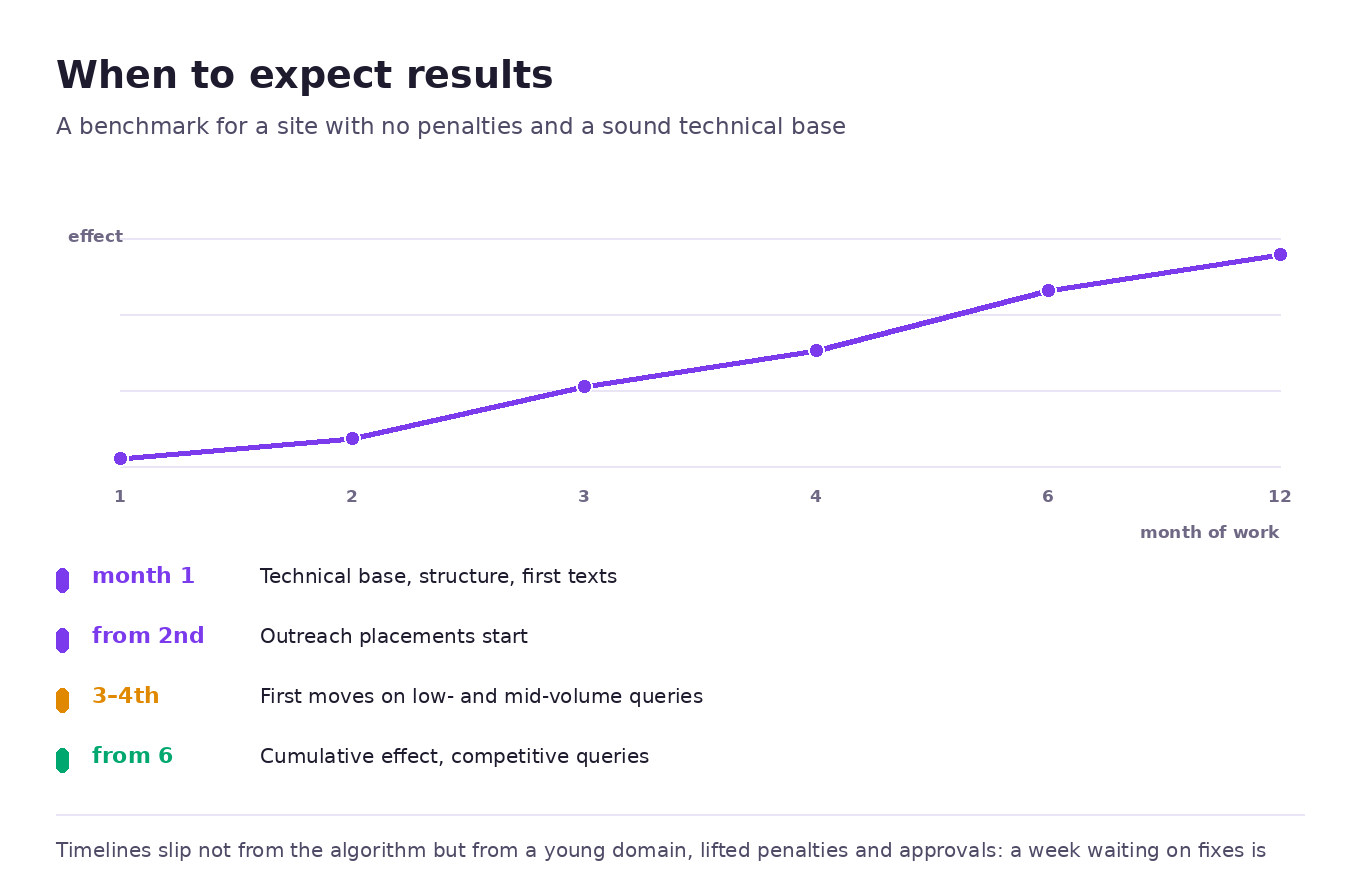
| What happens | When |
|---|---|
| Technical foundation, site structure, first texts | Month 1 |
| External placements begin | From month 2 |
| First noticeable shifts on low- and mid-volume queries | Months 3–4 |
| Compounding effect, competitive queries | From 6 months |
Timelines shift in both directions, and usually not because of algorithms. A young site with no history takes longer. A site under penalties has to come out of them first and only then starts to grow. And the most common brake is approvals: if changes wait a week for your reply, that week is simply subtracted from the work.
What happens if the algorithm changes
Liability for algorithm changes is excluded in the contract — mine and everyone else's. That is fair: it cannot be influenced, and paying out of pocket for someone else's decision would be odd.
But "not liable" is not the same as "not my problem". When the algorithm changes, the client gets a notice about potential risks: what exactly changed, what it means for their specific site and what we are doing in response. The difference between a vendor who disappears during an update and a vendor who writes to you first is precisely what you are paying for.
The same goes for competitors and for technical failures on the site's side. You cannot guarantee that a competitor will not invest three times more in promotion. Spotting it in the data and telling you in time — that you can, and it is part of the job.
"Pay for results only" — why it is a trap
The model sounds perfect: you pay only if you get the result. In practice it usually hides what you will not be shown before signing.
For a vendor to risk their own money, they need leverage that makes sure you cannot leave. That is where accounts registered to the agency come from, along with rented links that disappear on non-payment, closed-source development work and access credentials you do not hold. Formally you are paying for results. In fact you cannot leave, because leaving costs you everything at once.
The second problem is what counts as the result. I showed above how differently the same label can look: "pay per ranking" means thirty keywords in scope at one agency and five hundred queries with payment starting only in month six at another. A fifteenfold difference under an identical name.
So the question is not the payment model but the transparency of the mechanics. Before discussing what you pay for, find out what stays with you if you stop paying tomorrow. If the answer is "nothing", the payment model no longer matters. More on this in the breakdown of the contract with an SEO agency.
Why the site ranks but there are no enquiries
The most uncomfortable question on the list, and the answer is simple: you cannot sell what people do not buy, even from the top of the results.
SEO is responsible for making sure a person with the right query finds you. After that comes everything the vendor does not influence: price against the market, stock availability, response speed, delivery terms, trust in the site. If you rank top 3 for "buy X" and your price is thirty percent above the neighbours, there will be traffic and no enquiries. That is not a promotion failure — that is the market answering.
The second scenario is ranking for the wrong words. Positions on informational queries bring visitors who never intended to buy anything. The report looks splendid all the same. That is exactly why the query list has to be built together, with your understanding of who your buyer is.
And the third, the most common in practice: the enquiries are there but invisible. Calls are not tracked, the form submits with an error, emails land in spam. Before blaming the vendor, it is worth checking whether what they have already brought in is reaching you.
KPIs: a metric without a formula means nothing
If you do want to lock in a measurable result, lock it in properly. Out of the 22 agencies, eleven name a specific metric and only two give the calculation formula.
A workable formula answers three questions. What baseline are we counting from — otherwise the vendor gets credit for growth that would have happened anyway; the usual approach is to take the median for the year before the start and fix it in the contract. Do branded queries count — if they do, the KPI will include people who were searching for you by name anyway; they are filtered out in analytics. Based on which data — every platform reports different numbers, and the source has to be named.
Without those three clarifications, "30% traffic growth" is not a KPI but a wish, and you will end up arguing over it exactly the way you would over a "guaranteed top ranking".
How to check that the work is actually being done
Four things you can see without any specialist knowledge.
Search Console. You should have access, not only the vendor. It shows the number of indexed pages, the queries you are shown for, and errors. If impressions on target queries have not grown for three months running, that is a conversation to have.
What changed on the site. A report should answer "what was done", not "what grew". Growth can happen by itself. A list of fixes, pages and placements can be checked with your own eyes.
Links. Ask for the list of placements with URLs. Open a few. Are these live sites with their own audience, or dumping grounds?
The acceptance report. It should match what you see. A report you cannot reconcile with reality is just paperwork for the accountants.
What depends on you
Part of the result lies outside the vendor's zone, and it is fairer to say so upfront.
Approvals. If changes wait weeks for your reply, deadlines slip, and no guarantee compensates for that. My contract specifies two business days for sign-off — a mirrored clause that keeps both sides disciplined.
Implementation. A technical brief nobody implemented affects nothing. The most common reason SEO "did not work" is not vendor mistakes but recommendations that were never carried out.
Access and content. Without access to the site and analytics the work is done blind, and if the site has nothing to show a buyer, traffic will not turn into enquiries.
Frequently asked questions about SEO guarantees
Can you get any guarantees in SEO at all?
On the process — yes: scope of work, methods, reporting, response times, a refund of the prepayment for undelivered work. On the result in the form of rankings — no, and anyone who guarantees it is either taking queries you almost rank for already, or pricing the risk into the fee.
What are "guaranteed SEO services"?
Marketing packaging, not a separate type of service. Anything can hide behind it — from an honest commitment on the scope of work to a promise of top rankings for queries you do not need. The three questions from the start of this article settle it.
Do you guarantee top 10 or top 3?
No. And before you accept such a promise from anyone else, ask: for which queries exactly, in which wordings and in which location.
Can you guarantee leads or sales?
No. SEO is responsible for making sure you are found. The purchase is down to price, product range, the site and your sales team.
How many months until there is a result?
The first noticeable shifts usually come in months three and four, the compounding effect from six months on. A competitive query cannot be moved into the top in 30 days.
Is there a money-back option?
Yes. A work acceptance report is submitted at the end of each month, and if you end the engagement, the prepayment for undelivered work is refunded.
What happens if Google's algorithm changes?
Liability for that is excluded in the contract, as it is everywhere. But you will get a risk notice: what changed, what it means for your site and what we are doing about it.
Can I pay for results only?
You can find such an offer on the market. Before agreeing, find out what stays with you if you stop paying: that model often rests on accounts registered to the agency and rented links.
Why can't SEO offer guarantees the way paid search does?
In paid search you buy impressions directly from the platform at a known price. In SEO you are not buying a place in the results — it is assigned by an algorithm that no agency controls.
Can you win a court case if a vendor fails to honour a guarantee?
There are precedents, and the outcome depends on the wording. Where the contract named a specific ranking figure, courts have ruled against the vendor. Where it described a scope of work without promising a result, claims were dismissed. We have had no such disputes: we do not promise what we cannot deliver.
Which guarantees are worth writing into the contract?
Scope of work with volumes, prohibited methods, reporting frequency, a refund of the prepayment for undelivered work, and ownership of links and accounts. All of that is verifiable. A detailed breakdown is in the article on the contract with an SEO agency.
In short
A guarantee in SEO is not a promise of a ranking but a description of what the vendor is liable for with their own money. Rankings are not on that list for anyone working honestly.
If you are still promised top rankings, ask the three questions: for which queries, in which wordings, in which location. Specific answers mean you can work with this person. Generalities mean you have been sold a feeling.
And before talking to any vendor, it is worth seeing what shape your site is in going into that conversation — a free audit takes half an hour and shows you the picture without anyone else's interpretation.

SEO Agency Contract: What It Must Include
We checked 22 Ukrainian agencies: only two publish an SEO contract, and neither of them is a Ukrainian legal entity. We break down 21 court cases, nine ways clients get misled and what can actually be guaranteed.
Read →
How Much Does SEO Cost in 2026: 21 Ukrainian Price Lists and Our Own Quote
The entry point on the Ukrainian market runs from $111 to $2,000 a month — an 18x gap. A quarter of price lists never say what period the figure covers. I break down what the sum is made of and show my own quote line by line.
Read →
Website audit cost in 2026: what the price is built from
31 prices from 13 Ukrainian pages: $33 to $2,035 for the same word. How a report differs from an audit, which free tools still work, which are dead — and what we charge.
Read →Want to apply this to your site?
We will review the current situation, find the first growth levers, and suggest a practical working format.