Selling on Facebook in 2026: business page, Shops, community and Advantage+
Selling on Facebook in 2026 is not about blasting ads at everyone — it is a system: a business page, Shops and catalog, community, Messenger bots, Advantage+, and a content funnel wired into your CRM and quality leads.


I will look at your site and answer your questions on the topic of this article. 30 minutes, no slide decks, no pressure.
Book a consultationSelling on Facebook in 2026 is a stack of six elements: a polished business page, a Facebook Shops storefront with a catalog, a living community in a group, Messenger automation, Advantage+ campaigns with the Conversions API connected, and a content funnel that warms a cold audience up to purchase. A single creative shown to everyone and broad targeting with no CRM signals no longer work: Meta's algorithms need quality events and fresh creative, while users need a message that matches their level of intent.
Facebook is still a social platform, not a marketplace: most people come to chat, not to buy. That means the audience starts out cold, and before you can sell you have to warm it up. The good news is that Meta gives you a full toolkit for that — from organic community to AI-driven campaigns. Let's break down how to build Facebook sales systematically.
WOW, TRAFFIC! Need it too? Then check out what SEOquick offers here
No time to explain — let's quickly set up Google Ads for you and the clients will pour in. And not just anyone — targeted ones!
We'll help you pick business-relevant ads with a high return on investment
Clients are tired of waiting for you to make yourself known!
Step 1: Business page, Shops and catalog as your storefront
The foundation of sales is a properly set up business page and a Facebook Shops storefront. By industry forecasts, social commerce is approaching $1.2 trillion by 2026, and a storefront inside Facebook is the most direct way to sell to your audience without sending it to an external site.
What to do first:
- Create a business page and get full control of the account and permissions in Commerce Manager.
- Build a catalog — a Product Catalog for an online store, or a Services Catalog if you sell services: consulting, design, repair, training.
- Connect the catalog to an Instagram business account so the storefront works on both platforms.
- Turn on Commerce Manager analytics: the Performance tab (traffic and sales), Catalog (product status), Discovery (where shop traffic comes from), and Audience (buyer demographics).
For an online store, the catalog can sync with your product system and you can publish shoppable posts where the product is tagged right inside the post. An example for a Ukrainian business: an accessories store uploads a 200-SKU catalog, tags products in Reels and posts, and shows prices in hryvnia — a user sees a 890 UAH price and places an order without leaving the feed.
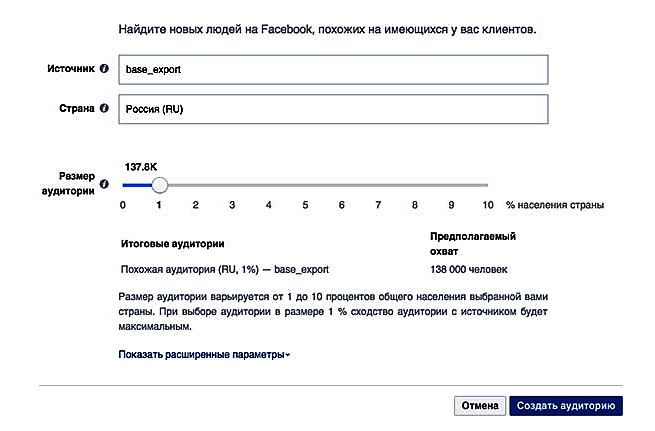
The key principle: the page and storefront are not a warehouse catalog but a content environment. Quality content should educate, surprise and engage, and only then sell. Pure advertising interests only the people who make it. Even if a post doesn't drive a sale right now, it strengthens the brand and raises loyalty — which converts to revenue later.
Different layers of the audience are at different decision stages, so you'll need content of various types: articles, video, infographics, cases, reviews, and guides. According to Sprout Social, the Shops storefront remains the most direct way to turn engagement into sales.
Step 2: Community in groups and Messenger bots
In 2026 users increasingly move from passive scrolling to active conversations inside closed groups. A strong, engaged micro-community in a private Facebook group often drives more loyalty, feedback and high-intent leads than a large but passive page audience.
A group is a pre-segmented audience: people join around a specific pain point or interest. When you share value there, you are not a cold advertiser but a helpful community member — a level of trust that a paid "sponsored" tag cannot replicate.
The second pillar of this step is Messenger automation. In 2026 chatbots are no longer a novelty but the core of omnichannel communication. Per industry data, companies that deployed Messenger bots report a 35% reduction in support tickets, a 28% increase in lead capture, and 3x faster response times. For e-commerce, bots deliver about +20% to conversion by engaging the buyer at the moment of intent.
A key tactic is click-to-Messenger ads: paid traffic from Facebook and Instagram lands straight in an automated conversation, bypassing the landing page and form. This removes the "landing page → form" friction and captures the lead in the conversational format users already feel comfortable with.
If you want to learn more about paid traffic and campaign economics — we have a useful video:
How to build an audience from people engaged on Facebook
To turn group activity and Messenger conversations into an ad audience:
- Go to Ads Manager and open the "Audiences" section.
- Click "Create a Custom Audience".
- Pick the source "Facebook engagement" — likes, comments, video views, Messenger opens.
- Gather people who interacted with the content but didn't leave a request.
- Exclude those who can't become customers (other region, children under 13).
That's it! Now you have a warm segment for further nurturing.
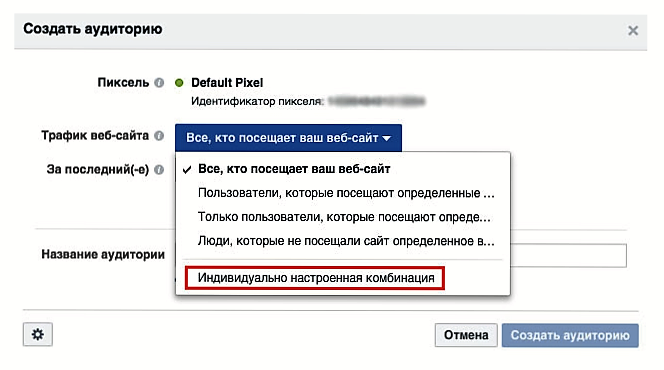
This is also where retargeting of unregistered visitors kicks in. Someone visited your site, viewed a product, but didn't subscribe or buy — maybe they hesitate or compare with competitors. The Facebook pixel together with the Conversions API helps "catch up" to them with a relevant ad. It's the same logic as paid search advertising: remind people of the product until they're ready to buy. More in our Facebook targeting setup case study.
Step 3: Advantage+, Conversions API and working with leads
The heart of Facebook sales in 2026 is Advantage+ Shopping (ASC) AI campaigns. This is Meta's automated system that tests combinations of creatives and audiences on its own. But the "autopilot" needs the right setup, otherwise money is wasted.
What's critical for results:
- Signals. Connect a verified catalog (from ~50 active SKUs), install the Conversions API alongside the pixel — this sharply improves event quality after the 2026 attribution changes.
- Existing customer budget cap. Set a cap on "warm" customers (usually 15–25% for prospecting-led accounts). Without it the algorithm gravitates to the warmest audience because it converts most easily — and you stop finding new buyers.
- Creatives. Load 6–15 variants per campaign and add 3–5 fresh ones weekly. 2026 studies show that only about 6% of ads pull the bulk of spend — so too few creatives means statistically missing the winner.
- Hybrid structure. 70–80% of budget on ASC (both prospecting and retargeting), 10–15% on a dedicated cart-abandonment campaign (1–7 days) with urgency creative. Dedicated cart campaigns consistently beat ASC's blended approach on this high-intent segment.
- Learning phase. Don't touch the campaign for at least 7 days (ideally up to 50+ conversions): any budget or creative edit resets learning.
A separate strategy is working with people who filled out a form but didn't buy. With Lead Ads the form opens right inside Facebook, fields are pre-filled from the profile, and such forms are 20–30% cheaper than sending traffic to a landing page. Average cost per lead in 2026 sits around $28–42 depending on the niche: e-commerce $10–25, while complex B2B niches are noticeably pricier.
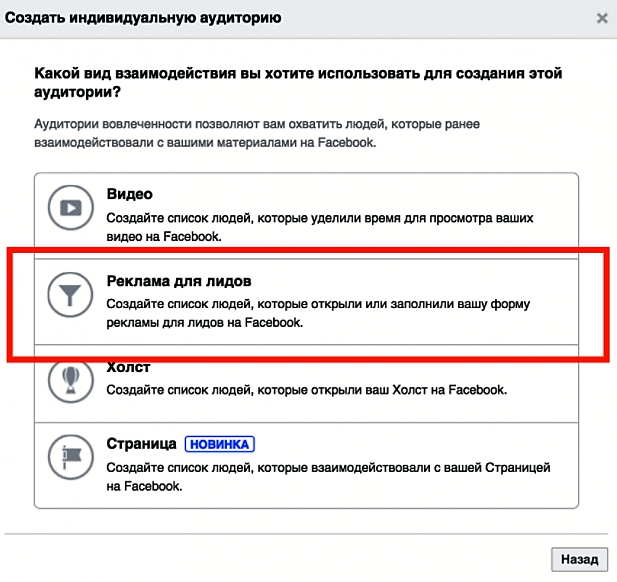
The main thing here is to optimize not for "any leads" but for quality ones. Connect a CRM and pass offline conversions and deals back to Meta: then the algorithm learns to find not just requests but people who actually buy.
Recommended reading:
Step 4: Repeat sales, creatives and measurement
A good buyer is one who becomes a repeat customer. According to Sprout Social research and other sources, repeat customers spend several times more than first-timers. Facebook makes it easy to build audiences of past buyers and retarget them with upsell, reviews and referral offers.
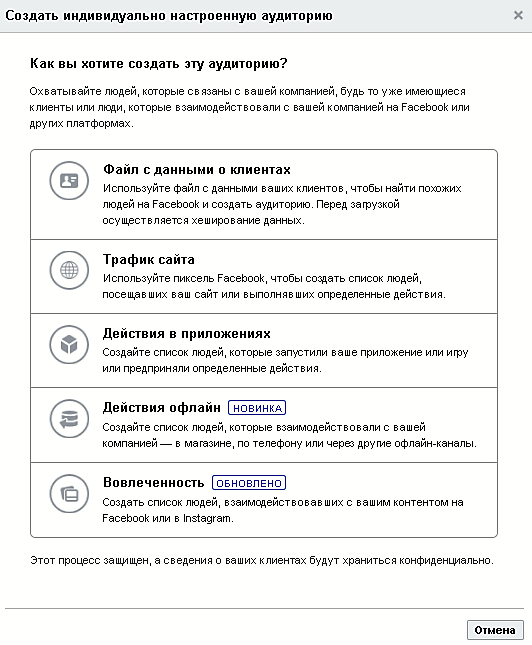
The "customer loop" logic: upload your customer list from the CRM, gather those who completed a target action (purchase, request, call), and direct cross-sell offers at them. Revenue from add-on sales often exceeds income from the main order.
But even a perfect funnel breaks on two things: creative fatigue and flawed measurement.
- Creative fatigue. The average creative burns out after 3–5 days of active delivery, with CTR dropping 20–40% by day seven. When frequency climbs above 2.5–3 you're in the "danger zone". Meta now shows a creative fatigue score — watch it and refresh creatives.
- Attribution. After the 2026 changes, comparing CPA month over month at face value is meaningless — they're different measurement systems. Reset your baselines and use incrementality tests: standard 7-day click attribution often understates real incremental ROAS.
For B2B, keep a separate metrics system in mind: top of funnel (CPM, 3-second video views), mid funnel (CTR, cost per click, landing page views), bottom (conversions, cost per conversion, ROAS). UGC video with social proof lifts conversion by roughly 25%, and Reels (9:16 vertical, 15–60 sec, hook in the first 3 seconds) remain Meta's highest-reach placement. The warm-up is reinforced by video marketing and regular A/B testing, which improves results by 30–50%.
Frequently asked questions
Can you sell on Facebook if the audience is "cold"?
Yes. Most people don't come to Facebook to shop, so you first warm the audience with content and community, then move it down the funnel via retargeting and Advantage+. Selling head-on to a cold audience is almost always more expensive and converts worse.
What's better for sales — a business page or a group?
They solve different jobs. The page and Shops storefront are the "store" and the conversion point, while the group is trust, feedback and high-intent leads. The strongest setup is the combo: content and community in the group warm people up, and the page and ads close the sale.
Do I need the Conversions API if I already have the pixel?
Yes. After the 2026 attribution changes the pixel alone loses some events because of browser limits. The Conversions API passes server-side signals, raises their quality, and directly improves Advantage+ learning.
How many creatives do I need for a 2026 campaign?
For Advantage+, usually 6–15 active creatives with 3–5 fresh ones added weekly. A creative burns out in 3–5 days, so betting on a couple of ads almost guarantees missing the winner.
Is Facebook suitable for B2B sales?
Yes, but adjusted for the deal cycle. For B2B, Facebook more often works as a top- and mid-funnel channel: warm-up with content, lead capture via Lead Ads and Messenger, then closing in the CRM. Optimize for qualified leads, not "any leads" — otherwise cost per deal climbs.
How do I measure the real return from Facebook ads?
Don't compare CPA month over month at face value — after the attribution changes these are different systems. Use incrementality tests, pass deals from the CRM, and look at metrics by funnel stage, not just the last click.
Conclusion
Selling on Facebook in 2026 is a system, not a one-off ad campaign. Build a Shops storefront with a catalog, build trust through community and Messenger, launch Advantage+ with the Conversions API connected and quality CRM signals, then refresh creatives systematically and measure incremental return. The main thing is to care about the customer rather than push products: customer-centric content and service bring more than aggressive "hard-sell" marketing. Use these strategies and Facebook will become a stable sales channel for your business.
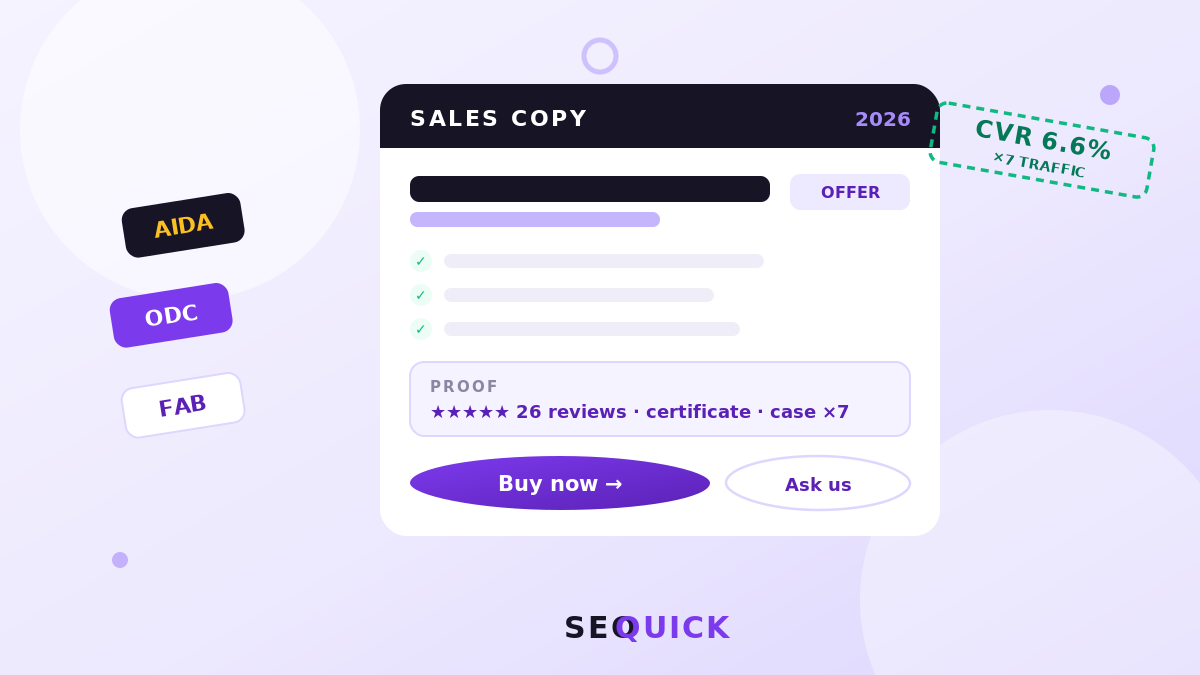
How to Write Sales Copy: Structure, 8 Formulas, Ready-Made Templates and Examples
Sales copy without fluff: the structure of a page that sells, 8 formulas (AIDA, ODC, PMHS…), a real first-screen breakdown, ready-made templates and prompts, SEO logic and metrics. SEOquick’s experience: a ×7 traffic case built on commercial pages.
Read →
How to run a Facebook group in 2026: a community guide for business
How to run and grow a Facebook group in 2026: setup, content plan, engagement and moderation, promotion, leads, and community analytics for business.
Read →
How to market your brand every day: SEO, content, reviews, AI, and sales
A daily brand marketing system: positioning, search demand, content, reviews, community, AI chat, analytics, and conversion.
Read →Want to apply this to your site?
We will review the current situation, find the first growth levers, and suggest a practical working format.