Email marketing: 16 tips to improve performance in 2026
Email marketing in 2026 is a system of consent, deliverability, segmentation, and sales analytics. 16 tips updated for the new Google and Yahoo rules, the AI era, and post-MPP metrics.


I will look at your site and answer your questions on the topic of this article. 30 minutes, no slide decks, no pressure.
Book a consultationEmail marketing in 2026 is not "blasting your list" — it is a managed system: consent, deliverability, segmentation, useful content, relevant landing pages, and sales analytics.
In short: for emails to make money, set up domain authentication (SPF, DKIM, DMARC), keep your list clean, segment by behavior and lifecycle, write one main idea per email, and measure clicks and revenue rather than "opens." Below are 16 tips, updated for the new Google and Yahoo rules, the AI era, and post-MPP metrics.
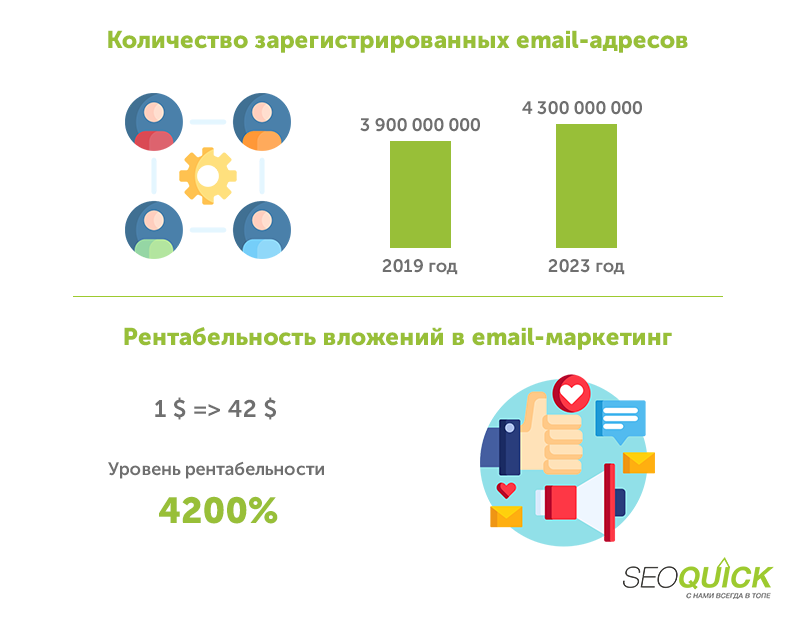
Despite messengers, email remains one of the most profitable channels: it has one of the best cost-per-lead to conversion ratios, and an email lands in a person's "personal space" — their inbox. But the rules of the game have changed: in 2024 Google and Yahoo tightened sender requirements, and Apple Mail Privacy Protection broke the familiar open-rate metric. Let's look at how to build email marketing that actually works.
What, again? Traffic dropped and no sales? Then SEOquick will help you get it all back
We will attract organic SEO traffic to your site from Google and Bing search engines
We will handle on-page optimization and SEO promotion. We will improve reputation and content. We will run an audit and build up your backlink profile.
No black magic – only white-hat SEO methods!
What email marketing solves in 2026
Before diving into the tips, it helps to understand why you need email at all. Modern email marketing covers several jobs at once:
- Building an expert image. Regular useful emails make you a recognizable authority in your niche.
- Building trust. The more communication channels you offer, the more likely a customer stays with you — and many still prefer email.
- Educating about the product. Especially in B2B, where the product is complex: emails answer questions and "warm up" the buyer.
- Reactivating "dormant" customers. A personalized series can win back interest from people who haven't bought in a while.
- Growing sales. In B2C, automated emails generate a disproportionately large share of revenue relative to their volume.
- Collecting behavioral data. Every click and open feeds your segmentation and personalization.
Email works well alongside other channels. If you also run SEO promotion and contextual advertising, email "closes" the people who already know your brand but haven't bought yet.
Understanding your audience and consent
People's inboxes are overflowing. To stand out you need knowledge about your audience and a strategy built on it — plus a legal list collected with explicit consent.
Tip 1. Decide whether you are B2C or B2B. If your buyers are private individuals, that's B2C: a short, often spontaneous buying cycle, an emotional tone, and marketing emails (thank-you for signup, abandoned cart, discounts, product recommendations, birthday greetings). If your customers are companies, that's B2B: a long cycle, collective decisions, a business tone, and content emails (product announcements, case studies, proposals, event invitations). Your whole strategy depends on this.
The welcome email is your first touch, and it has the highest open rate in your entire program. Here is what a B2C store greeting can look like (note the name personalization and the time-boxed promo code):
Tip 2. Build your list with explicit consent (opt-in) only. This isn't just politeness — it's a legal requirement (GDPR in the EU, plus CAN-SPAM and CASL in North America) and a deliverability condition. Buying and scraping lists in 2026 will reliably destroy your sender reputation. Collect addresses via lead magnets, signup forms, checkout, surveys, and prompts in your videos. Best of all is double opt-in: the person confirms the subscription via a link in an email, and you get a clean, engaged contact.
Tip 3. Verify and clean your list regularly. Any list decays by 10–15% a year: people change jobs, forget passwords, abandon mailboxes. List hygiene is one of the three pillars of deliverability (alongside authentication and warm-up). Industry data shows only about a quarter of marketers validate their list before sending — and that's a mistake: a single spam complaint hurts your reputation more than a hundred opens help it. For large lists, use validators such as MillionVerifier, which automatically filter out non-existent and risky addresses.
Tip 4. Segment by behavior and lifecycle, not just gender and city. Basic segmentation (gender, age, geo) is just the tip of the iceberg. In 2026 the winners use micro-segmentation: lifecycle stage, purchase history, on-site activity, interests, intent. The tighter the segment, the more relevant the email — and the higher the response.
Tip 5. Make content relevant to each segment. One email for everyone works worse than separate emails tailored to each group. Tag your links with UTM parameters so you can clearly see which segment and which email drive results.
Deliverability: the new Google and Yahoo rules
In 2024 Google and Yahoo introduced mandatory requirements for bulk senders (5,000+ emails per day to Gmail). Since then, emails simply don't arrive without compliance. By the end of 2025, non-compliant emails face temporary and then permanent rejections.
Tip 6. Set up SPF, DKIM, and DMARC. These are three authentication records in your domain's DNS. They prove to mailbox providers that an email is genuinely from you and not from a fraudster. Bulk senders are required to use both SPF and DKIM, plus DMARC with a policy of at least p=none. Without authentication, high-trust ESPs won't even let you send large volumes. Check your domain setup with free testers, for example via Mail-Tester.
Tip 7. Make unsubscribing one click. Google and Yahoo require one-click unsubscribe and processing the request within two days. Don't hide the unsubscribe button — make it easy. The paradox: easy unsubscribing protects deliverability, because an annoyed person will hit "spam" instead of "unsubscribe," which is far more damaging to your reputation.
Tip 8. Keep complaints below 0.1%. Google recommends a spam complaint rate below 0.1% and never above 0.3%. Watch this in postmaster tools. If complaints rise, slow down your frequency and revisit consent and relevance. For a new domain, warm-up is mandatory: ramp volume gradually over 4–12 weeks rather than jumping "from zero to thousands."
Copy, subject line, and mobile
Copy is what email marketing can't exist without. According to Litmus, about a third of recipients decide whether to open an email based on the subject line.
Tip 9. A/B test your subject lines. Don't guess — test. Keep the subject within 28–50 characters (longer gets cut off on mobile), and test one element at a time: personalization (name, city), an emoji at the start, numbers, a question. For statistical significance, use at least ~1,000 recipients per variant and give the test 24–48 hours. In B2C, specifics and numbers work well ("20% off for 7 days," "$10 back on your next order"); in B2B, use descriptive, business-like subjects without creative riddles. US benchmarks put a healthy across-industry click rate around 2–3% — send mid-morning Tuesday–Thursday in the recipient's time zone for B2B.
For a B2B digest, a promise-plus-number subject line tends to win. Here is a content email example for a US/EU audience:
Tip 10. Add a preheader. This is the short text next to the subject line, visible before the email is even opened. It clarifies the subject and adds motivation to click. If you don't set it, a random opening line gets pulled in — usually an illogical one.
Tip 11. Meet the 9 criteria of a good email. The copy should be: clear (straight to the point), persuasive (arguments and proof), visually light, structured (subheadings, lists), lively, free of cliches like "team of professionals," mobile-adapted, useful, and with a clear call to action. Remember: a large share of people read email on a smartphone — big CTA buttons, short copy, and responsive layout are mandatory.
Tip 12. Sign your emails smartly. The signature is marketing too: logo and name, contacts, the sender's name and role, a link to your site or blog, and optionally an avatar. A human image builds trust and makes the conversation feel personal.
Automation, AI, and metrics
The biggest shift of recent years is the move from manual "broadcasts" to automated triggered flows and the use of AI.
Tip 13. Build automated triggered flows. Welcome series, abandoned cart, reactivation, post-signup onboarding — automated emails bring a disproportionately large share of revenue relative to their volume in your overall sending. Set them up once and they work for you continuously. Start with a 3–7 email flow for new subscribers.
The most profitable trigger for most e-commerce stores is the abandoned-cart email. State the cart value in dollars and add a concrete incentive (a reservation window, free shipping):
Tip 14. Use AI where it genuinely helps. In 2026 most email teams already use AI: for generating and optimizing subject lines, dynamic content per segment, send-time selection, and predictive segmentation. AI personalization noticeably lifts revenue and CTR. But AI is an accelerator, not a replacement for strategy: feed it clean data and clear segments, or it will just make mistakes faster.
Tip 15. Measure clicks and revenue, not "opens." Since Apple Mail Privacy Protection launched, the open-rate metric is unreliable: Apple Mail artificially "opens" emails and inflates the number, while accounting for a large share of all opens. So rely on CTR (clicks across all delivered emails) and CTOR (clicks relative to opens) together — and above all on conversions and revenue from your CRM. Tag links with UTM and reconcile the data with sales, or you'll be optimizing the wrong metric.
Tip 16. Choose a reliable sending service and check emails before sending. For sending and automation, Mailchimp, Klaviyo (the e-commerce favorite in the US), and Brevo all work well — they handle authentication, one-click unsubscribe, and analytics for you. Before sending, always test the email: layout and inbox placement via testing services, and copy for fluff and typos. Factual errors are unacceptable: calling a recipient by the wrong name is a failure of the entire campaign.
Conclusions
- Email marketing in 2026 is a working, profitable channel — but only if you follow the new deliverability rules.
- SPF, DKIM, DMARC, one-click unsubscribe, and a low complaint rate are not optional — they're the condition for landing in the inbox.
- Deep segmentation and automated triggered flows drive the bulk of revenue.
- AI accelerates personalization and subject lines, but doesn't replace strategy and clean data.
- Open rate is no longer metric #1 — focus on CTR, CTOR, conversions, and revenue.
Frequently asked questions about email marketing
Does email marketing still work in 2026?
Yes. Email has one of the best cost-per-lead to conversion ratios of any channel. Messengers haven't replaced it — they cover different scenarios. Email remains the primary channel for triggered flows, reactivation, and sales to a "warm" list.
What must I set up so emails don't land in spam?
At minimum three things: domain authentication (SPF, DKIM, DMARC), one-click unsubscribe, and regular list cleaning. On top of that, keep your complaint rate below 0.1% and warm up a new domain gradually over 4–12 weeks.
Which email metrics should I track after Apple MPP?
Open rate has become unreliable due to automatic "opens" in Apple Mail. Rely on CTR (clicks across all delivered emails), CTOR (clicks relative to opens), and above all on conversions and revenue from your CRM with UTM tagging.
How does AI help in email marketing?
AI generates and optimizes subject lines, creates dynamic content per segment, picks send times, and builds predictive segments. This noticeably raises CTR and revenue, but it requires clean data and a thought-out strategy — otherwise it only speeds up mistakes.
Which sending service should I choose?
For most needs, Brevo (a strong free plan and built-in CRM), SendPulse (a generous free tier and multichannel features), Mailchimp (all-purpose), or Klaviyo (for online stores) all fit. They cover authentication, one-click unsubscribe, and analytics out of the box.
How often can I send emails?
In B2C, 2–3 emails per week is acceptable if they're relevant and useful. In B2B, usually no more than 1 email per week, because the buying cycle is longer. The main guide is your complaint and unsubscribe rate: if they rise, reduce frequency.
CTOR in email marketing: what it shows and how to improve it
What CTOR is, how it differs from CTR, and how to improve post-open relevance, CTA clarity, segments, and landing pages.
Read →
Website Monetization in 2026: 15 Working Methods and How to Prepare
How to monetize a website in 2026: ads (AdSense, Ezoic, Mediavine), affiliate marketing, info products, subscriptions, e-commerce, lead gen and sponsorships. The impact of AI Overviews on publisher revenue and a diversification strategy.
Read →
20 Google Ads Mistakes That Burn Your Budget: A 2026 Checklist
20 common Google Ads mistakes — from negative keywords to Performance Max and Consent Mode v2. Each one explained with examples and a concrete fix.
Read →Want to apply this to your site?
We will review the current situation, find the first growth levers, and suggest a practical working format.