What is a digital agency: 3 types and 5 core areas of work
A digital agency in 2026 is a team that connects SEO, ads, content, UX, analytics, and AI into one growth system. We break down agency types, services, pricing, KPIs, red flags, and the role of artificial intelligence.


I will look at your site and answer your questions on the topic of this article. 30 minutes, no slide decks, no pressure.
Book a consultationThe terms "social media," "online store," and "paid search" are familiar to everyone. But behind well-known brands there is almost always a team that makes them visible online: it runs ads, writes content, pushes the site to the top of search, and now also fights for mentions inside AI-generated answers.
A digital agency is a company that systematically promotes a business across digital channels: SEO, paid advertising, SMM, content marketing, web development, analytics, and optimization for AI search (GEO/AEO). What matters is not the length of the service list, but how the agency makes decisions: it audits, sets priorities, calculates the economics, and is honest about the risks.
In this article we break down the types of agencies, what exactly they do, how to choose a partner in 2026, what is more cost-effective — an agency or an in-house team — how pricing and KPIs work, which red flags to watch for, and the role artificial intelligence now plays in agency work.
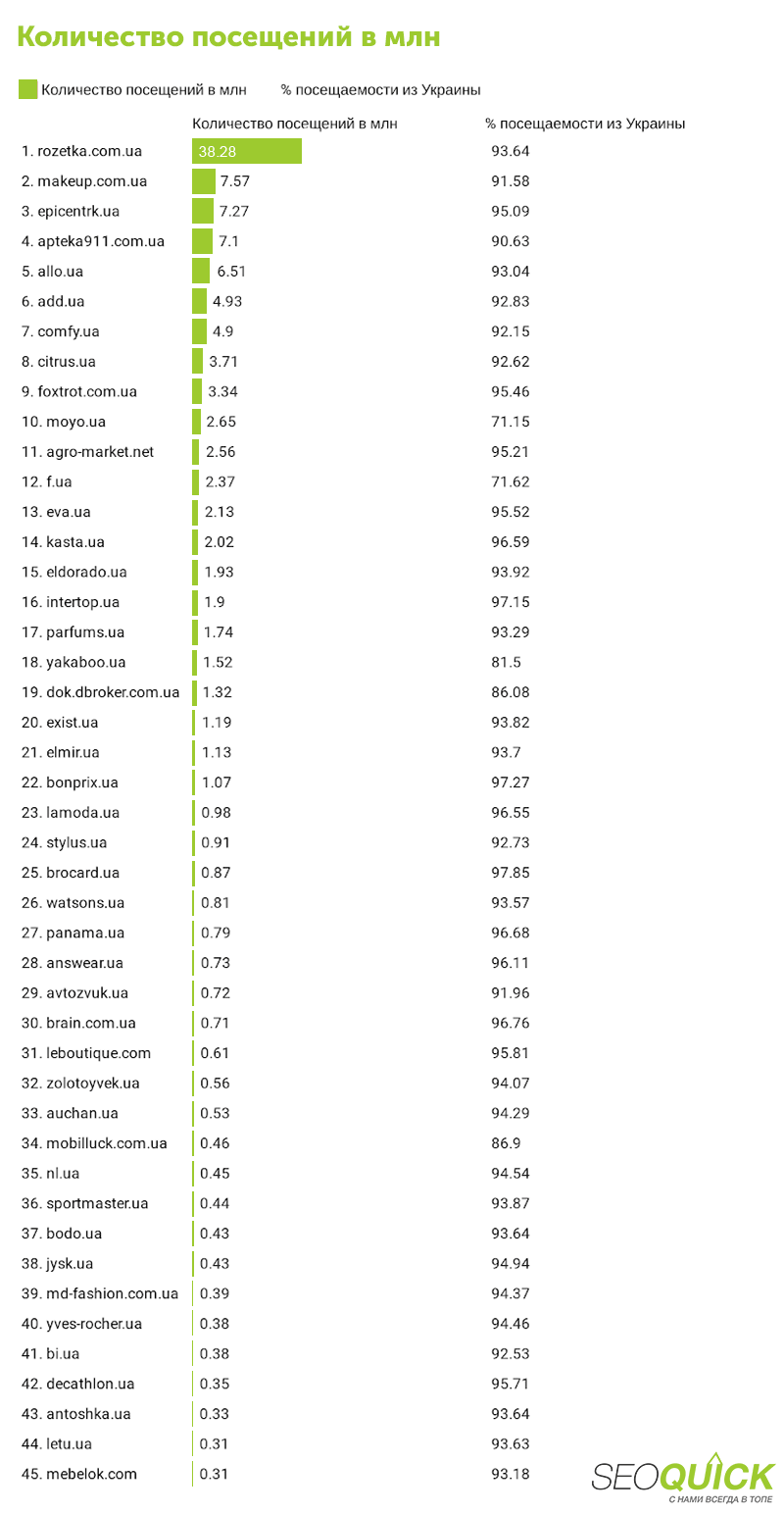
Behind the visibility of large stores lie not only good products and prices, but also thoughtful promotion: targeting, paid search, social content, and organic traffic from search. This large-scale work is usually run by digital agencies — and they are exactly what we will talk about today.
Hey! Yes, you. Looking for traffic to your site? SEOquick will bring you 100% organic!
SEO is your long-term and reliable source of traffic from Google and Bing.
We deliver comprehensive SEO promotion: content, reputation, on-page SEO optimization, link building.
Our SEO is white-hat, and our goal is to get you to the TOP! We know exactly what to do and how. That's what you need, right?
Types of internet marketing companies
Online promotion involves far more tools than it seems at first glance, so the market is full of companies with very different profiles. There are no strict dictionary definitions for them — the names stuck informally, for mutual understanding between clients and contractors. Broadly, they fall into three big categories.
Internet marketing agency
Essentially, this is a familiar advertising agency that works exclusively online. Such companies usually handle paid search and display advertising, SEO promotion, and social media growth. Their strength is generating demand and traffic; the typical risk is a focus on traffic detached from conversion and sales.
Website development agency
The name speaks for itself: such companies build sites from scratch — from informational projects to online stores. This also includes design, layout, content population, and quality control of the resource. The strength is the website and design; the risk is a weak marketing strategy after launch, when a beautiful site brings no leads.
Web studio
The work of web studios partly overlaps with that of website development agencies, but studio specialists build not only sites but also mobile apps and complex systems. There are also narrow-profile players: small web agencies, copywriting firms, and teams that do only performance advertising. Either way, they all gravitate toward one of the three categories above.
Want to get organic traffic and discuss website promotion? Fill in the form below — we will analyze your niche and propose a growth plan for your business.
What is a digital agency
We have sorted out the types of companies — now to the main point. A digital agency is the broadest-profile company in digital promotion. It can cover website development and design, media advertising, social media promotion, video content, content marketing, and SEO — and connect all of it into a single system. Agencies are also the ones who most often create "viral content" that grows organically through reshares.

Inventing genuinely viral mechanics is not easy — it is a distinct competency. The range of specialists in digital agencies is wide: copywriters, SEO specialists, developers, marketers, paid-media specialists, designers, videographers, and analysts. In 2026, this list has been joined by AI-search specialists, prompt engineers, and data analysts responsible for the measurability of results.
Recommended reading:
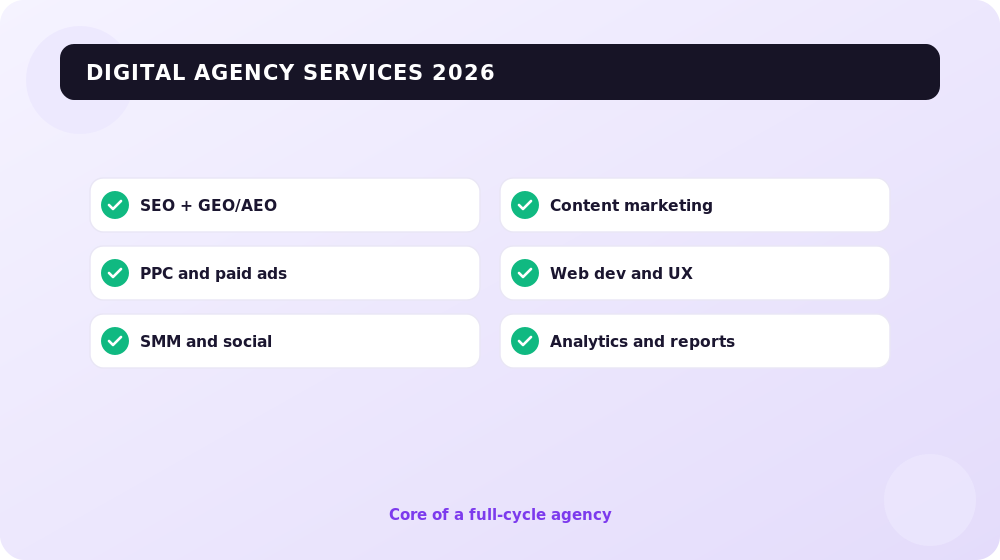
Digital agency services: 5 key areas
Some agencies work as full-cycle providers, while others pick one or two areas and go deep. Here are the five areas that form the core of a modern digital agency.
- SEO and AI-search optimization. SEO optimization means technical clean-up of the site, work on structure and content, and growth of organic positions. In 2026, a GEO/AEO layer was added on top of classic SEO — optimization for generative search. According to industry research, up to 60% of search sessions now end without a click, because the user gets the answer right inside an AI summary. That is why strong agencies grow both rankings in search results and brand mentions inside AI answers at the same time.
- Paid advertising (PPC). Google Ads, social media ads, remarketing. A fast source of demand, but with direct dependence on budget — the moment ads are switched off, the flow of leads drops.
- SMM and social media work. Community management, content planning, and paid promotion on Instagram, Facebook, and TikTok. The choice of platforms depends on the target audience.
- Content marketing. First, useful content is created to attract and retain an audience, then a selling layer is gradually added. In 2026, content is written so that both people and language models understand it at the same time.
- Web development and UX. The website is the foundation of all other channels. Without a convenient structure, speed, and a thoughtful user journey, traffic does not turn into requests. That is why web development and UX optimization are a mandatory part of a full-cycle agency's work.
All SEOquick services are collected in the services section, and search promotion specifically lives on the search promotion page.
What is a full-cycle digital agency
A full-cycle digital agency takes on the entire range of marketing work: from strategy and the website to advertising, content, and analytics. Businesses turn to such agencies for convenience and speed — you agree on terms, budget, and timelines once, while a team of specialists with different profiles works on the project in parallel. An added benefit is high efficiency thanks to channel synergy: SEO reinforces content, content feeds social media, and ads amplify what already works in organic.
The main risk of full-cycle is blurred accountability: when "everyone is responsible," in practice no one is. That is why it is important to fix in the contract who owns each KPI and how responsibility is split between channels.
Agency or in-house team: what to choose in 2026
One of a business's main questions is whether to hire marketers in-house or work with an agency. The short answer: it depends on scale, the pace of change, and the need for narrow competencies.
An in-house team offers deep product immersion, full control, and fast approvals. The downsides are high cost and difficulty scaling. A fully loaded in-house function (salaries, taxes, tools, training, management) costs more than it seems: the real cost of an employee is usually 1.3–1.5x their base salary. And the narrow competencies of 2026 — AI search, technical SEO, attribution analytics — are expensive to hire and even more expensive to retain on your own.
An agency gives access to a team of specialists across all areas at once, flexible scaling up and down for the season, and a fresh perspective from dozens of projects. The risk is competing for the contractor's attention with other clients, so transparency and regular reporting matter.
A hybrid model often turns out to be optimal: one internal person owns the brand and communication, while the agency handles execution across SEO, ads, content, and analytics. This way the business keeps control over strategy without paying for a full staff of narrow specialists.
How to choose a digital agency: criteria, pricing, and KPIs
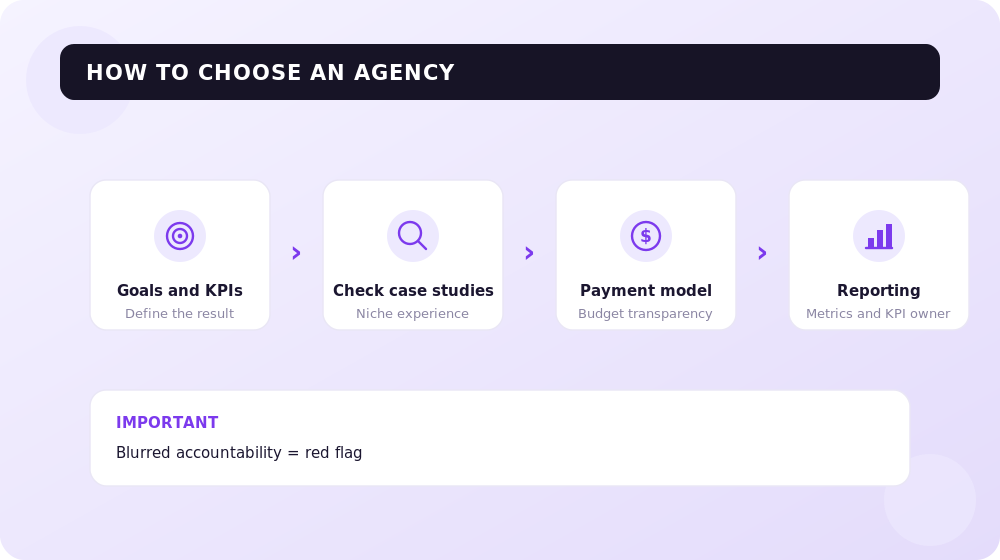
Choose an agency not by a pretty list of services, but by how it thinks and counts.
Selection criteria
Look at the process: does the agency run an audit before the start, explain priorities, and show the risks and assumptions behind its forecasts. What matters is mastery of analytics (GA4, end-to-end analytics, attribution models), relevant case studies for your short- and long-term goals, and how the agency applies AI — for efficiency, but under human control.
Pricing and payment models
Three models are common on the market: a fixed retainer for a scope of work, a percentage of ad spend (often 10–20% for PPC), and a hybrid "base + performance bonus" model that splits risk more fairly between client and contractor. According to 2026 industry pricing reviews, budgets vary widely depending on the scope of tasks. The main benchmark is not the lowest price, but ROI relative to the investment.
KPIs and metrics
Demand metrics that reflect business growth: cost per lead (CPL), customer acquisition cost (CAC), lifetime value (LTV), and the share of organic growth. Avoid agencies that send dashboards full of impressions, clicks, and reach unrelated to revenue. A good practice is to fix KPIs over 30 / 90 / 180-day horizons. Google Search Central covers approaches to measurability in more detail.
Red flags when choosing a contractor
Be cautious if an agency:
- guarantees "top rankings and leads" without access to analytics, CRM, current pages, and product economics;
- operates only with impressions and reach, without tying them to the funnel and revenue;
- does not explain the assumptions behind its forecasts;
- refuses to fix scope, timelines, and responsibility in the contract;
- pushes a rigid annual contract with no performance clauses and no right to exit with 30 days' notice.
The role of AI in digital agencies in 2026
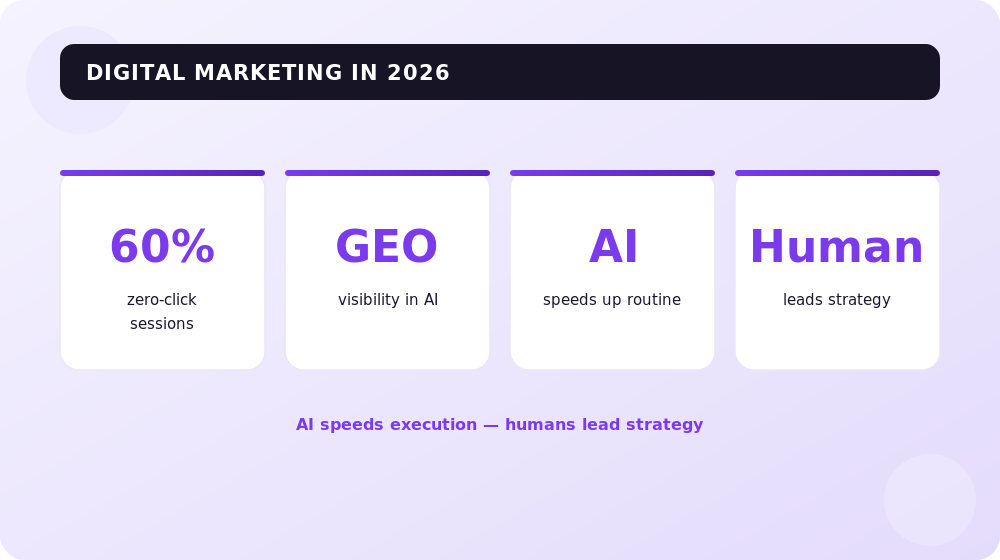
Artificial intelligence is now embedded in almost all agency processes: from data analysis and content drafts to campaign personalization and predictive analytics. But the key principle of 2026 is that AI speeds up execution, while strategy is still led by a human.
The main change is the emergence of a GEO (Generative Engine Optimization) layer: optimization for visibility, citation, and brand presence inside the answers of neural networks and language models. This is not a replacement for SEO, but its natural continuation on top of a solid foundation. GEO includes technical preparation for AI crawlers, content structuring, authority building through mentions on third-party sites, and monitoring where the brand appears in AI answers and where it does not.
At SEOquick we develop our own AI tools for diagnostics and routine automation — you can see them in the AI tools section, and learn about the team and approach on the about us page. Useful guidance on managing a local business presence is provided by the Google Business Profile help.
Frequently asked questions
How is a digital agency different from a marketing agency?
A marketing (internet marketing) agency focuses on attracting the client's target audience through performance channels. A digital agency is a broader concept: it works on both demand and brand awareness, connects online channels into a single system, and often adds video, content, and media work. In practice the boundaries are blurred, and many use the terms as synonyms.
How much do digital agency services cost?
The price depends on the scope of tasks and the payment model: a retainer, a percentage of ad spend, or a hybrid "base + performance bonus." The range is wide, so focus not on the minimum price but on return on investment and transparency about what is included versus what is billed separately.
Which is more cost-effective — an agency or an in-house marketer?
For small and medium businesses, an agency is usually cheaper than a full in-house team and gives access to narrow competencies. Large brands with a unique product lean toward in-house or hybrid: an internal person owns the brand, while the agency handles execution.
What is GEO and why is it needed in 2026?
GEO (Generative Engine Optimization) is the optimization of content for the answers of neural networks and AI search. Since more and more users get an answer right inside an AI summary without visiting the site, it is important for the brand to be cited and mentioned there. GEO works as an add-on layer on top of classic SEO.
How do you know an agency is working effectively?
By business-related metrics: CPL, CAC, LTV, the share of organic growth, and revenue — not by impressions and reach. A good agency shows progress over 30 / 90 / 180-day horizons and is honest about what worked and what did not.
Which red flags should you watch for?
Result guarantees without access to data, reports built only on vanity metrics, refusal to fix scope and responsibility in the contract, a rigid annual contract with no exit option, and the opaque use of AI without human control.
Conclusions
A digital agency in 2026 is not a "magic wand" but a system: SEO and GEO, paid advertising, SMM, content, web development, and analytics, connected by a single strategy. Choose a partner by their decision-making process, transparent KPIs, and honest attitude toward risks — not by the length of the service list. The choice between agency, in-house, or hybrid depends on your scale and need for narrow competencies. And the role of AI comes down to a simple rule: the machine speeds up execution, while the human is responsible for strategy and results.
Crowd Marketing: 2 Core Goals, 5 Platform Types, 5 Approaches to Use
Crowd marketing yesterday and today. 2 core directions for choosing a crowd strategy and ideal platforms. The systematic work of a crowd marketer.
Read →
Best SaaS SEO Agencies in 2026 and What They Charge
Nine pages seriously compete for this search in the US — after that Google pads the results with the IAEA and DARPA. The real price range starts at $5,000 a month and runs to $40,000, nine of seventeen agencies rebranded around AI search this year, and I am not first on my own list.
Read →
What ecommerce SEO costs in 2026 and what you pay for
Why the same question gets answered with $300 and $3,000, what actually drives the price, what agencies publish on their own sites, the five costs that are never in the quote, and how to work out whether it pays back on your catalogue.
Read →Want to apply this to your site?
We will review the current situation, find the first growth levers, and suggest a practical working format.