How to Build a YouTube Channel for Business in 2026: A Step-by-Step Growth Guide
Launching a YouTube channel for business in 2026: niche, the Shorts and long-form balance, YouTube SEO, AI tools, retention analytics and monetization thresholds.


I will look at your site and answer your questions on the topic of this article. 30 minutes, no slide decks, no pressure.
Book a consultationYou can launch a YouTube channel for your business in 2026 over a weekend and with almost no budget: all you need is a smartphone, a clear niche and a content plan. But growth is driven not by your camera and lighting, but by three things — viewer retention, a clickable package (title + thumbnail) and consistency. In 2026 the YouTube algorithm ranks by audience satisfaction and watch time, not by subscriber count. A hybrid of Shorts (for reach and discovery) plus long-form videos of 8–12 minutes (for retention and sales) delivers 3–4x better results than betting on Shorts alone. Below is a step-by-step plan: niche and positioning, content strategy, YouTube SEO, AI tools, analytics and monetization.
YouTube remains the No. 1 video platform in the world: over 2.5 billion monthly active users and the second-largest search engine after Google. People watch reviews, how-to guides, case studies and product breakdowns here — and make buying decisions. For a business this isn't about being "trendy"; it's a standalone channel for attracting warm audiences who are looking for answers and trust those who provide them.
In this article we've gathered the current 2026 best practices: how to choose a niche, what and how to film, how to optimize videos for YouTube search, which AI tools save time and when a channel starts earning. If you'd like an individual promotion strategy for your channel, leave your contacts in the form below.
What does your competitor have that you don't yet? Right — traffic. SEOquick to the rescue!
We'll bring a ton of traffic to your site through SEO.
We'll do it with white-hat methods only, with no filters or penalties from Google.
We'll run a deep optimization: strengthen content, build links and reputation. And it will all work out!
When it comes to YouTube in the context of influence marketing (where you don't sell head-on but provide value, and the buying decision comes based on your expertise and brand strength), video has a huge advantage here: a long video has time to build the trust that a short feed post cannot. In parallel, YouTube promotion and overall video marketing work as part of your brand strategy.
Who needs their own YouTube channel in 2026
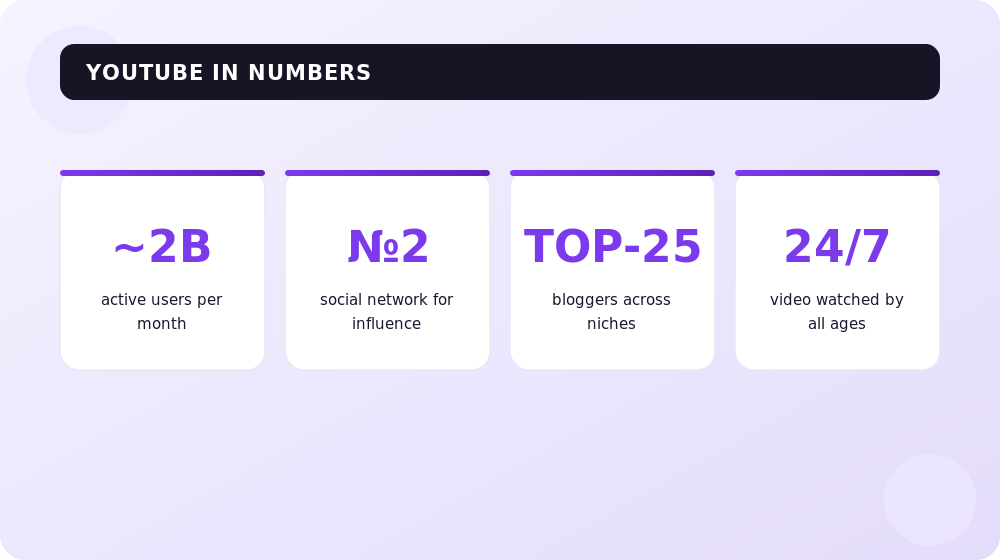
The short answer is almost any business and any expert who has something to show and explain. YouTube itself serves each viewer relevant videos, so even a narrow niche finds its audience. A channel is especially justified if:
- Your product needs to be explained or demonstrated — SaaS, equipment, services, complex products. Video answers the "how does it work" question better than any text.
- You're building an expert brand — a lawyer, dentist, marketer, craftsman. Educational content turns a viewer into a client.
- You have a long sales cycle — video "warms up" the audience between the first touch and the purchase.
- You want cheap, evergreen traffic — a good video brings views from YouTube and Google search for years, unlike a social feed.
For example, you own a business and are thinking about content for your channel. There are several ideas right away: tell the story of your company's journey, show the team and the work process, break down the typical mistakes clients make in your niche. People come to YouTube not only for entertainment but for solutions — give them solutions.
Ukrainian examples confirm this: local experts in construction, cooking, IT and education build audiences of tens and hundreds of thousands of subscribers by staying genuine and showing real work rather than a polished facade. The key is consistency and usefulness.
Niche and positioning: the channel's foundation
In 2026 a generic channel doesn't win. Within 3 seconds the viewer must understand why they should subscribe to you specifically rather than to "just another marketer." A clear niche isn't a limitation but a navigator for the algorithm: when you stick to a single theme, YouTube understands faster who to recommend you to and lifts your reach.
Before launching, answer three questions:
- Why do I need a channel? Sales, leads, personal brand, hiring, client education — each goal has its own success metric. "Because everyone has one" is not a goal.
- Who am I filming for? Describe a specific viewer: their pain, level of knowledge, the question they Google before buying.
- What makes me different? A narrow angle, personality, format, access to real cases — find your edge.
A great technique is series. YouTube rewards consistent recurring formats: if a viewer watches several episodes of one series, the platform learns the audience's interest and recommends your content more often. Plan 2–3 permanent recurring formats for the channel to live around.
Recommended reading:
Content strategy: Shorts versus long-form
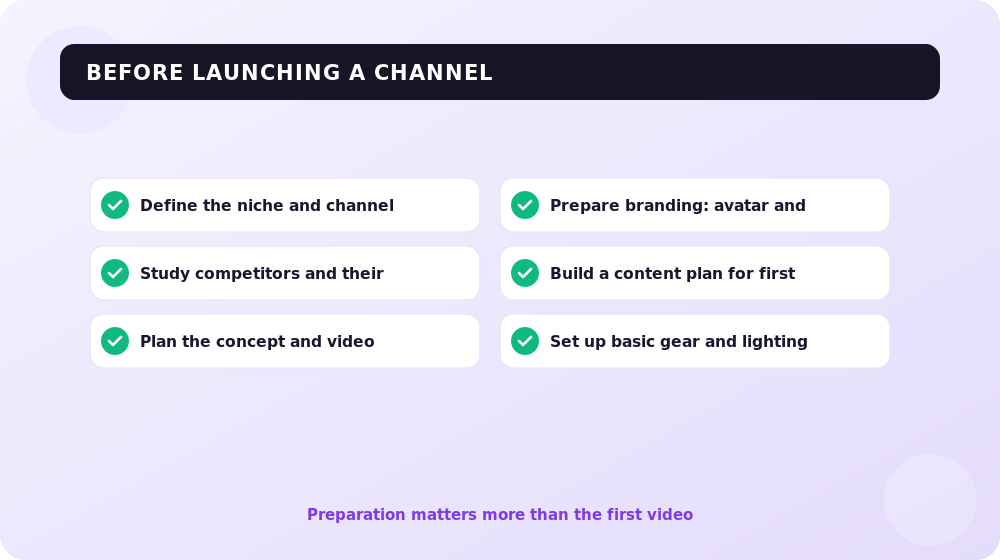
The main strategic question of 2026 is the balance of formats. The data shows a clear division of roles:
- Shorts deliver a high CTR (15–30%) but only 40–55% retention. They are a tool for reach and introduction — you use them to attract new viewers who don't know you yet.
- Long-form videos have a more modest CTR (5–12%) but 60–70% retention and noticeably higher revenue per view. They are a tool for trust and conversion.
The optimal length for revenue without losing retention is 8–12 minutes: it fits 2–3 ad breaks while average view duration stays around 65–70%. The 2026 algorithm explicitly rewards channels that publish both formats: long videos get more recommendations and Shorts reach a broader audience.
The recommended starting mix for a business channel is 60–70% long-form and 30–40% Shorts. Shorts lead to long videos, long videos lead to your site and product.
Consistency matters more than frequency
Upload frequency on its own doesn't affect rankings — YouTube doesn't penalize "once a week" versus "three times a week." What really works is a steady, realistic schedule. Most successful channels publish 1–3 quality videos per week. If your audience expects a video every Thursday and you reliably deliver, the platform pushes notifications and recommendations more confidently. Long-term consistency beats short bursts of daily uploads followed by burnout.
First steps on camera
- Shoot a test video. Find a spot with good light, talk about yourself, watch the recording and assess the picture, speech and framing.
- Write a plan, not a script. A word-for-word script kills naturalness — write out the talking points and speak in your own words.
- Strong first 30 seconds. Retention is decided at the start: state right away which problem the video solves, with no long intros.
- Call to action. Ask viewers to subscribe and like — but offer value in return: "subscribe and every week you'll get one case study breakdown."
YouTube SEO: how videos get found in search
CTR and watch time are the two biggest ranking factors in 2026. The title and thumbnail drive the click, the content drives retention. Here is a working optimization checklist:
- Titles. Titles with numbers or a year ("2026," "in 5 steps," "complete guide") get clicked more than vague ones. Pick one target phrase before filming and lead with the keyword.
- Description. 300–500 words, the primary keyword in the first 2–3 lines (those are the only ones visible before the "Show more" click). Add timestamps.
- Chapters. Chapter markers increase average watch time by about 11% — viewers jump to the relevant section and the algorithm better understands the video's structure.
- Thumbnail. High contrast, large readable text, genuine facial expression, a style that's recognizable yet distinct per video. Test two thumbnail variants in YouTube Studio and keep the one with the higher CTR.
YouTube SEO is part of overall search engine optimization: optimized videos bring traffic both from YouTube itself and from Google's results, where videos often appear directly in the SERP.
AI tools for filming and promotion
In 2026 a single creator with the right stack of tools does in a day what used to take a team of four. What to use:
- Scripts and ideas: Claude and ChatGPT help assemble the structure, titles and talking points. Specialized services like vidIQ turn a single idea into a script, title, description and a thumbnail prompt.
- Editing: Descript and CapCut automatically remove pauses, generate captions and cuts, and suggest edits.
- Video and voiceover: generative platforms (Veo, Runway, Sora) create b-roll from text, and dubbing tools translate a video into other languages in the creator's own voice.
- Thumbnails: AI generators suggest colors and composition based on current trends and predict CTR.
Important: AI is an accelerator, not a substitute for substance. Expertise, real cases and your personality remain the reason a viewer subscribes.
Analytics, your first 1,000 subscribers and monetization
You can't grow a channel blind. The key metrics in YouTube Studio:
- Thumbnail CTR — whether people click the video in impressions (around 5–10% is normal for long-form).
- Average retention — where viewers drop off; the first seconds and dips in the graph show what to fix.
- Traffic sources — search, recommendations, the Shorts feed: you can see exactly what brings new viewers.
As for monetization, the YouTube Partner Program thresholds in 2026 look like this:
- Full ad revenue: 1,000 subscribers and 4,000 watch hours in a year — or 10 million Shorts views in 90 days.
- Early access: you can apply with just 500 subscribers, 3 public videos and 3,000 watch hours (or 3 million Shorts views) in 90 days — unlocking Super Thanks, memberships and YouTube Shopping.
- Required: two-step verification, no active strikes, original content. Review typically takes around 30 days.
But for a business the main money isn't in YouTube ads — it's in the leads, sales and orders that come from the channel. Ad revenue is a nice bonus, but the payback comes from the warm audience you've nurtured with content.
The advantages of YouTube for business
There's Vimeo, TikTok, Instagram Reels — but YouTube was and remains the backbone platform for video marketing. Why:
- Evergreen traffic. Unlike a social feed, a video brings views from search for years — it's an asset, not a one-off post.
- Dual search. You get found both inside YouTube and in Google, where videos appear directly in the results.
- Depth of trust. A long video builds an expert image in a way a short format cannot.
- Format flexibility. Shorts, long videos, livestreams, podcasts — all on one platform.
- Minimal startup. A smartphone, daylight, an inexpensive lavalier mic — and you can start; buy more gear once the channel is already growing.
Frequently asked questions about launching a YouTube channel
How much does it cost to launch a channel in 2026?
The start is almost free: a smartphone with a camera, free editing software (CapCut, InShot, iMovie) and daylight. The only paid item worth getting at the start is a lavalier mic — audio matters more than picture. Buy more gear as you grow.
How many videos do you need to grow?
Consistency matters more than quantity. 1–3 quality videos a week on a steady schedule work better than a sprint of daily uploads ending in burnout. The algorithm values viewer satisfaction and retention, not volume.
What should you choose — Shorts or long-form?
Both. Shorts deliver reach and new viewers; long-form delivers retention, trust and sales. For a business, 60–70% long-form and 30–40% Shorts is optimal, with Shorts leading to the long videos.
When will the channel start making money?
YouTube ads turn on at 1,000 subscribers and 4,000 watch hours (or 10 million Shorts views); early access starts at 500 subscribers. But for a business the main income is the leads and sales from the channel, which can begin long before monetization.
How do you grow fast from zero?
A narrow niche and recurring series, a strong first 30 seconds for retention, clickable titles with numbers and high-contrast thumbnails, A/B testing covers in YouTube Studio, and retention analysis. Use Shorts to bring in new audiences.
Does a beginner need AI tools?
They save a lot of time on scripts, editing, captions and thumbnails, but they don't replace expertise and the creator's personality. Use AI as an accelerator and keep the substance and real cases for yourself.
Conclusions
Launching a YouTube channel for your business in 2026 is easier than it seems, but growing it is systematic work. Choose a narrow niche, keep a regular schedule, balance Shorts and long-form, optimize titles, descriptions and thumbnails for search, use AI for speed and watch your retention analytics. The money doesn't come instantly and not only from ads — the channel's main value for a business is the warm audience that trusts you and buys. Don't wait for the perfect moment: pick up your smartphone and shoot your first video today.
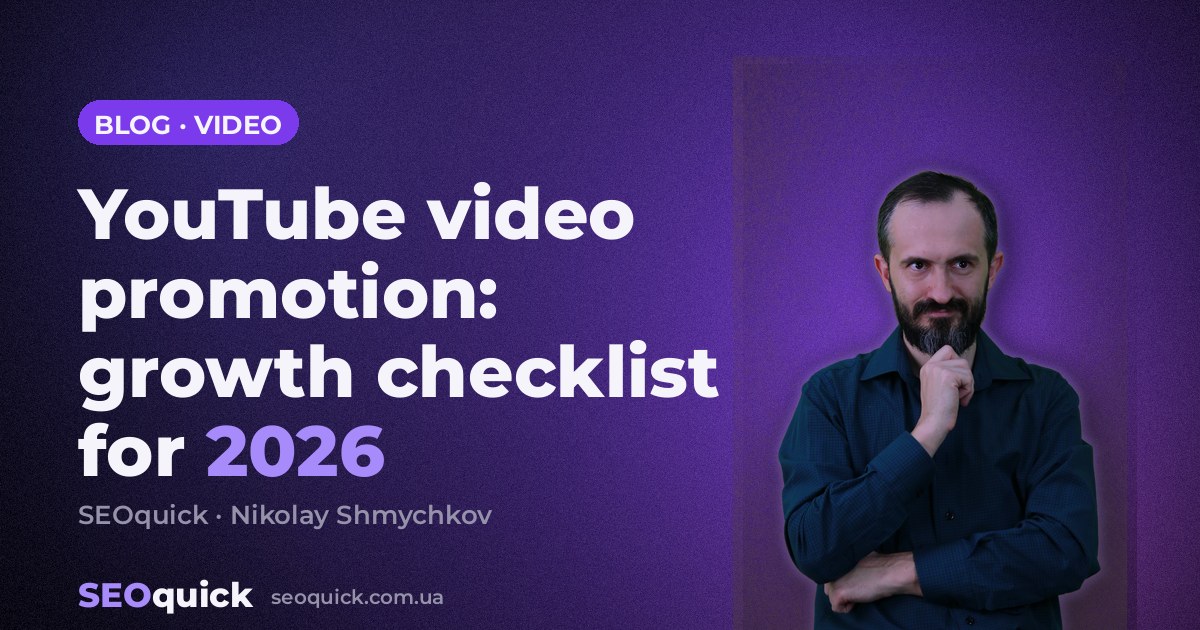
YouTube Video Promotion in 2026: Algorithm, Optimization, Monetization
How to promote YouTube videos in 2026: algorithm signals, thumbnails and retention, Shorts, YPP monetization thresholds, and the channel-to-site-to-leads funnel.
Read →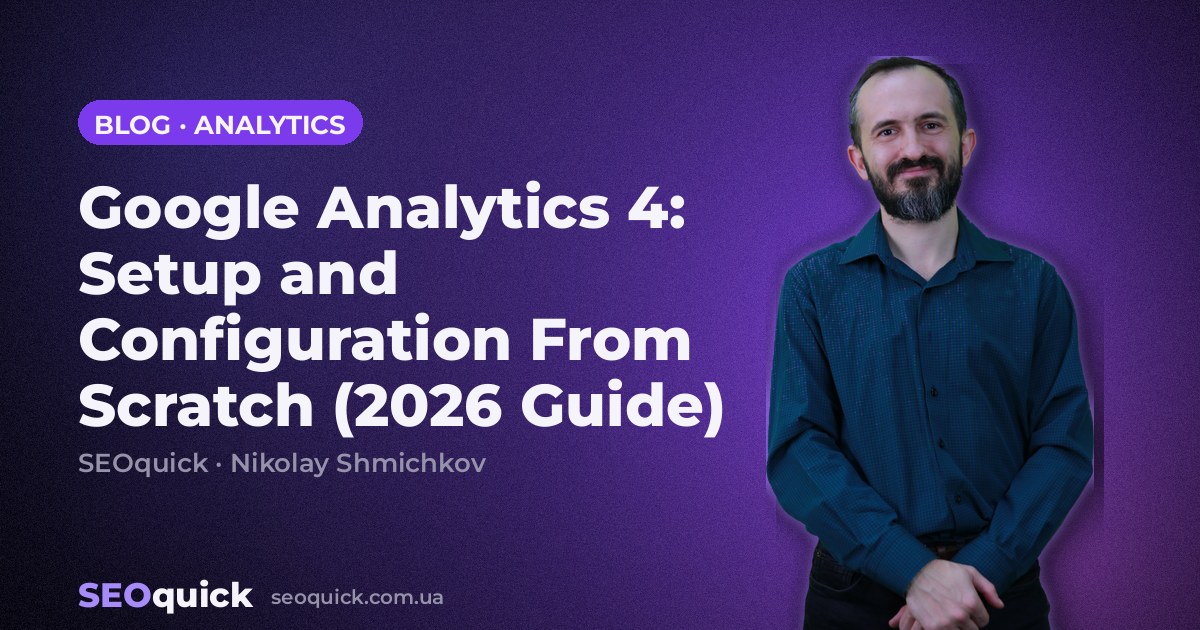
Google Analytics 4: Setup and Configuration From Scratch (2026 Guide)
Step-by-step Google Analytics 4 guide: creating a property and data stream, installing the tag via gtag or GTM, key events, reports, Consent Mode v2, and AI traffic.
Read →
How to Track AI Traffic in GA4: ChatGPT, Gemini, Claude, Perplexity
Google Analytics 4 added an AI Assistant channel — but it misses a lot. How to build a custom channel group, catch Perplexity and the invisible AI traffic hiding in Direct, and see the real revenue AI brings you.
Read →Want to apply this to your site?
We will review the current situation, find the first growth levers, and suggest a practical working format.