ChatGPT for SEO in 2026: 8 Ready-Made Prompts, Limits, and How to Rank in AI Search
In 2026, ChatGPT is both a working tool for SEO specialists and a new search engine you need to rank in. I break down the GPT-5.5 lineup, share 8 ready-made prompts for routine tasks, and show how to get your site cited in ChatGPT Search answers.


I will look at your site and answer your questions on the topic of this article. 30 minutes, no slide decks, no pressure.
Book a consultationI have been using ChatGPT in my work since 2023 — and in three years it has gone from a toy that produced fluffy, watered-down copy to a tool that handles half of an SEO specialist’s routine. But alongside that, ChatGPT’s second role has grown: it is no longer just an assistant, it is also a search engine in which your site either gets cited or simply does not exist.
This guide covers both sides. First, the practice: which model fits which task, the 8 ready-made prompts we use at SEOquick, and the limitations that trip up beginners. Then, ranking inside ChatGPT itself: how its search works under the hood and which factors influence citations.
ChatGPT for SEO is a way to automate routine work (keyword research, clustering, meta tags, schema markup, copywriter briefs, quick audits) and, at the same time, a new traffic channel: for your site to be cited in ChatGPT Search answers, it must be open to OpenAI’s crawlers, indexed in Bing, and provide direct, well-structured answers. AI speeds up the work many times over, but final fact-checking and expertise remain a human job.
Why You Cannot Ignore ChatGPT in 2026
A few numbers that capture the scale:
- 900 million weekly active users — OpenAI’s figure as of February 2026. This is no longer a “tool for geeks” but a mass habit.
- 12.1% of signups from 0.5% of traffic. An Ahrefs study showed that ChatGPT traffic delivers a disproportionately high share of conversions — visitors arrive “warmed up” because the assistant has already answered their basic questions.
- 69% of search sessions end without a click — Similarweb’s estimate. Zero-click is the new normal: users get their answer in the SERP or from an AI assistant and never visit the site.
- Gartner predicts a 25% drop in classic search traffic — a share of queries is migrating to AI assistants for good.
The takeaway for an SEO is twofold. First, ChatGPT saves hours of work — it would be foolish not to use it. Second, you now need to optimize your site not only for Google but also for AI answers — more on that in the GEO section below.
The Model Lineup: What to Pick for SEO Tasks
In 2026, “just ChatGPT” no longer exists — there is the GPT-5.5 lineup, and your results depend on the model you choose. GPT-5.5 launched on April 23, 2026, and since May 5 the default model for all users has been GPT-5.5 Instant — by OpenAI’s internal evaluations it produces 52.5% fewer false claims than the previous Instant model on “sensitive” topics like medicine and finance.
| Model | What it is | Best SEO use cases |
|---|---|---|
| GPT-5.5 | Flagship model (April 2026) | Complex copy, deep competitor analysis, strategy |
| GPT-5.5 Instant | Fast, default since May 2026, −52.5% hallucinations | Routine: meta tags, product descriptions, quick ideas, clustering |
| GPT-5.5 Thinking | Reasoning model that “thinks” before answering | SERP analysis, audits, large keyword spreadsheets |
| GPT-5.5 Codex | Coding model | Schema markup, GSC API scripts, regex, scrapers |
My rule: routine goes to Instant; anything that needs logic and data work goes to Thinking; markup and automation go to Codex. A paid plan pays for itself within one working day: on the free tier, Thinking-model limits run out faster than an average audit takes.
8 Ready-Made Prompts for SEO Tasks
We use these prompts at SEOquick every day. They are written so you can copy them and plug your own data into the square brackets. The general principle: the more context you give (niche, region, language, output format), the fewer edits you make later.
1. Keyword Research
You are an SEO specialist. Niche: [food delivery], region: [Chicago],
language: English. Build a list of 50 search queries that potential
customers type into Google. Split them into groups by intent:
commercial, informational, navigational, local. Add long-tail queries
and questions like "how / how much / where". Format: a table
"query | intent | suggested landing page".
Important: ChatGPT does not know search volumes — it will make them up if you ask. Run the idea list through Serpstat, Ahrefs, or Keyword Planner first, and only then put it to work.
2. Keyword Clustering
Here is a list of keywords with search volumes (pasted below).
Group them into clusters by search intent: one cluster =
one landing page. For each cluster specify: the primary keyword
(highest volume), supporting keywords, page type (category /
article / service / product page), recommended H1.
Format: a table. Queries that do not fit any cluster should go
into a separate "to remove" list.

[list: keyword - search volume]
On small keyword sets (up to 300-500 keywords) GPT-5.5 Thinking clusters on par with paid tools. On large sets, split the list into chunks — otherwise the model starts “losing” queries from the middle.
3. Meta Tags
Write a Title and Description for a page.
URL: [/pizza-delivery-chicago/]
Page type: [service category]
Primary keyword: [pizza delivery Chicago], supporting: [order pizza
online, pizza delivery near me]
Requirements: Title up to 60 characters with the keyword near the
beginning, no clickbait; Description 140-155 characters with the
keyword and a call to action.
Give 3 versions of each and count the characters.
4. Schema Markup
Generate JSON-LD schema.org markup for a page [type: FAQPage /
Product / LocalBusiness / Article]. Here is the page content: [text].
Requirements: only real data from the page, do not invent anything;
valid JSON-LD in a single <script> block; Google's required and
recommended properties. After the code, briefly explain which fields
I should verify manually.
The Codex model is a better fit for markup: fewer syntax errors. Still run the result through the Schema Markup Validator and the Search Console report.
5. SERP Analysis
I want to rank in Google's top results for [query]. Here are the
texts / heading structures of the top 5 pages in the SERP (pasted
below). Analyze: 1) what intent the SERP satisfies; 2) which subtopics
all competitors cover (mandatory); 3) which subtopics only 1-2 cover
(opportunity); 4) what nobody covers but would logically belong.
Output a recommended H1-H2-H3 structure for my page.

[competitor content]
ChatGPT cannot see the live SERP for your region — collect the data yourself (manually or with a scraper) and feed it to the model. If built-in search is enabled, check which pages it actually opened.
6. Copywriter Brief
Write a content brief for a copywriter.
Topic: [topic], primary keyword: [keyword], supporting: [list].
Audience: [who reads it and why]. Include in the brief: a working
headline, an H2-H3 structure with talking points for each block
(2-3 sentences on what to cover), word count per block, a list of
facts and figures that must be verified against sources, uniqueness
and style requirements, and 3 questions for an FAQ block.
7. Refreshing Old Content
Here is my article published in [year] (text below). Today is [date].
Analyze it for staleness: 1) facts and figures that need re-checking;
2) mentions of tools/features that have changed or died; 3) blocks
worth deleting; 4) subtopics that have emerged in the niche since
then and are missing from the article.
Output an update plan by block: "keep / rewrite / delete / add"
with explanations.

[article text]
This is my most-used prompt of 2026: reworking old articles drives growth faster than writing new ones — the page already has age and backlinks.
8. Quick Page Audit
Run a quick SEO audit of a page. Here are the URL, Title, Description,
H1-H3, and text (pasted below). Primary keyword: [keyword].
Check: intent match, keyword usage (under- or over-optimization),
heading structure, topic coverage, duplicate and filler text,
presence of a direct answer above the fold, internal links.
Format: a table "issue | severity | how to fix".

[page data]
An audit like this takes two minutes and catches 80% of typical on-page issues. It does not replace a deep technical audit (speed, indexing, log analysis).
How to Supercharge Any of These Prompts
Answer quality is 80% determined by the context you give the model. Before the main request, I load a “brief” into the chat — and only then assign the task:
| Brief block | What to include |
|---|---|
| Goal | Exactly what I want to get and in what format |
| Example | A text or page to use as a style reference |
| Facts | Specific numbers, prices, and details that must appear in the answer |
| First-hand experience | Cases and observations so the text is not “internet average” |
| Structure | Desired blocks and conclusions, if already clear |
| Anti-examples | What to avoid: clichés, phrasings, topics to steer clear of |
This takes five minutes but saves you three rounds of edits. For teams, it is convenient to package such a brief as a custom GPT or a project — then the context loads automatically into every chat.

ChatGPT Limitations That Trip Up Beginners
Even with 52.5% fewer hallucinations in the Instant model, ChatGPT remains a language model, not a source of truth. Keep these points in mind:
- It makes up numbers and search volumes. Ask for “keyword volumes” or “market statistics” without a source and you will get a plausible fabrication. Every figure must be verified in Serpstat, Ahrefs, GSC, or the primary source.
- Formulaic writing. Models gravitate toward identical constructions (“in today’s world,” “it is worth noting”), identical paragraph structures, and zero first-hand experience. Google detects such text not with AI detectors but by its lack of added value — and does not rank it.
- Regional context. ChatGPT has weak knowledge of local specifics: prices, local laws and regulations, niche slang. In YMYL topics this is a direct road to factual errors. (Our team sees this constantly with Ukrainian-market specifics — assume the same for any non-US market.)
- Data freshness. Without web search enabled, the model relies on its training data. Anything that changed in recent months it simply “does not know” — but it will confidently tell you the old version.
- Confidentiality. Do not paste client data, credentials, or commercially sensitive information into the chat without anonymizing it: your team needs a policy on what may and may not be given to the model.
- Legal responsibility is yours. For an error in a medical or financial article, the website answers — not OpenAI.
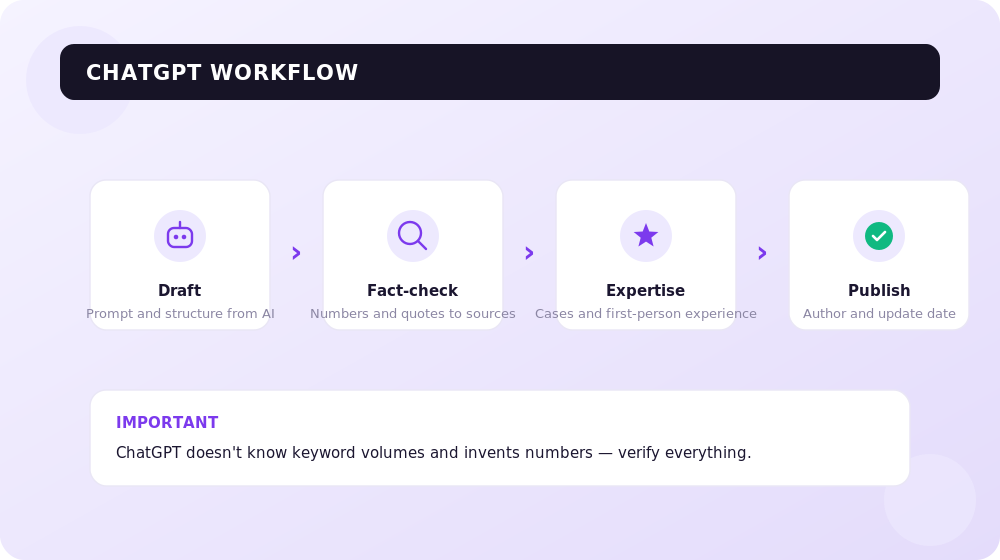
A Working Workflow: Draft → Verification → Expertise
Over three years we have settled on a simple scheme that removes almost all the risks:
- Draft. ChatGPT generates the structure and text from a detailed prompt with source material (your data, cases, and examples go in as input — not “from the model’s head”).
- Verification. A human checks every fact, figure, and name; cleans out formulaic phrases, repetitions, and invented sources; runs a plagiarism check.
- Expertise. A specialist adds what the model lacks: first-hand experience, cases with numbers, screenshots of real projects, opinions on contested questions. This layer is what makes the text meet E-E-A-T.
Drop the third step and you get “internet average” text — and Google and AI assistants cite primary sources, not averages.
SEOquick case: for an e-commerce store in Moldova we built a GPT-content pipeline using exactly this scheme — the model generated drafts, the team supplied source material and verification. The result: +34.8% branded demand and organic growth without a single Google penalty. AI content works when there is a process behind it, not “generate and publish.”
ChatGPT vs Claude vs Gemini: Which Is Better for SEO
We regularly test copy and analytics across all three flagships. There is no universal winner — each model has its zone of strength:
| SEO task | ChatGPT (GPT-5.5) | Claude | Gemini |
|---|---|---|---|
| Keyword research and clustering | Excellent (Thinking) | Good | Good |
| Copy in non-English languages (e.g., Ukrainian) | Good, sometimes formulaic | Best style, less filler | Average, drier |
| Long documents (keyword sets, exports) | Good | Excellent context retention | Excellent (huge context window) |
| Schema, code, automation | Excellent (Codex) | Excellent | Good |
| Fresh data from the web | ChatGPT Search | Web search | Best integration with Google |
| Competitor and SERP analysis | Excellent | Excellent | Good |
| Ecosystem | GPTs, API, mass adoption | Projects, artifacts | Google Workspace, GSC |
My practical split: Claude more often wins at writing and editing, ChatGPT at data work and automation, and Gemini at tasks inside the Google ecosystem (Sheets, GSC, YouTube). If you can only afford one — take ChatGPT: it is the most universal, and its audience means you are also learning the platform you will be ranking in.

How ChatGPT Search Works Under the Hood
To rank in ChatGPT, you need to understand its mechanics. OpenAI runs three crawlers, each with its own role:
- OAI-SearchBot — the search crawler. It is responsible for getting your site into ChatGPT Search results. If it is blocked in robots.txt, you will not appear in ChatGPT’s search.
- ChatGPT-User — the agent that visits a page when a user asks the assistant to open or cite a specific URL. These are “live,” on-demand visits.
- GPTBot — the crawler for model training. You can block it on principle, and it will not affect your visibility in ChatGPT search.
The minimal checklist:
- Check robots.txt: OAI-SearchBot and ChatGPT-User must not be disallowed (and make sure your firewall or anti-bot CDN is not cutting them off).
- Bing indexing is mandatory. ChatGPT’s search index relies heavily on Bing — set up Bing Webmaster Tools, submit your sitemap, and verify that key pages are indexed.
- Connect IndexNow. The protocol instantly notifies Bing (and through it, the AI search ecosystem) about new and updated pages. Ready-made plugins exist for WordPress and most CMSs.
- Watch your server logs: ChatGPT-User visits are a direct signal that you are being cited. ChatGPT traffic shows up in GA4 as a referral from chatgpt.com.
A separate note on the quality of this traffic: it is small in absolute numbers but converts noticeably better than organic — the same 12.1% of signups from 0.5% of traffic in the Ahrefs study. The user arrives after a “consultation” with the assistant, already knowing what they need. So measuring the channel’s value by sessions is a mistake: look at conversions and assisted touchpoints.
GEO: 7 Factors That Drive Citations in AI Answers
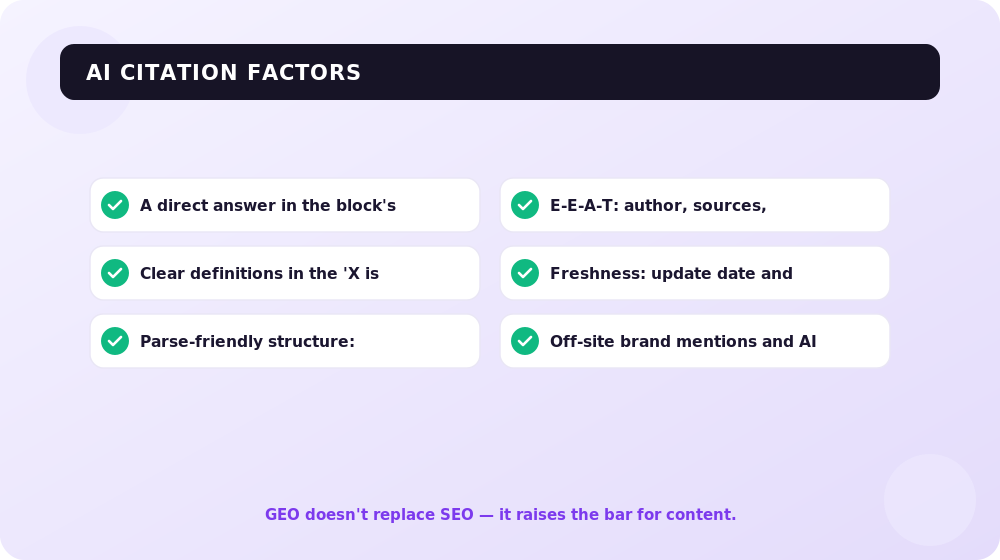
GEO (Generative Engine Optimization) is optimizing content to be cited by AI assistants: ChatGPT, Gemini, Perplexity, AI Overviews, and AI Mode in Google. Classic SEO remains the foundation, but a new layer of requirements has appeared on top of it. Here are seven factors that, in our observation, genuinely affect citability:
- A direct answer at the start of each block. AI assistants extract self-contained passages. Every H2 section should open with the answer to the question in its heading (2-4 sentences), not with a lead-in like “in this chapter we will discuss.”
- Clear definitions. The “X is …” format gets cited most often. Define terms explicitly, even if they seem obvious to your audience.
- Structure that is easy to parse. Lists, tables, numbered steps, FAQ blocks. The model “disassembles” the page into fragments — help it.
- E-E-A-T signals. A named author with expertise, links to primary sources, cases with numbers. AI assistants are trained to prefer authoritative sources — you can see it in the makeup of their citations.
- Freshness. A visible last-updated date and genuine content updates. For “in 2026” queries, assistants try to cite recent material.
- Brand mentions off-site. Models “know” brands from training data and search: reviews, rankings, industry sites, Reddit, and forums influence whether the assistant recommends you.
- Technical accessibility. Openness to AI crawlers, fast HTML delivery (content must not be assembled by JS rendering alone), schema markup, Bing indexing.
The good news: all of this is simply good-content practice that Google already requires. GEO does not replace SEO — it raises the bar.
How to measure results: in GA4, track referral traffic from chatgpt.com, perplexity.ai, and gemini.google.com; in server logs, watch for ChatGPT-User visits; brand visibility in AI answers can be monitored with tools like Ahrefs Brand Radar. Once a month, manually ask the assistants 10-20 key questions from your niche and record whom they cite — this is the most honest “rank tracking” in the new search.

SEOquick case: this is not theory — we already see conversions from AI search in our projects. A service website, nadomu.kiev.ua, gets leads directly from ChatGPT (visible in analytics as referral traffic) after we reworked its content into direct answers. And a medical website of one of our clients appears in Google’s AI answers for 26,714 queries — even though it is a YMYL niche with the strictest source requirements.
Conclusion
In 2026, ChatGPT is two tools in one. As an assistant, it handles the routine: keyword research, clustering, meta tags, schema, briefs, audits — the prompts in this article will save you hours every week. As a search engine, it demands its own workstream: open crawlers, Bing indexing, IndexNow, direct answers, and E-E-A-T.
The main rule has not changed since 2023: AI generates the draft, a human adds the facts and the expertise. Models and hallucination rates change, but what gets cited — and ranked — is still primary sources, not retellings.
Want to know whether AI assistants can see your site and what to fix first? Reach out to us at SEOquick — we will show you on your own project’s data.
FAQ
Can I use ChatGPT for SEO content without risking Google penalties?
Yes. Google officially evaluates content quality, not how it was created. Penalties hit mass-produced, unedited AI content with no added value (the scaled content abuse policy). The working scheme: AI draft → fact-checking → adding expertise, cases, and your own data.
Which ChatGPT model is best for SEO in 2026?
For routine work (meta tags, descriptions, ideas) the default GPT-5.5 Instant is enough — it is fast and produces 52.5% fewer hallucinations than the previous generation. For clustering, SERP analysis, and audits use GPT-5.5 Thinking; for schema markup and automation, Codex.
Can ChatGPT determine keyword search volumes?
No. ChatGPT has no access to search engines’ volume data and will invent numbers if asked. Use it for generating ideas and clustering, and verify volumes in Serpstat, Ahrefs, or Google Keyword Planner.
How do I get my site into ChatGPT Search answers?
Allow the OAI-SearchBot and ChatGPT-User crawlers in robots.txt, get the site indexed in Bing (Bing Webmaster Tools + sitemap), connect IndexNow, and rework key pages into direct answers: definitions, lists, tables, FAQs, and a named author.
How is GEO different from classic SEO?
GEO (Generative Engine Optimization) is optimization for being cited by AI assistants rather than for SERP positions. The technical foundation is shared, but GEO adds requirements: self-contained answer passages, clear definitions, freshness, off-site brand mentions, and accessibility for AI crawlers.
Will ChatGPT replace SEO specialists?
No, but it will change the profession. Models already do the routine (keyword research, meta tags, drafts, basic audits) faster than humans. What remains is strategy, fact-checking, expertise, working with business data, and accountability for results. A specialist with AI replaces a specialist without AI — that is already happening.
50+ mega-prompts for ChatGPT and Gemini: the SEO specialist workflow for 2026
A practical SEO prompt library for keyword research, content, GEO, technical audit, UX, and conversion, with rules for checking AI output.
Read →
Bing Webmaster Tools in 2026: How to Get Into the Bing Index — and Into ChatGPT Answers
A guide to Bing Webmaster Tools 2026: sign-up, import from GSC, IndexNow, reports and audits. Why the Bing index matters for a site that wants into ChatGPT Search.
Read →
Merchant Center for AI Mode: Getting Your Product Feed Ready for Conversational Shopping in 2026
Google AI Mode is reshaping product search and a plain feed no longer cuts it. Here are the new Merchant Center attributes, why stores get banned, and where to start.
Read →Want to apply this to your site?
We will review the current situation, find the first growth levers, and suggest a practical working format.