Local Citations for a Business in Ukraine: Directories, NAP, and AI Search
This article was once called 'How to Submit Your Site to Web Directories.' That era is over: DMOZ is dead, and mass directory submission for links is a spam signal. Here is what replaced it: NAP citations, Google Business Profile, Bing Places, Apple Business, and the Ukrainian platforms that both Google and ChatGPT pull business data from.


I will look at your site and answer your questions on the topic of this article. 30 minutes, no slide decks, no pressure.
Book a consultationLet me be honest: the first version of this article (2020) taught readers to collect hundreds of web directories, scrape search results, and mass-submit their sites for backlinks.
In 2026, I would advise against doing any of that. DMOZ shut down back in 2017, “whitelisted web directories” have either died or turned into dumping grounds, and Google explicitly calls directory submission a link scheme — a violation of its spam policies and a job for SpamBrain, not for your traffic.
But the underlying idea — publishing your business data on third-party platforms — didn’t die. It mutated. It’s now called local citations, and it solves two problems: local SEO in Google and business visibility in AI answers from ChatGPT, Gemini, and Perplexity, which pull company data from exactly these kinds of sources.
I have completely rewritten this piece: what citations are, where a business operating in Ukraine should get listed, how to keep your NAP in order, and why Bing Places suddenly matters again.
TL;DR: a local citation is a mention of a company’s name, address, and phone number (NAP) on a third-party platform: Google Business Profile, Bing Places, Apple Business, marketplaces like Prom.ua, classifieds like OLX, industry directories, and review sites. In 2026, citations are needed not for links but as a trust signal: Google cross-checks NAP across sources for local ranking, while ChatGPT and Perplexity pull business data from the Bing index and Apple Maps. The golden rule: your data must match character for character everywhere.
What Local Citations and NAP Are
A local citation is any mention of your business’s key data on a third-party website. The core of a citation is the NAP formula:
- Name — the company name;
- Address — the address;
- Phone — the phone number.
In practice, NAP is extended with the website, business hours, business category, and description — sometimes called NAP+W (with website).
Citations come in two types:
- Structured — a company listing in a directory, on maps, or on a review site: Google Business Profile, Bing Places, Prom.ua, ua-region. The data sits in predictable fields that crawlers parse easily.
- Unstructured — a mention of the company with its address or phone number in an article, news piece, review, or a “best dental clinics in Kyiv” roundup.
The fundamental difference from the 2020-era “directories for links”: the value of a citation is not in the link (it’s almost always nofollow or absent entirely) but in confirming that the business exists. Google and AI systems cross-check your data across dozens of sources: the more matches, the higher the trust in your company’s entity.
Why Directories for Links No Longer Work
Let me put it bluntly: if someone in 2026 is selling you “submission to 1,000 whitelisted directories,” they are selling you a spam signal pointed at your own domain.
What has changed over the years:
- DMOZ (the Open Directory Project) closed in March 2017. The “grandfather of directories” that the whole industry looked up to hasn’t existed for nearly a decade. Its mirrors like dmoz-odp.org are a museum, not a promotion tool.
- Google explicitly calls it spam. Google’s spam policies list “low-quality directory or bookmark site links” as an example of link spam. Since 2022, the SpamBrain algorithm doesn’t just ignore such links — it neutralizes their value at scale.
- The surviving directories have degraded. Most “whitelisted directories” from the old lists are pages with no moderation, no traffic, and no purpose, existing only to sell placements to other SEOs.
- Blasting your site across 9,000 directories for $50 via GSA and similar tools is no longer gray-hat — it’s black-hat SEO. Best case, the links get ignored; worst case, you get a manual action for link spam.
In 18 years of work, we’ve seen dozens of sites for which “directory submission” produced nothing but a junk backlink profile that later had to be cleaned up via Disavow.
Does this mean listing your business on third-party platforms is pointless? No. The goal has simply changed: instead of “get a link,” it’s now “confirm your business data wherever search engines, people, and language models read it.”

Why a Business Needs Citations in 2026
Three reasons, in descending order of importance.
1. Local Ranking in Google
According to Whitespark’s annual local ranking factors study, Google Business Profile signals account for roughly a third of the weight in the local pack, review signals for about 16%, and citation consistency for roughly another 7%. Citations are not the top factor, but they are the foundation: without a verified NAP, the other signals work worse.
Meanwhile, 46% of all Google searches have local intent, and the top 3 of the local pack collects about 44% of clicks. If you are a business with an address or a service area, local results often bring more clients than the classic organic top 10. We cover this in detail in our local SEO guide.
2. Visibility in AI Answers
This is a new reason that didn’t exist in the first version of this article. When a user asks ChatGPT to “recommend a dental clinic in Kyiv” or asks Perplexity for “the best boiler repair service in Odesa,” the model doesn’t invent an answer — it relies on sources:
- ChatGPT and Microsoft Copilot use the Bing index — business data gets there, among other routes, via Bing Places.
- Perplexity and ChatGPT pull addresses, business hours, and directions from Apple Maps — that is, from Apple Business.
- Gemini and Google’s AI Overviews rely on Google Business Profile and cross-check it against your website and third-party mentions.
- All models additionally “read” review sites, directories, and roundups — unstructured citations.
AI visibility studies from 2026 show that only about 1% of local businesses make it into AI assistant recommendations at all — and what decides it there is not links but profile completeness, reviews, and data consistency across sources. We break down exactly how LLMs choose whom to cite in our articles on GEO: optimizing a website for GPT and content for AI answers.
3. Direct Traffic and Trust
A listing on Prom.ua (Ukraine’s largest marketplace) or OLX (the country’s top classifieds site) is a storefront with its own traffic. A Google profile with 200 reviews is a stronger argument than any banner. And when a client checks out a company before paying, consistent data across five platforms looks like a living business, while mismatched phone numbers look like a reason to close the tab.
SEOquick case: for a massage salon in Kyiv, we built local SEO exactly along these lines — a Google Business profile, a consistent NAP, and systematic review management. The result: #1 for “Thai massage Kyiv” and 120-150% traffic growth in a year. Details in our massage salon SEO case study (in Russian).
The Big Three: Google, Bing, Apple
If you only have time for three platforms, here they are. These are the baseline citations without which everything else is pointless.
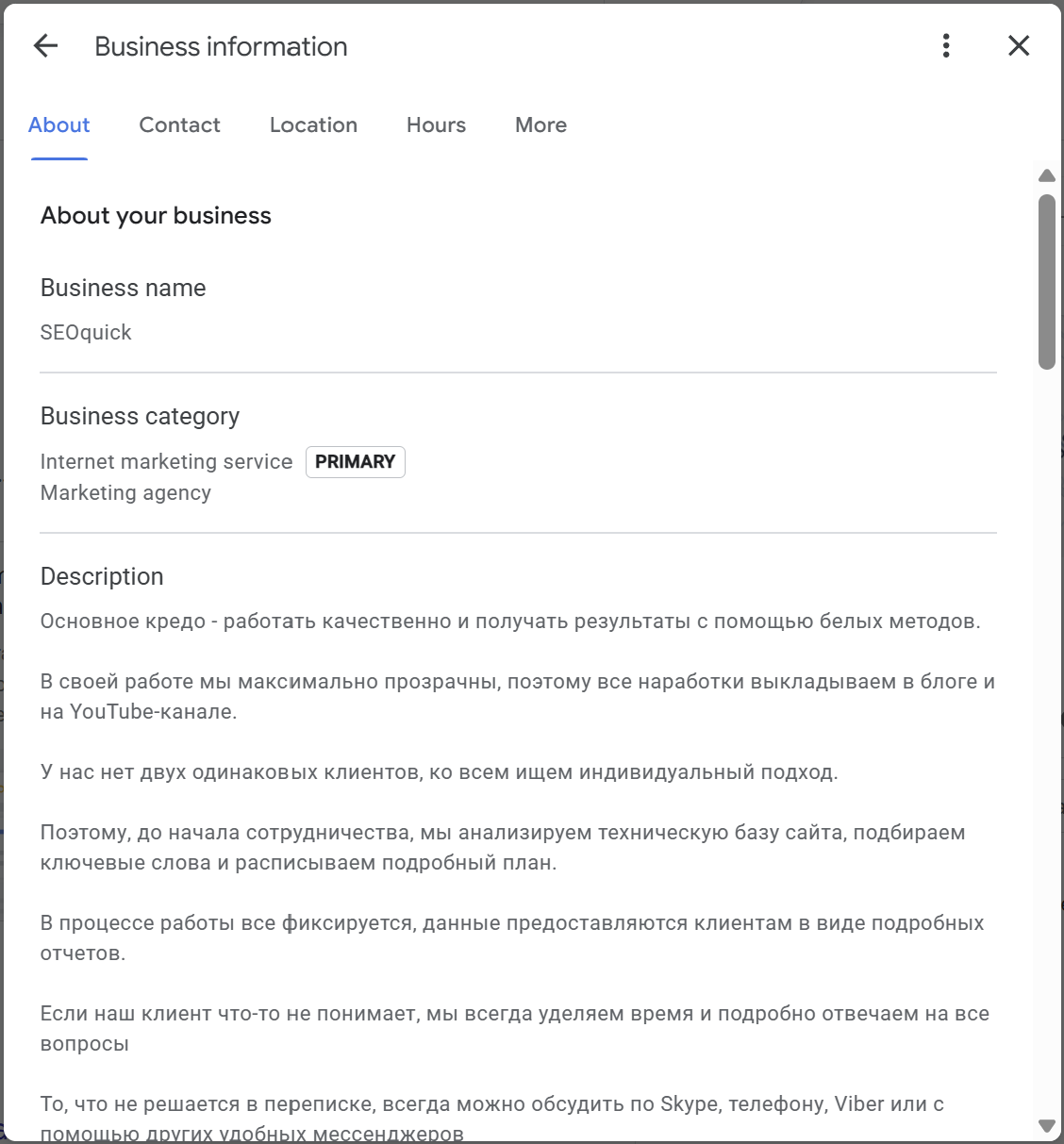
Google Business Profile
Formerly Google My Business. Mandatory for any business with an address or a service area: the listing appears in Google Maps, the local pack, and is used by AI Overviews.
Registration: business.google.com.
What to fill in, no exceptions:
- The exact company name — as on your signage and website, with no keywords like “Dental Clinic #1 Cheap Kyiv” (your listing can get suspended for that).
- Business category — primary plus additional ones.
- Address or service area, phone, website, business hours.
- Description, photos (storefront, interior, team, products), products and services with prices.
- Attributes: card payments, accessibility, Wi-Fi, and so on.
After filling everything in, complete verification — Google increasingly requires video verification (filming your signage, entrance, and workspace on your phone) instead of a postcard with a code.
The listing needs ongoing care: reply to reviews, publish updates, add photos. According to Google, complete profiles get substantially more actions (calls, direction requests, website visits) than empty ones. To let clients book appointments, you can connect online booking.
Bing Places for Business
For a decade, everyone shrugged Bing Places off. In 2026 the situation has changed radically: the Bing index is the raw material for ChatGPT and Microsoft Copilot. When a user asks ChatGPT to “find a plumber nearby who’s open now,” the answer is assembled from Bing data.
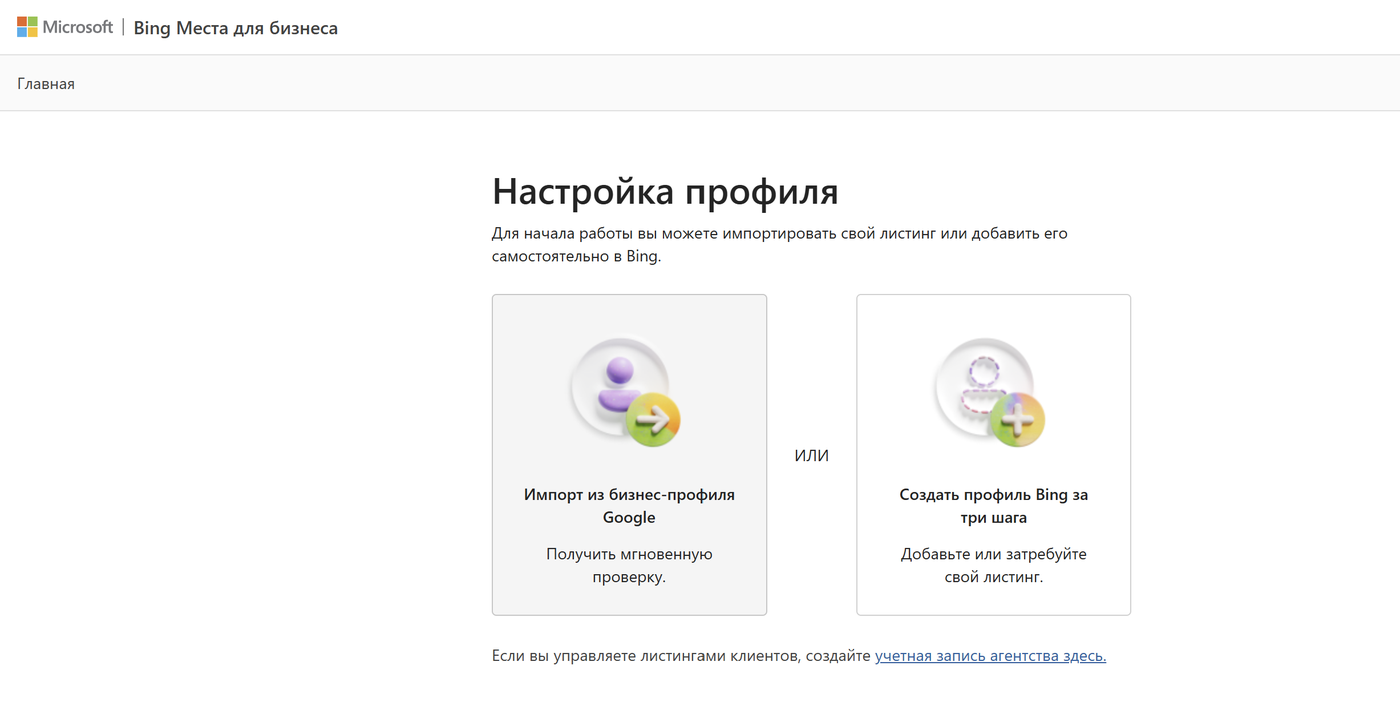
Registration: bingplaces.com.
The killer feature is the direct import from Google Business Profile: you can sync your listing in a few minutes without re-entering everything. After importing, check that the data came through correctly and enable auto-sync.
Apple Business (formerly Apple Business Connect)
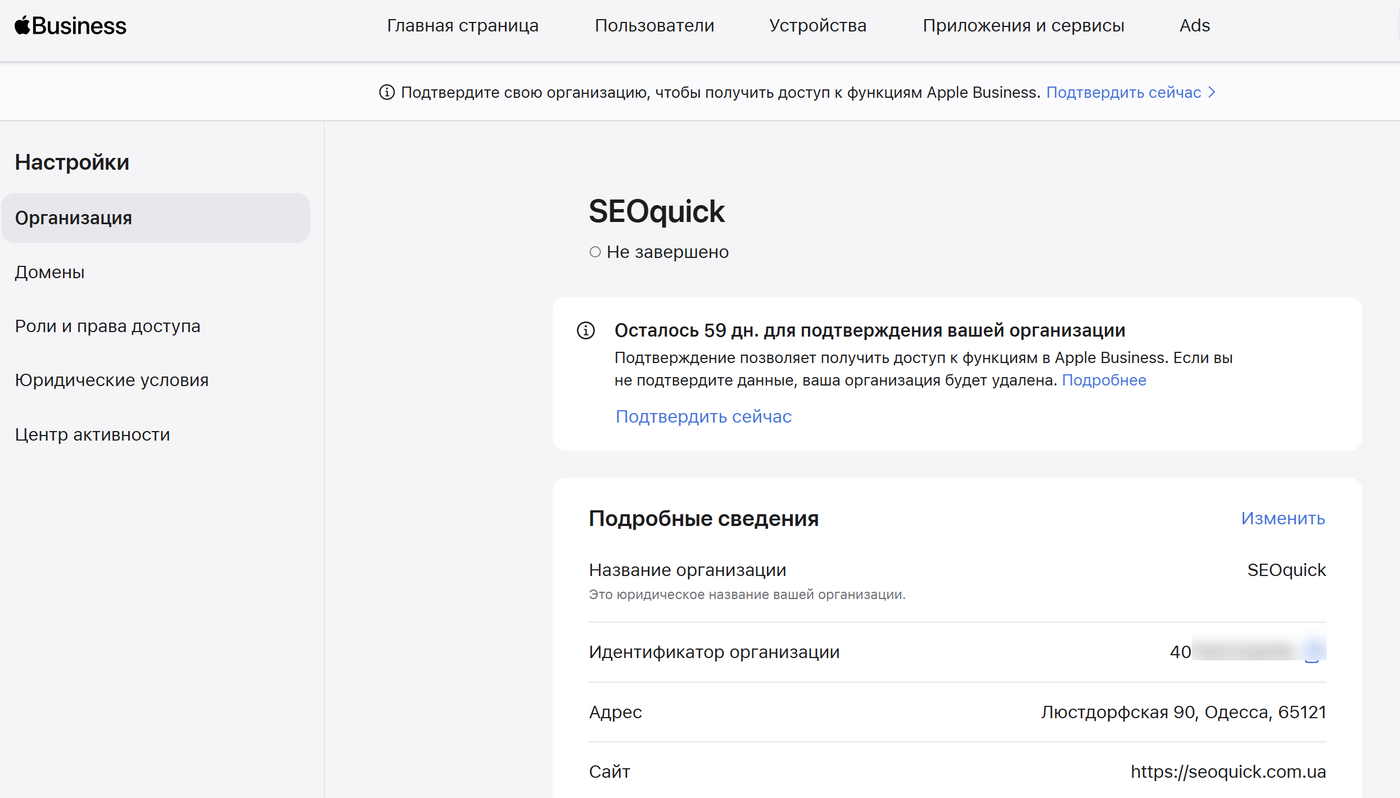
A business listing in Apple Maps, Siri, Spotlight, and Wallet. In 2026, Apple merged Business Connect, Business Manager, and Business Essentials into a single Apple Business platform.
Why this matters even if your clients aren’t Apple users: Apple Maps is used as a local data source by Perplexity and ChatGPT. Plus, there’s all the traffic from the iPhone’s built-in navigation — a significant share of the high-spending audience in Ukrainian cities.
Registration: businessconnect.apple.com (an Apple ID is required).
Useful extras: free Showcases — promo blocks in your listing for sales and seasonal offers — and built-in analytics (calls, directions, search impressions).
OpenStreetMap — a Bonus
A free, open map of the world whose data is used by hundreds of apps and services (including some AI products and navigation apps). You can add your organization yourself via the OSM editor: drop a pin and fill in the name, category, address, phone, website, and hours. Edits are reviewed by the community.
Ukrainian Platforms: the 2026 Checklist
Next, the platforms for businesses operating in the Ukrainian market. You don’t need to register on all of them — choose by business type. An asterisk marks what I consider mandatory for almost everyone.
| Platform | Type | Who needs it | What it gives |
|---|---|---|---|
| Google Business Profile* | Maps/profile | Everyone | Local pack, Maps, AI Overviews |
| Bing Places* | Maps/profile | Everyone | Data for ChatGPT/Copilot |
| Apple Business* | Maps/profile | Everyone | Apple Maps, Siri, a source for Perplexity |
| Prom.ua | Marketplace (Ukraine’s largest) | Product businesses | Company page, product catalog, traffic |
| OLX.ua | Classifieds (Ukraine’s top site) | Products and services | Business profile, direct inquiries |
| Rozetka | Marketplace (major Ukrainian e-retailer) | E-commerce | Sales + a seller page |
| Hotline.ua | Price comparison aggregator | Online stores | Price comparison, referral traffic |
| ua-region.com.ua | Business directory | B2B, manufacturing | Structured NAP, legal-entity data |
| Clarity Project / YouControl | Open company registries | B2B | Legal-entity verification (checked by both people and LLMs) |
| work.ua / robota.ua | Job boards | Employers | Company profile, employer brand |
| DOU.ua / Djinni | IT community / job platform | IT companies | Profile, employee reviews |
| TripAdvisor | Review site | HoReCa, tourism | Reviews, a listing with NAP |
| Booking / Airbnb | Aggregator | Hotels, rentals | Bookings + a citation |
| Tabletki.ua / Liki24 | Industry aggregators (pharmacy) | Pharmacies, healthcare | Point-of-sale listings |
| Industry directories | Directory | By niche | A citation + targeted traffic |
How to find industry platforms for your niche: google the names of 2-3 competitors and see which directories, aggregators, and review sites have their listings but not yours. That is your registration list — this method beats any “top 1,000 directories” compilation.
And a common-sense filter: the platform must have live traffic, moderation, and an audience in Ukraine. If a directory exists only to sell placements, walk on by — that’s a postcard from 2015.
Reviews — the Other Half of Citations
A listing without reviews is a dead listing. According to Whitespark, review signals account for about 16% of local ranking weight, and for top-10 local positions their contribution is even higher — the algorithm looks at the count, rating, recency, and the presence of keywords in review texts.
The practical minimum:
- Ask for reviews systematically. Google Business Profile has a short review link — add it to your email signature, receipts, and the message you send after delivering a service.
- Reply to every review — positive ones, and especially negative ones. Replies are seen by both future clients and algorithms.
- Don’t buy fake reviews. Google keeps getting better at detecting them, and losing your listing to a suspension means losing the entire local channel.
- Diversify your platforms: Google is the foundation; then go by niche: TripAdvisor for HoReCa, DOU for IT employers, price aggregators for stores.
Reviews are also unstructured citations for AI: language models summarize a business’s reputation based on review texts. Asking ChatGPT “what do people say about company X” is essentially a summary of your review-site presence.
NAP Consistency: the Golden Rule
Now the most important part — what separates a working citation system from chaos.
NAP consistency means the company’s name, address, and phone number match on every platform character for character. Not “almost match” — match exactly: “12 Haharina St., office 3” and “Haharina Street 12/3” give the algorithm a reason to doubt whether this is one company or two.
Why it matters: both Google and LLMs build an “entity portrait” of your business by cross-checking data between sources. Matches increase confidence (and rankings); discrepancies dilute the signal. According to 2025 industry research, about 64% of small businesses have NAP discrepancies in at least one major directory — meaning most of your competitors have a hole here that is easy to exploit.
How to Run a NAP Audit
- Lock in your canonical version: a single format for the name, address, and phone (I recommend the international format, +380…). Write it down in a separate document.
- Google your phone number in quotes:
"+380 44 123 45 67"— you’ll find every platform where it has appeared, including ones you forgot about. - Google your company name + your old address or old phone number if you’ve moved or changed numbers.
- Put everything into a spreadsheet: platform, listing URL, what’s listed, what to fix, login/access.
- Fix the discrepancies and delete duplicate listings — a duplicate in Google Business Profile hurts more than having no listing at all.
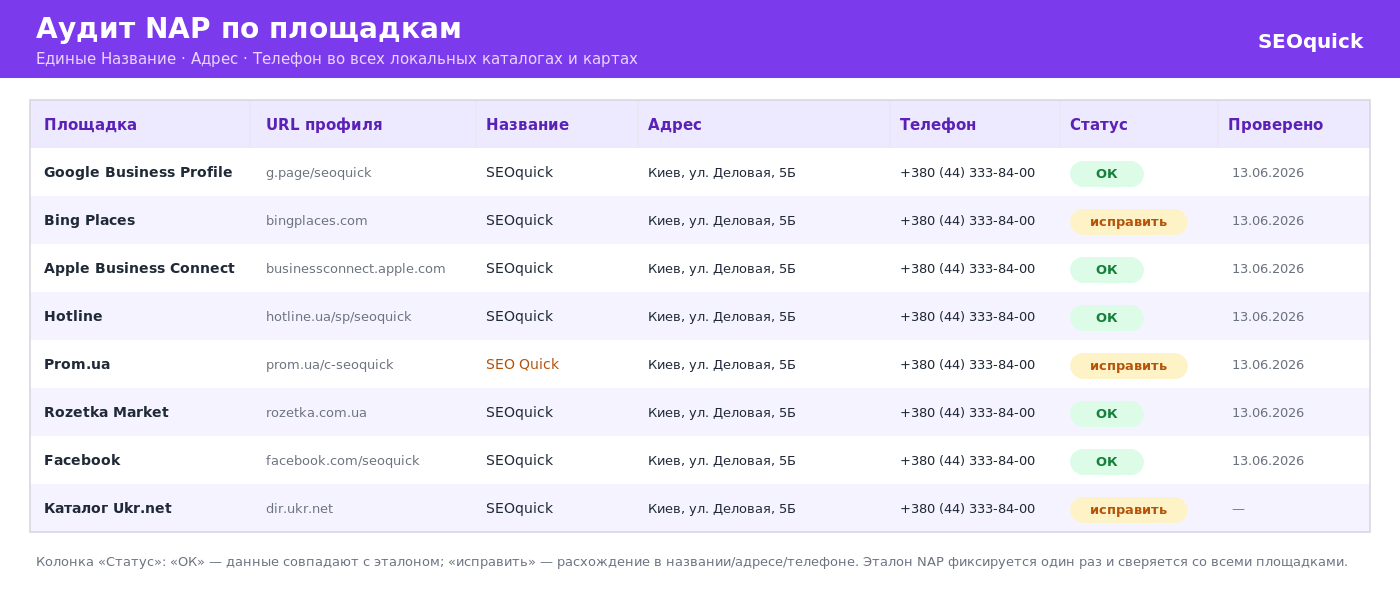
Re-run the check quarterly: platforms sometimes “enrich” listings with data from third-party sources and corrupt your NAP without asking.
Schema.org LocalBusiness — NAP on Your Own Site
The canonical version of your NAP should live on your website in LocalBusiness structured data (JSON-LD): name, address, phone, hours, geo-coordinates, and links to your profiles in the sameAs fields. This is the markup that Google and AI crawlers check all external citations against. Without it, you force the algorithms to guess which version of the data is correct.

Citations as a Channel into AI Answers
Let me gather in one place where language models get their local business data — useful to keep in mind when choosing platforms:
| Data source | Who uses it |
|---|---|
| Bing index (+ Bing Places) | ChatGPT, Microsoft Copilot, partly Perplexity |
| Apple Maps (Apple Business) | Perplexity, ChatGPT (addresses, hours, directions) |
| Google Business Profile | Gemini, AI Overviews, AI Mode |
| Review sites and directories | All models — as confirmation and a source of “opinions” |
| Your website + Schema.org | All models — as the primary source for cross-checking |
The logic is simple: an AI assistant can’t “walk over and look” at your office. Its confidence that your business exists, operates, and is good is built from the number and consistency of independent mentions. Citations are the proof the machine needs.
SEOquick case: we have been running nadomu.kiev.ua, a home-services website, for over five years — traffic grew 10x, and since 2025 the client has been getting conversions directly from ChatGPT: the model recommends the service in answers to queries about at-home services in Kyiv. This is the result of a combined effort: content, local signals, and consistent company data. Case study: service website promotion (in Russian).
If you want to dig deeper into using ChatGPT for SEO tasks, we have a dedicated ChatGPT for SEO guide and a collection of 50 mega-prompts for ChatGPT and Gemini.
The Work Plan: Citations in One Month
A realistic plan for a small or medium-sized business in Ukraine — no budget, one person.
Week 1 — the foundation:
- Lock in the canonical NAP (a document with the exact spelling of the name, address, and phone).
- Add LocalBusiness markup to the website.
- Create or clean up the Google Business Profile and complete verification.
Week 2 — the big three and maps:
- Bing Places — import from Google, verify the data.
- Apple Business — register, fill in, set up Showcases.
- OpenStreetMap — add or verify your pin.
Week 3 — Ukrainian platforms:
- Go through the checklist above: 5-10 platforms relevant to your business type.
- Analyze 2-3 competitors — find the industry directories and review sites where they are listed and you are not.
Week 4 — reviews and the audit:
- Set up a review collection process (a review link, a script for asking).
- Run the NAP audit by phone number and name, fix discrepancies, delete duplicates.
After that, it’s maintenance: reply to reviews weekly, update listings whenever data changes, and repeat the audit quarterly.
SEOquick case: for a generator rental and sales service, we combined local signals with guest publications on DA 40-60 platforms — the company reached the top 3 in Google Maps for the niche’s commercial queries. Case study: SEO for generator rental and sales websites (in Russian).
What Not to Do in 2026
Anti-patterns that are still sold under the label of “promotion”:
- Directory blasts (GSA and the like, “9,000 directories for $50”) — link spam and a direct violation of Google’s policies.
- Mass registration in dead “whitelisted directories” — zero benefit, junk in your backlink profile.
- Fake addresses and virtual offices for listings in new cities — Google detects networks of linked fakes and removes all of the network’s listings at once.
- Keywords in the company name in Google Business Profile — a suspension risk.
- Buying reviews — losing both the listing and your reputation.
- A different NAP “for different platforms” — you are diluting, with your own hands, the very signal this whole effort is for.
If your goal is the backlink profile itself rather than local signals, other methods work: content, outreach, digital PR. Directories are no longer on that list.
Conclusions
- The era of “submit your site to directories for links” ended together with DMOZ. In 2026 it’s a spam signal, not a strategy.
- It was replaced by local citations: consistent NAP data on platforms trusted by Google, people, and language models.
- The mandatory minimum is the big three: Google Business Profile, Bing Places (data for ChatGPT/Copilot), and Apple Business (data for Apple Maps and Perplexity).
- For Ukraine, add platforms by business type: Prom.ua, OLX, Hotline, ua-region, job boards, industry directories, and review sites.
- The golden rule is consistency: one canonical NAP everywhere, LocalBusiness markup on the site, a quarterly audit.
- Reviews are the other half of the system: without them, listings neither rank nor get cited by AI.
Citations are a part of local SEO, not the whole strategy. The full picture — listings, reviews, local content, links — is laid out in our local SEO guide.
FAQ
What is a local citation?
A local citation is a mention of a company’s name, address, and phone number (NAP) on a third-party platform: on maps, in a directory, on a review site, or in an article. Citations confirm the business’s existence to Google and AI systems and influence local rankings even when they contain no link to the website.
Is it worth submitting a site to web directories for links in 2026?
No. Google classifies links from low-quality directories as link spam, and DMOZ — the flagship directory of that era — closed back in 2017. Register only on platforms with live traffic and moderation, and do it to confirm your business data, not for the link.
Which platforms are mandatory for a business in Ukraine?
The minimum is the big three: Google Business Profile, Bing Places, and Apple Business. Then by business type: Prom.ua and Rozetka (major Ukrainian marketplaces) for products, OLX (classifieds) for products and services, Hotline (price comparison) for stores, ua-region for B2B, work.ua and robota.ua (job boards) for employer branding, TripAdvisor for HoReCa, plus your niche’s industry directories.
How do citations affect answers from ChatGPT and other AI?
ChatGPT and Copilot take local data from the Bing index (including Bing Places), Perplexity and ChatGPT use Apple Maps, and Gemini relies on Google Business Profile. The models cross-check data between sources: the more consistent mentions of a business there are, the higher its chance of making it into an AI assistant’s recommendation.
What is NAP consistency and why does it matter?
NAP consistency is the identical spelling of a company’s name, address, and phone number across all platforms. Google and LLMs cross-check data between sources: matches strengthen trust in the business, while discrepancies dilute the signal and can spawn duplicate listings. The canonical NAP should live in the LocalBusiness markup on your website.
How many citations does a business need?
Don’t chase quantity. For a local business in Ukraine, 15-25 quality citations are enough: the big three, OpenStreetMap, 5-10 Ukrainian platforms in your niche, and 3-5 review sites. Beyond that, what matters is not growing the number but keeping the data current and the reviews flowing.
Local SEO for Small Businesses in Ukraine: How to Attract Customers in Your City
How can a small business in Ukraine reach the top of Google's local search and get into AI answers? Google Business Profile setup, website, reviews — a guide.
Read →
Search Everywhere Optimization: Ranking on TikTok, YouTube, Reddit and AI Search
Your customer does not only search on Google: 49% of consumers search on TikTok, Reddit pulls 842M organic clicks a month, and YouTube is the source of roughly one in four AI Overview citations. Here is how a business owner picks 2–3 platforms without burning the budget.
Read →
How to add a site to search engines: Google, sitemap, and indexation checklist
How to prepare a site for indexing: Search Console, sitemap, robots.txt, internal links, canonical, mobile, speed, HTTPS, and monitoring.
Read →Want to apply this to your site?
We will review the current situation, find the first growth levers, and suggest a practical working format.